 Vietnamnet.vn

 Podcast


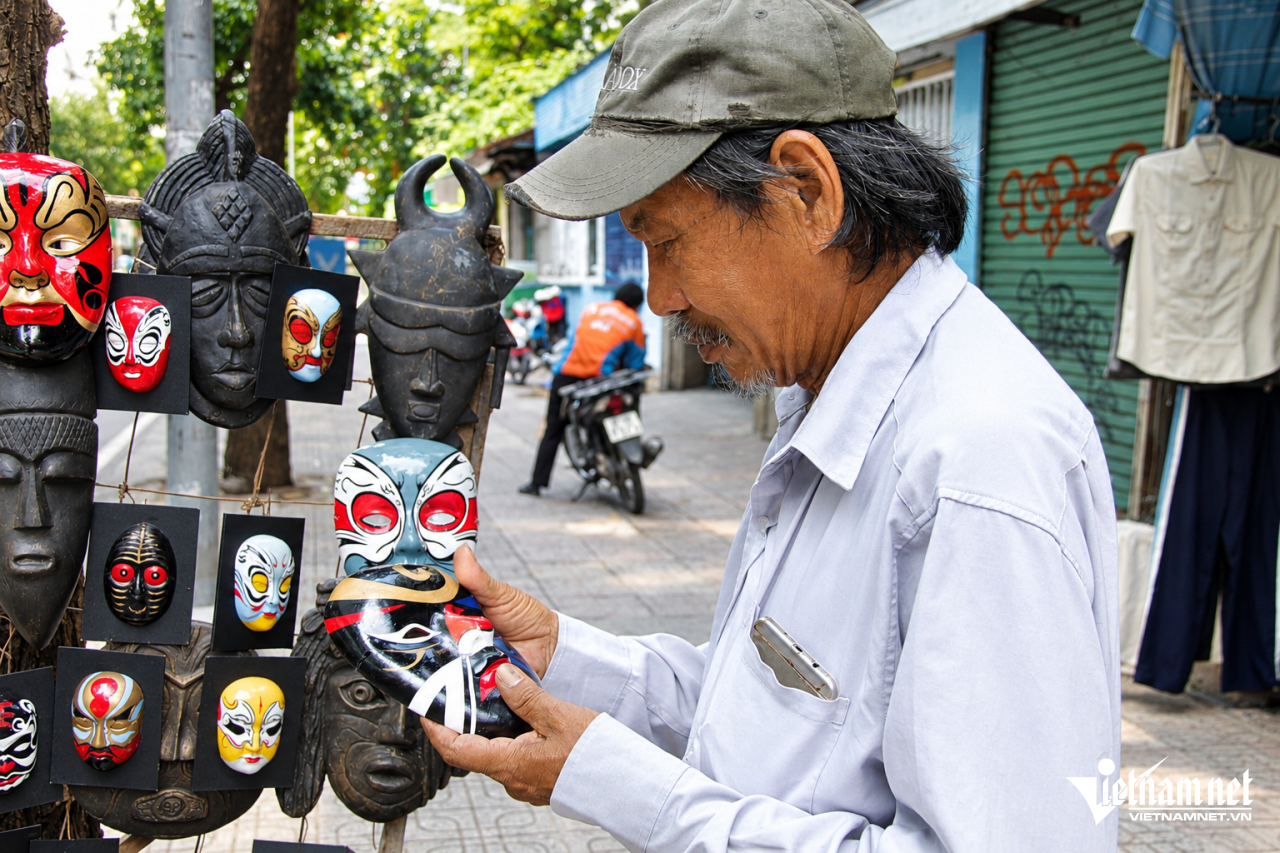
For more than 30 years, a man in his late 50s has continued to hand-paint hat boi masks and cycle through the streets of HCMC to sell them and support his family.
On a weekend morning, Nguyen Duc Duy (born in 1966 in formerly Binh Dinh Province) rode his old bicycle along various streets in HCMC. His bicycle caught the attention of passersby, as a rack over the rear wheel was filled with masks featuring a variety of colors, lines and expressions.
In HCMC, Duy is affectionately known as “Chu Bay Mat Na” (Uncle Bay the Mask Maker). The nickname comes from his craft of making traditional Vietnamese opera masks, a profession considered unique in the city.
Duy has loved hat boi since childhood. When he was around five or six, whenever an opera troupe came to his village, he would ask his parents for permission to watch. After seeing a performance in one hamlet, he would head to another to watch the troupe again.
At the time, he was particularly impressed by the performers’ facial makeup. Back home, he would use charcoal to recreate their faces on the floor. Even so, he never imagined that those drawings would one day become his livelihood.
“Growing up, I went to school and then joined the army. After serving in the military in Cambodia, I came to HCMC to seek employment. In 1994, I realized that no one in the city was painting and selling traditional opera masks, so I decided to give it a try,” he recalled.
“I had never received formal training, so when I started making the masks, I bought books and reference materials about the art form to learn more and teach myself to paint. Before painting a particular character’s mask, I always studied the character’s personality, background and distinctive makeup in detail.
“If I didn’t have enough information about a character or didn’t fully understand them, I wouldn’t paint their mask. You have to understand a character to portray them accurately and capture their personality and spirit.
“I also research the characters thoroughly so that I can give customers accurate, comprehensive answers if they ask about a mask they are considering buying.”
Duy initially painted the masks on plaster. After a while, he found that the material was not durable and could easily be damaged during transport, so he switched to wood.
However, wooden masks were prone to cracking and warping when exposed to sun and wind. Eventually, he researched and began using poly stone as the material for his masks.
Once he has a blank mask, he uses paint to carefully draw each line on its surface. Each mask typically takes him around six hours to complete.
Unsteady income
In the early days, Duy relied on his memory and images in books and reference materials on traditional Vietnamese opera when painting masks. He taught himself how to mix colors, handle a paintbrush and draw each line. As he worked, he learned from experience and gradually refined his mask-painting techniques.
After years of practice, he became able to paint masks of iconic characters from classic operas without consulting reference materials.
“Painting traditional opera masks requires not only accuracy but also the ability to capture a character’s spirit. To do that, the artist must genuinely love and be passionate about the craft.
“The artist has to put their heart and emotions into the character. After finishing a mask, I usually sit and look at my work. If it doesn’t meet my standards, I keep adjusting it or even start over.
Because his products are still not widely known, Duy sells them by cycling from place to place. In the past, depending on their size, his traditional opera masks cost VND10,000-20,000 each. Today, they sell for VND250,000–550,000 apiece.
According to Duy, most customers buy his masks to decorate their homes, shops and restaurants. Others seek them out because they love traditional opera, while some are simply drawn to the unusual beauty and artistic appeal of products that are uncommon in HCMC.
Despite this, the work has provided Duy with an unstable income throughout more than 30 years. He sells only a few masks a day, and sometimes returns home without selling a single one.
“Because this is my passion, I will not give it up even though it does not provide a high or stable income. I will keep painting traditional opera masks until I am no longer able to do so.”
Ha Nguyen

