 Vietnamnet.vn

 Podcast



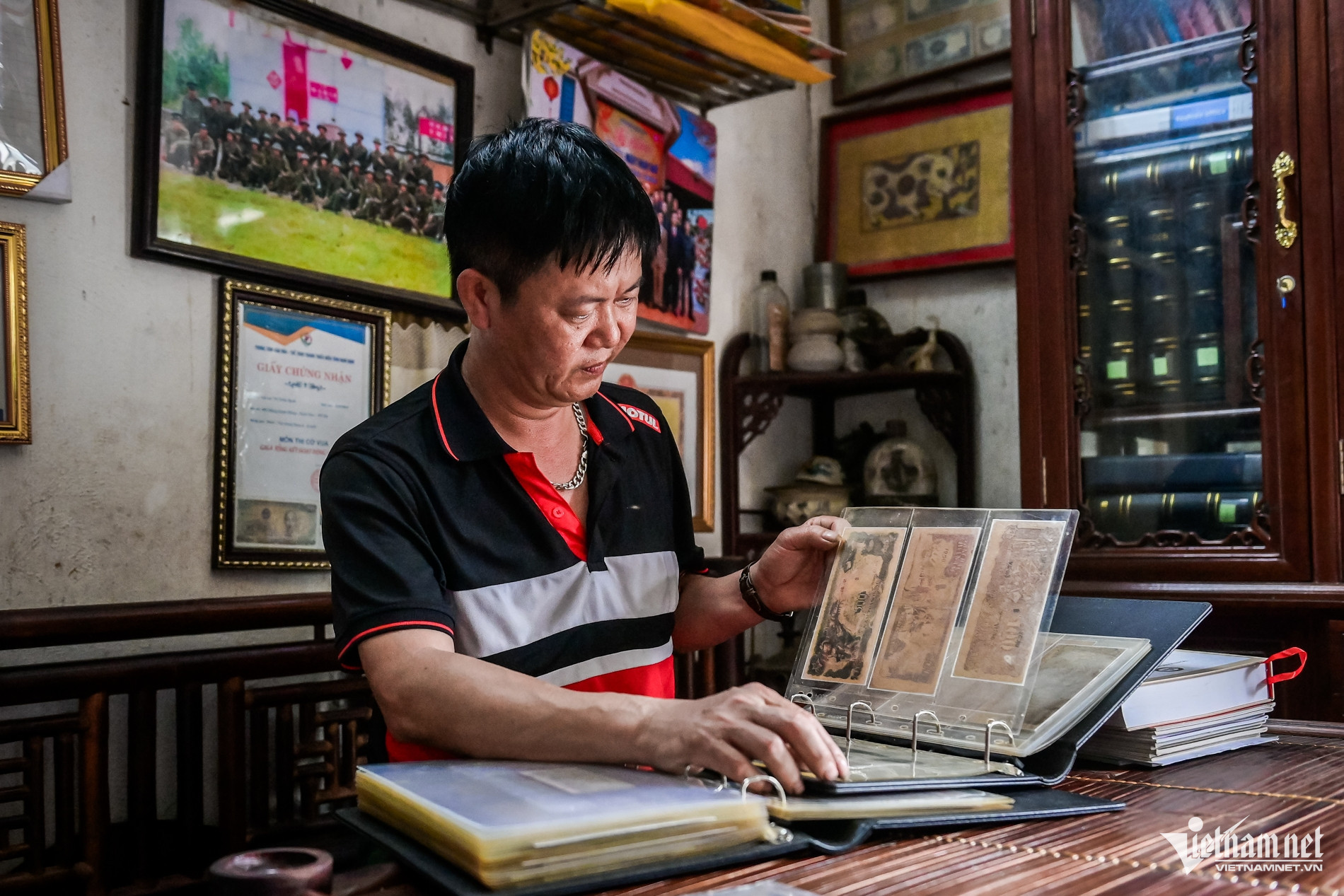
Nam shared that in 1994, while serving in the army in Khanh Hoa Province, he was given three old banknotes by local residents as souvenirs. From time to time, he would take them out to look at them and explore the patterns, designs and illustrations on each note. The more he learned, the more fascinated he became, and that sparked his desire to collect old currency.
At the end of 1995, after finishing his military service, Nam began to study old banknotes more deeply and officially started his collecting journey.
“At that time, collecting old bank notes was extremely difficult. I had to wait for the Vieng spring market in Nam Truc Commune (Ninh Binh Province), a market that opens only once a year, to search for notes I didn’t have yet. I also asked friends and acquaintances for help. Whenever I heard that someone was selling a note missing from my collection, I would travel there to buy it at any cost.
In recent years, as social media has grown, collecting old money has become easier. I can go online to buy or trade with fellow collectors in various groups, thanks to which I have obtained many rare notes,” Nam said.
After 30 years of collecting, Nam now owns around 500 Vietnamese banknotes from different periods and more than 200 coins.
Many notes in his collection cost him tens of millions of VND. Most recently, he spent VND60 million to acquire a rare banknote he had been searching for many years.
Nam said that to understand the historical and cultural value hidden in each old banknote, he reads specialized books, research documents and searches for additional information on the Internet. He also actively learns and exchanges experience with other collectors. Thanks to that, he can accurately assess the rarity and actual value of each item in his collection.
“Each period had its own size, colors, materials and printing techniques. Just by looking at a banknote, you can recognize the distinctive marks of its historical era. From the typography and patterns to the material, everything reflects the socioeconomic context of the time.
To me, these notes hold not only material value but also the spirit of the era, tied to each stage of the country’s history. The more I collect, the more passionate I become. So even if I have to spend a large amount of money to acquire one, I still feel it’s worth it,” Nam said.
Nam has his own methods of preservation. Whenever he obtains a new note, he dries it with air conditioning to remove moisture and prevent mold. After that, the note is placed in a hard plastic sleeve, carefully sealed along the edges, then organized into an album and stored in a cabinet. This method helps the notes retain their original color, printing details and texture for many years.
For high-value rare notes, Nam sends them abroad for grading and preservation using specialized technology, ensuring they are kept in optimal conditions.
Though many people have offered to buy certain notes in his collection at high prices, he firmly refuses. For him, the spiritual value of these notes is far greater than the monetary value buyers are willing to pay.
In addition to old money, Nam also dedicates great effort to collecting ration coupons and postage stamps. He currently owns around 10,000 stamps, including many rare sets highly sought after in the collector community.
According to him, every old banknote or stamp carries a piece of history. For that reason, he hopes that one day, when conditions allow, he will build an exhibition room at his home so that those who share the same passion can come to admire, exchange and learn from one another.
Ha Nguyen
.svg)
