 Vietnamnet.vn

 Podcast



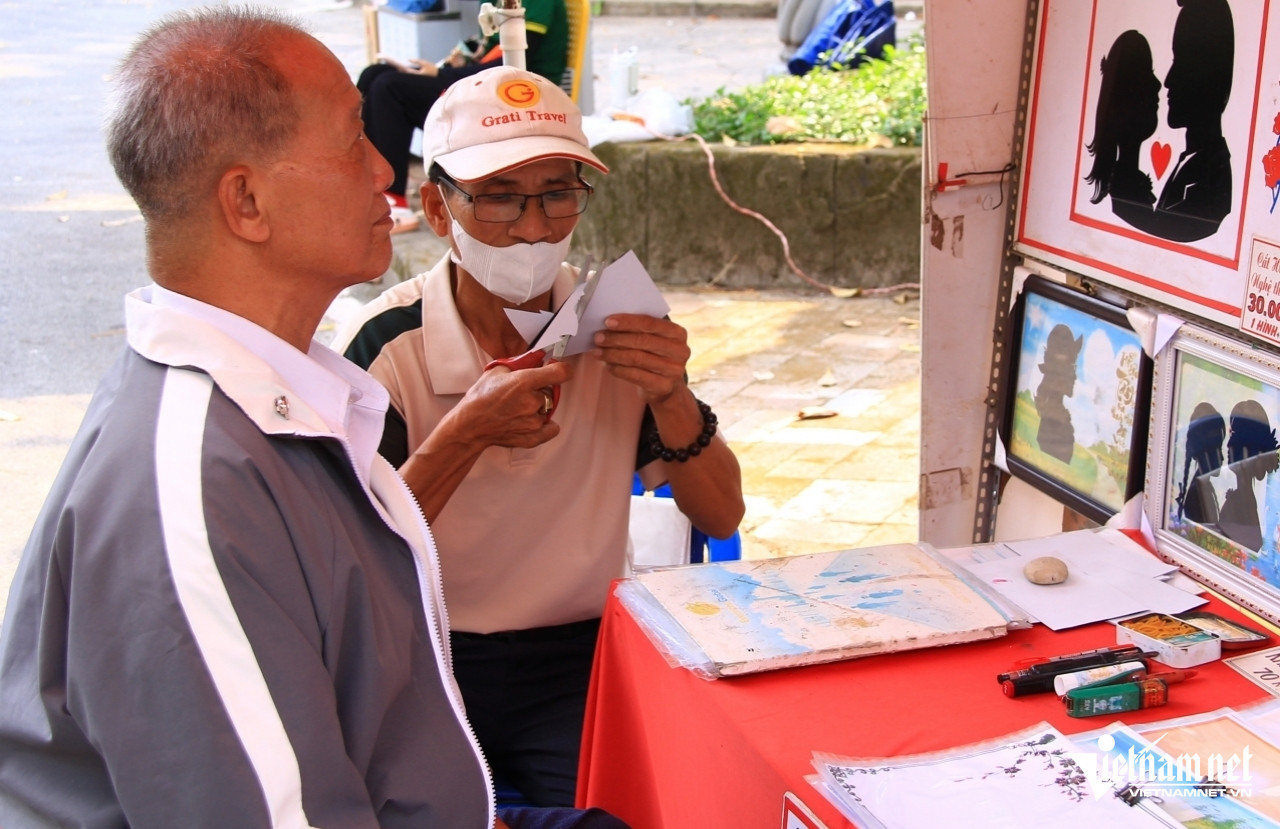
On a weekend morning, a girl named Nhi, 25, in HCMC, and her boyfriend visited the Sai Gon Zoo (Saigon ward, HCMC). After strolling around, she was drawn to a roadside display of black-and-white profile portraits. The small stall belonged to Van The, 63.
The explained that his craft is the art of cutting papers to create profile silhouettes, sometimes referred to as “silhouette portrait cutting.”
This is the technique of using black paper and sharp scissors to create portraits based on observing the subject’s side profile. According to The, the art form originated in France.
In its early days, people used lamps to project a shadow onto paper and then used sharp knives to carve along that shadow. However, this made the incisions inaccurate and lacking sharpness.
Later, artisans did not need to project shadows on paper but only looked directly at the model and used scissors to cut along. Using scissors helps the cuts stay smooth, sharp, and continuous, allowing the work to be finished better.
The shared: “I learned this art from my predecessors and started the profession in 1986. To date, I have followed the craft for 40 years.
“In the early days when I was not used to it, I cut very slowly, even inaccurately. Through practice and accumulating experience, I can now complete a work in just 1-2 minutes”.
“Since the technique uses scissors to create vivid and soulful portrait images of the model, many people jokingly call this the profession of “portrait painting with scissors”.

“The difficulty is that the finished work is only a black shadow, without mass, color, or light. However, when outsiders look in, they can recognize whose silhouette the artisan is cutting.
“To achieve this, the practitioner must be skillful and have an observant eye. For, it is not just about cutting to resemble the customer's face, but the finished work must express the soul of the model.”
Holding a small pair of scissors in hand, The looked at the profile of his customer's face and began cutting.in less than 1 minute, The finished cutting the portrait silhouette of the young girl accurately and vividly. Holding the work in her hand, Nhi was amazed and surprised because it looked exactly like her face.
“I was very surprised. I did not expect that just by looking and using scissors, The could cut out my face shape so accurately, matching every detail like that. In my opinion, this is a very special art form,” Nhi said.
In 40 years of following the profession, The has only sat at the Zoo and has never moved locations. Previously, he worked all week. Later, for many reasons, he only worked two days on the weekend. On the remaining days, he earned a living by taking photos for tourists.
Many visitors to the zoo who want to preserve their portraits in a special way are often introduced to The.
Many customers who had him cut their silhouettes when they were children still return today to preserve the changes on their faces over time.
The’s number of customers changes, depending on the number of visitors to the zoo. His work is particularly crowded during Tet days. On this occasion, in addition to regulars, he is hired by many tourists from inside and outside the city, including foreigners, to cut portrait silhouettes.
On Tet days, instead of staying home with his family to enjoy spring, The goes to the Zoo to work. For the past 40 years, he has celebrated Tet with travelers from everywhere.
“On the eve of New Lunar Year, the Zoo closes for cleaning, so I go home for New Year's Eve offerings. On the morning of the 1st day of Tet, the zoo opens to welcome guests, and I come to serve again. I stay here from morning until late afternoon before going home,” he said.
“And so, throughout the Tet holidays, I serve guests at the Zoo all day and only return home late in the evening. Since the day I followed this profession, there has not been a year where I celebrated Tet at home.
“When Tet ends and the number of guests thins out, I return to my daily life rhythm,” he explained.
Nguyen Hue
.svg)
