 Vietnamnet.vn

 Podcast



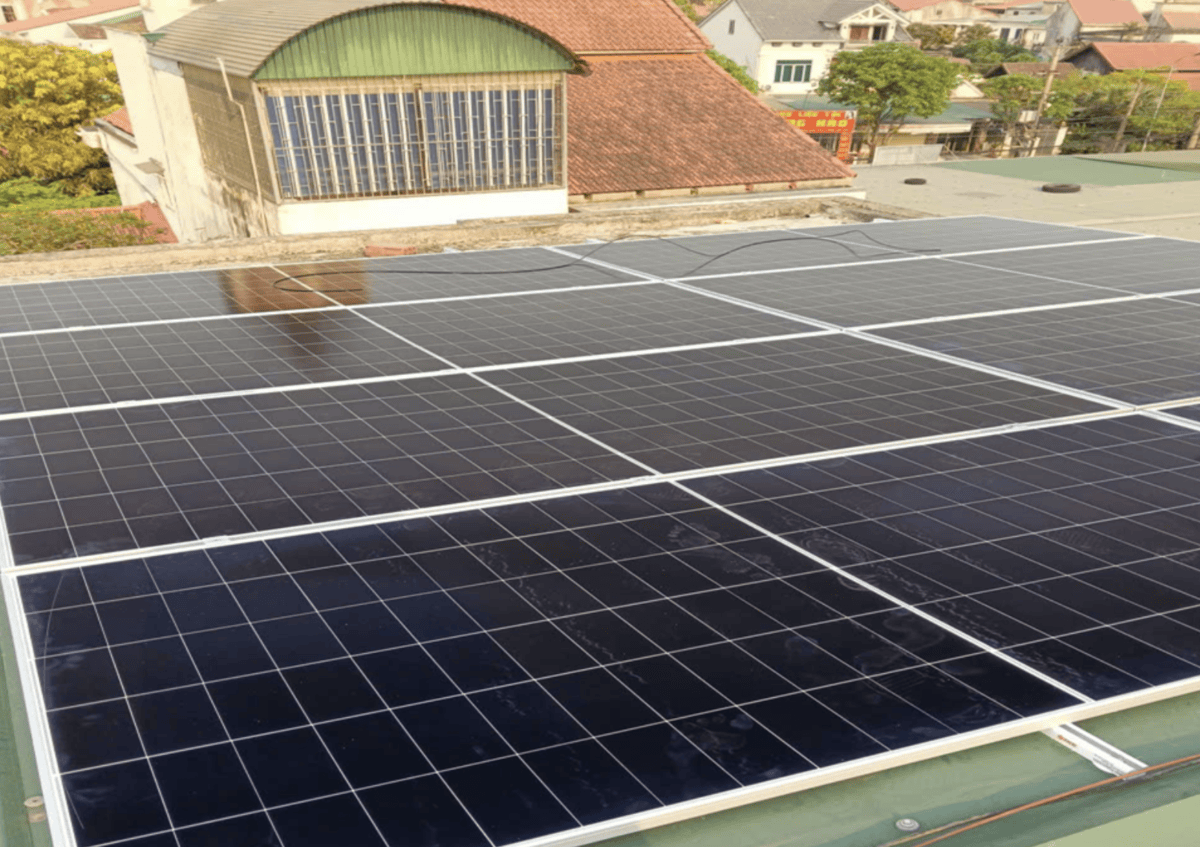
As one of the early households to install rooftop solar, Nguyen Xuan Hai in Thanh Sen Ward, Ha Tinh Province, said that although the initial investment cost remains relatively high, the efficiency is very clear.
With a 9 kW rooftop solar system, his family saves around VND2.5-3 million in electricity costs each month. He estimated that the system would break even after five years and continue generating stable economic benefits over the long term.
Since the installation, most household appliances have operated using self-generated electricity, helping the family secure energy and reduce dependence on the national grid. For electricity use at night, Hai’s family has adjusted daily habits toward energy saving, significantly reducing monthly electricity expenses.
A rooftop solar installation company in Hanoi said that one year ago, most customers only stopped at learning about rooftop solar. Now, under pressure from rising electricity costs, customers are coming to finalize installation orders much faster.
A report from Northern Power Corporation (EVNNPC) showed that the self-produced, self-consumption rooftop solar development program continued to accelerate strongly, with 1,839 new customers in April alone, totaling 62.9 MW in capacity.
Cumulatively, in the first four months of this year, the corporation recorded 5,639 self-produced, self-consumption rooftop solar customers with total capacity of around 528.1 MW.
Similarly, HCMC has installed 22,355 rooftop solar systems with total capacity of around 1,832 MWp. However, development potential remains very large, especially in residential, commercial, and industrial sectors.
A representative from EVNNPC said self-produced, self-consumption rooftop solar is recording positive growth across northern provinces, especially after Directive No10 issued by Prime Minister Le Minh Hung on strengthening electricity-saving measures and rooftop solar development.
The current interest in rooftop solar is mostly among businesses, commercial-service establishments, and households seeking to reduce electricity costs.
The market is beginning to form a trend in which customers not only install solar systems but also integrate battery energy storage systems (BESS) to optimize electricity usage efficiency.
Northern Vietnam currently has more than 1,450 rooftop solar systems integrated with BESS, with total storage capacity of around 8,600 kWh.
More favorable policy expected for rooftop solar
Bui Quoc Hoan, deputy general director of Southern Power Corporation, said at a recent event that the Government and the Ministry of Industry and Trade are drafting a decree on rooftop solar, allowing more flexible grid connection models, including systems that do not feed electricity into the grid, while also considering relaxing installation capacity limits.
For self-produced, self-consumption rooftop solar, policymakers are collecting opinions on increasing the proportion of excess electricity output eligible for payment when fed into the grid from 20 percent to 50 percent at market electricity prices.
Vietnam has now established a competitive electricity market, where electricity purchase prices are determined by time periods announced by the system operator.
Specifically, the average electricity market price in 2025 was estimated at VND1,100/kWh, compared with around VND800/kWh currently. Therefore, the fixed feed-in tariff (FIT) mechanism has ended for new projects, replaced by a market-based mechanism focusing on purchasing excess electricity output.
From a technical perspective, Hoan identified BESS as a key solution for electricity supply. Expanding the limit from 20 percent to 50 percent, and potentially higher in the future, would create major opportunities for customers.
Regarding the investment efficiency, experts have calculated several break-even scenarios. For households in southern Vietnam spending around VND2 million per month on electricity, investing in a rooftop solar system combined with BESS to meet most electricity demand would allow break-even within 3.5-4 years.
Another scenario involves optimizing tiered electricity pricing. Instead of investing in a large system capable of meeting 100 percent of electricity demand, customers can install a moderate-capacity system sufficient to reduce usage in higher-price tiers while continuing to use grid electricity at lower-price tiers. This adjustment in consumption behavior can deliver high economic efficiency.
For industrial park businesses, efficiency is even clearer because of larger scale. Previously, a seven-year break-even period was considered good. Now, a 3.5-4.5 year break-even period is viewed as highly positive, Hoan said.
Tam An
.svg)
