 Vietnamnet.vn

 Podcast



Co-organized by three Vingroup-affiliated organizations - the For Green Future Foundation, VinUniversity, and the VinTechTalent Young Technology Talent Club - the competition aims to identify and develop highly applicable technology initiatives addressing pressing environmental challenges in the region while promoting innovation and interdisciplinary collaboration among young people.
A total of 439 teams comprising 1,439 contestants from 22 countries have registered for the competition.
Vietnamese teams account for the largest share with 174 groups, followed by India with 114 teams, the Philippines with 44 teams, China including Hong Kong and Taiwan with 23 teams, and Indonesia with 20 teams.
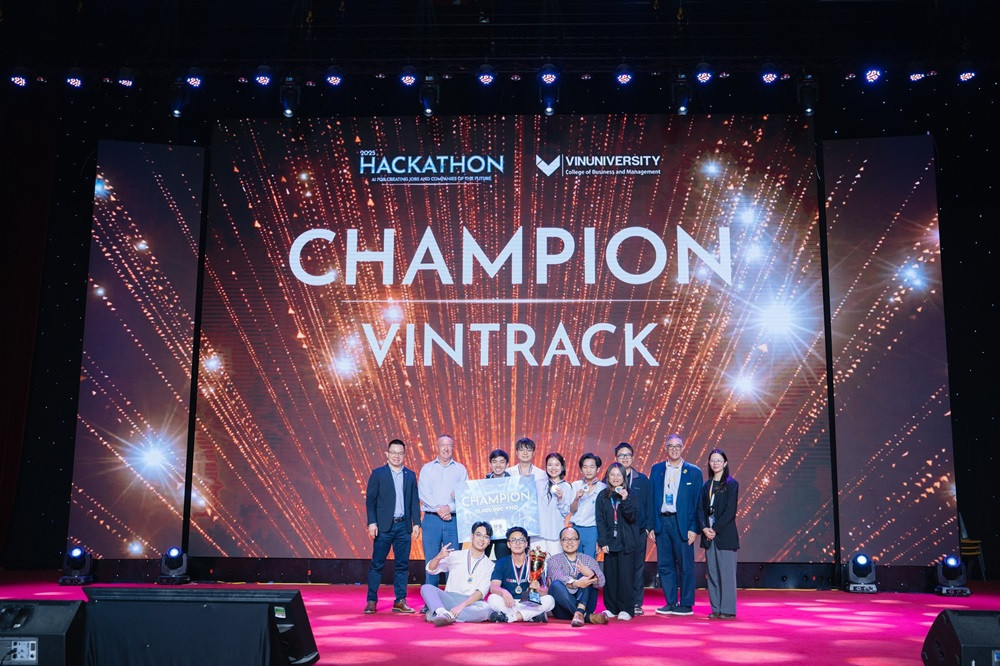
The Top 30 teams will receive sponsorship to compete in person at VinUniversity in Hanoi. Photo illustration: The championship-winning team of the VinUni Hackathon 2025. Photo: VinUniversity
Notably, many participating teams come from leading universities ranked in the 2026 QS World University Rankings and QS Asia University Rankings.
Among universities ranked globally are the National University of Singapore - NUS (8th globally) and Nanyang Technological University - NTU (12th globally) from Singapore; the University of Hong Kong (11th globally), Hong Kong University of Science and Technology - HKUST (44th globally), and Hong Kong Polytechnic University (54th globally) from Hong Kong, China; Seoul National University - SNU (38th globally) and Yonsei University (50th globally) from South Korea; Kyoto University (57th globally) from Japan; Universiti Malaya - UM (58th globally) from Malaysia; and the Indian Institute of Technology Madras (180th globally) from India.
The competition has also attracted teams from universities highly ranked in the QS Asia University Rankings, including Universitas Indonesia - UI (47th in Asia), Ateneo de Manila University (141st in Asia), and Nazarbayev University (201st in Asia).
In Vietnam, participating institutions include leading science and technology universities such as Hanoi University of Science and Technology, Ho Chi Minh City University of Technology under Vietnam National University, and VinUniversity.
Strong interest in sustainability and interdisciplinary innovation
The competition’s three main themes reflect strong and balanced interest among young Asians in sustainability and environmental challenges.
The category “Water Resources and Climate-Resilient Agriculture” attracted the largest share of entries at around 37%, followed by “Urban Air Quality and Climate Resilience” with 33%, while “Renewable Energy and Low-Emission Transportation” accounted for 30%.
Contestants come from diverse academic backgrounds including computer science, artificial intelligence, engineering, sustainable development, agriculture, logistics, healthcare, and environmental science, underscoring the competition’s interdisciplinary nature.
The event aims not only to foster technological innovation but also to create opportunities for young people across the region to co-develop practical solutions capable of generating long-term impact for communities.
“Through Asian Hackathon for Green Future 2026, the For Green Future Foundation continues to affirm its international vision in initiatives promoting sustainable development and innovation,” said Dr. Le Thai Ha, Executive Director of the For Green Future Foundation and Head of the competition’s organizing committee.
“The foundation is not only supporting Vietnam’s green transition journey but also seeking to connect young intellectual resources across Asia to mobilize high-value ideas addressing future environmental and development challenges,” she added.
Following the preliminary round, the Top 30 teams are expected to be announced in early June 2026 and will participate in intensive training programs with international experts before entering the 36-hour in-person hackathon from July 2-5 at VinUniversity in Hanoi.
Projects will be evaluated by a judging panel featuring leading Asian experts in technology, innovation, and sustainable development.
The Top 30 teams will compete for prizes totaling $24,000, including a first prize worth $8,000, one second prize worth $5,000, two third prizes worth $3,000 each, and five consolation prizes worth $1,000 each.
Beyond being a competition, Asian Hackathon for Green Future is emerging as a platform connecting hundreds of teams from multiple countries and leading universities across Asia, highlighting the potential for a cross-border innovation ecosystem where technology initiatives can evolve into practical and lasting solutions for society.
PV
.svg)
