 Vietnamnet.vn

 Podcast



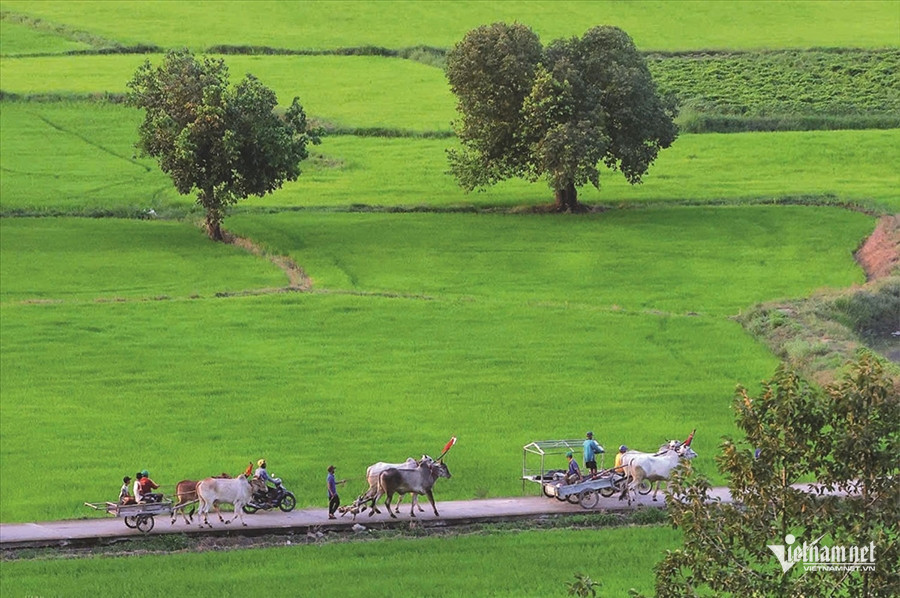
These results stem from ethnic policies and programs, particularly the National Target Program 1719.
An Giang is a border province with distinct characteristics in the Mekong Delta, home to around 472,000 ethnic minority people, accounting for more than 11 percent of the province’s population. Among them, the Khmer community, the largest ethnic group, mainly lives in mountainous, remote, and hard-to-reach communes in the Bay Nui area. As ethnic policies and programs have been rolled out, rural landscapes and local livelihoods have seen positive changes.
With resources from the National Target Program for Socio-Economic Development in Ethnic Minority and Mountainous Areas (NTP 1719), Chau Kop, a Khmer household in O Lam commune, boldly invested in reproductive cattle farming.
Kop said: "Initially, I was very worried, fearing I couldn't manage. But with guidance from officials and technical training, I finally dared to do it."
Thanks to his diligence, starting from just a few initial cows, Kop's herd has gradually increased, providing a stable source of income. More importantly, he no longer has a mindset of waiting for support but instead plans his investments.
Kop's story is not an isolated case but a microcosm of the changing mindset spreading across many phum and sroc (Khmer villages) in the Bay Nui region.
From disadvantaged area to bright spot
With 65 percent of its population Khmer, O Lam commune was once known as a "remote area" where difficult terrain and poor transportation hindered all development opportunities. Fueled by resources from NTP 1719, over the past few years, the appearance of this mountainous commune has changed significantly.
Phan Thanh Luong, Chair of the O Lam Commune People's Committee, said the local government has focused on directing guidelines and policies related to ethnic minorities in general and the Khmer people in particular. Specifically, the commune has been effectively implementing NTP 1719.
Currently, the commune's road system has been developed, facilitating convenient connections with neighboring areas. Houses are more spacious, and trading and service activities are increasingly bustling.
Farmers' agricultural products are no longer "stuck" at the edge of the fields, but have been brought into the market. Ecological and historical tourism is gradually developing, especially around O Thum Lake, Tuc Dup Hill, and O Ta Soc, attracting nearly 200,000 visitors annually.
At the same time, the program has supported vocational training and job creation for nearly 3,000 local workers; living standards have improved; school enrollment rates at all levels have reached 96.7 percent or higher; and social welfare and sustainable poverty reduction have been effectively implemented.
Chau Soc Sa, a respected community figure in Phuoc Tho Hamlet, O Lam Commune, has witnessed these changes firsthand. He said: “What Khmer people here feel most clearly is that life is less precarious than before. People no longer see poverty as fate, but believe it can be changed through work and suitable approaches. That belief is the brightest ‘flame.’”
Amid An Giang’s rugged mountainous terrain, the socio-economic development journey of Khmer communities still faces many challenges. However, from newly opened roads to emerging livelihood models, one thing is clear: when policies are on the right track and truly resonate with people’s aspirations, Bay Nui communities not only can escape poverty but are steadily moving forward on their own strength.
Danh Phuc, Director of the An Giang Department of Ethnic and Religious Affairs, said that thanks to program support, average income among ethnic minority people in the province has increased by more than 1.2 times compared with before, while the poverty rate among Khmer households has fallen steadily by 3-4 percent each year. Many households have risen to a better standard of living, gradually achieving legitimate prosperity in their homeland.
The National Target Program for socio-economic development in ethnic minority and mountainous areas for the 2021–2030 period was approved by the 14th National Assembly under Resolution No 120/2020/QH14 dated June 19, 2020.
The 2021-2025 phase was approved by the Prime Minister under Decision No 1719/QD-TTg dated October 14, 2021 (National Target Program 1719). The program includes 10 projects, comprising 14 sub-projects.
After nearly five years of implementation, NTP 1719 has provided residential land support to 10,549 households; housing support to 42,567 households; direct production land support to 13,387 households; and resettlement and stabilization for 25,056 households, including 5,711 households resettled in concentrated areas and 13,096 households resettled under on-site stabilization projects.
PV
.svg)
