 Vietnamnet.vn

 Podcast



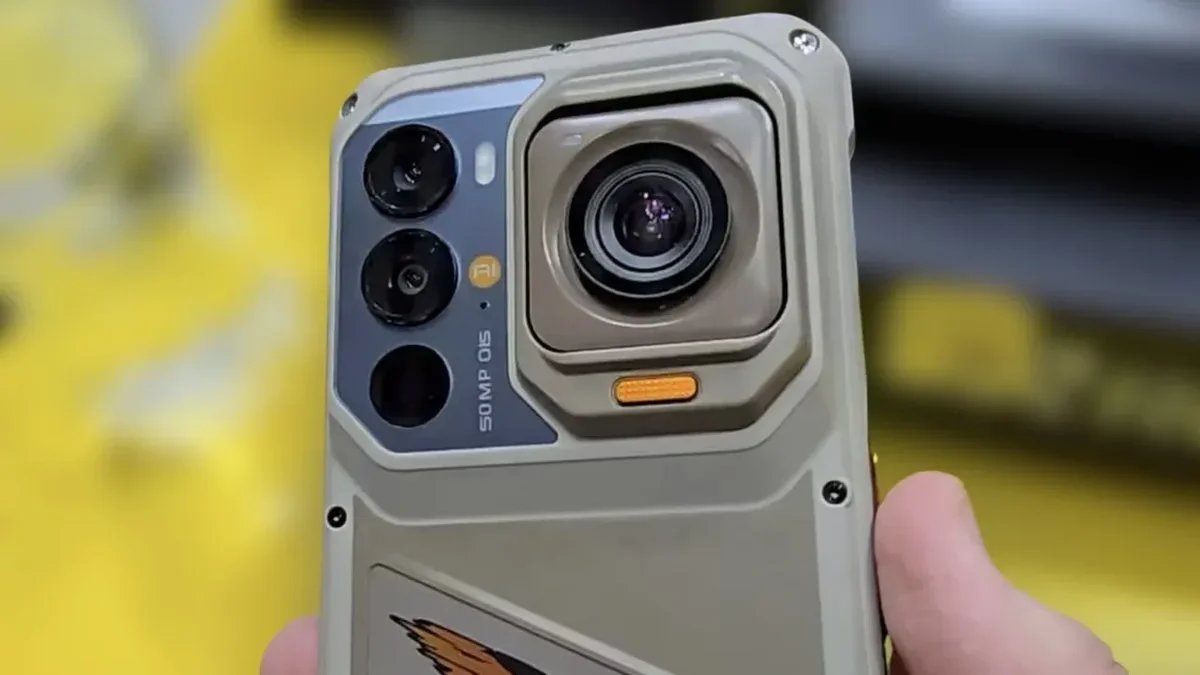
The device, called the XSnap 7 Pro, comes from uleFone and has been attracting considerable attention at the company’s booth during the IFA 2026 technology show.
Its most distinctive feature is not the processor or display, but a detachable camera module called RugOne.
Main camera detaches to work like a GoPro
UleFone’s idea is relatively simple but inventive: instead of carrying an entire smartphone to record adventurous activities, users can simply remove the main camera from the phone and use it as an action camera.
RugOne has an almost cube-shaped design and weighs just 39 grams, making it light enough to carry around or attach to the body during activities.
The camera comes with 64GB of built-in storage and its own battery, allowing it to operate independently of the smartphone.
According to uleFone, RugOne can record video at up to 2.7K resolution at 30 frames per second, with around 40 minutes of recording time.
It could be an intriguing solution for people who regularly take part in outdoor activities or extreme sports, or simply want a compact camera without having to carry a separate dedicated device.
Video transmission works from up to 50 meters away
One notable feature of RugOne is that the camera does not need to remain physically attached to the smartphone.
It can transmit video to its companion smartphone app from a distance of up to 50 meters.
The software also offers several useful features. Users can record the camera sensor’s entire field of view in a square format, then choose and crop the footage into vertical or horizontal frames afterward, depending on their needs.
This gives users greater flexibility in deciding on the final video format after recording.
RugOne also features distortion correction and horizon lock, two technologies commonly found in modern action cameras.
The camera is water-resistant to a depth of around five meters, allowing it to be used in a variety of outdoor conditions.
UleFone even offers a separate strap accessory that allows users to wear RugOne on their body, effectively turning it into a body-mounted camera. This could prove to be one of the device’s most appealing uses.
XSnap 7 Pro does not stand out for its specs
Take away the detachable camera and the XSnap 7 Pro is not a smartphone designed to overwhelm users with cutting-edge specifications.
Like many rugged smartphones, it focuses more heavily on durability and specialized features than on competing with flagship devices in raw performance.
The phone is powered by a MediaTek Dimensity 8400 chipset and features a 6.67-inch OLED display with peak brightness of 1,700 nits and a 120Hz refresh rate.
Those specifications should provide more than enough performance for everyday use while offering a relatively strong viewing experience outdoors.
The phone’s fixed camera system is also somewhat unusual. Its 50MP main camera features optical image stabilization, or OIS, while a 64MP infrared camera paired with an IR LED enables photography in low-light and nighttime conditions.
In terms of durability, the XSnap 7 Pro carries IP68 and IP69K ratings and uses a polycarbonate chassis designed to withstand tougher conditions than a conventional smartphone.
That could be an important advantage for customers who regularly work or spend time in harsh environments.
Is a price of nearly $1,000 worth it?
UleFone plans to launch a Kickstarter campaign for early buyers. The product will go on sale from Sept. 7, with an early-bird price of around €799, equivalent to approximately $930.
That price, however, could prove to be a significant obstacle. While the detachable camera concept is certainly unusual, the XSnap 7 Pro still has to compete with dedicated action cameras that have been specifically optimized for sports footage and outdoor adventures.
The XSnap 7 Pro is clearly an intriguing smartphone, particularly because it offers a feature that would be difficult to imagine on an iPhone. But being distinctive does not necessarily mean it will become a mainstream choice.
For extreme sports enthusiasts, a genuine GoPro still offers several advantages and is purpose-built for this kind of filming.
Meanwhile, customers who need a rugged smartphone but rarely shoot action footage may find it difficult to justify spending close to $1,000 largely for the novelty of a detachable camera.
Hai Phong
.svg)
