Vietnamese mathematician Ngo Bao Chau believes that even as AI becomes better than humans at proving mathematical theorems, it is human curiosity and the questions people ask that will shape the future of science.
AI calls for new approaches to teaching and learning
Artificial intelligence (AI) has made remarkable advances in recent years, demonstrating its ability to solve a range of important mathematical problems.
Speaking to VietNamNet, Professor Ngo Bao Chau described the progress of AI as “staggering.” While he believes that solving difficult mathematical problems independently still brings greater personal satisfaction, he sees these advances as an opportunity for humans to explore AI-generated solutions in greater depth.
According to Chau, this process could expose mathematicians to new mathematical ideas, opening up further opportunities for the discipline to develop.
“I don’t entirely agree with the idea that science will die when AI becomes better than humans at proving mathematical theorems. AI may be better at producing proofs, but we are the ones who know what we want to understand. AI can help us solve a problem, but it is the person asking the question who identifies what is truly meaningful and advances our understanding,” Chau said.
Professor Ngo Bao Chau, scientific director of the Vietnam Institute for Advanced Study in Mathematics. Photo: Thanh Hung
As AI increasingly influences teaching and learning, Chau believes schools should place greater emphasis on assessment to accurately determine students’ actual abilities.
Alongside in-class tests, where using AI to cheat is more difficult, schools could make greater use of oral examinations.
“Sooner or later, schools will have to conduct more oral assessments and examinations. More time will also need to be devoted to assessment. Teaching should shift from traditional classroom lectures toward greater dialogue.
“Students can use AI to prepare learning materials and lesson content, but the classroom must become a place for exchanging ideas. They need to know how to learn with AI while being able to articulate their own ideas and answer questions without direct technological assistance,” Chau said.
He noted that as AI reshapes education, both the mathematical community and the wider scientific community are still struggling to coordinate efforts and develop initiatives that respond to emerging trends.
This was one of the reasons he initiated the establishment of a network of mathematical research and applied mathematics institutes across the Asia-Pacific region.
The network brings together international scientists and leaders of research institutes from countries and territories throughout the region.
It aims to build a more connected, dynamic mathematical community with a stronger voice on the international stage, as Asia emerges as a new global center for mathematics.
Ngo Bao Chau plans mathematics summer school for 2027
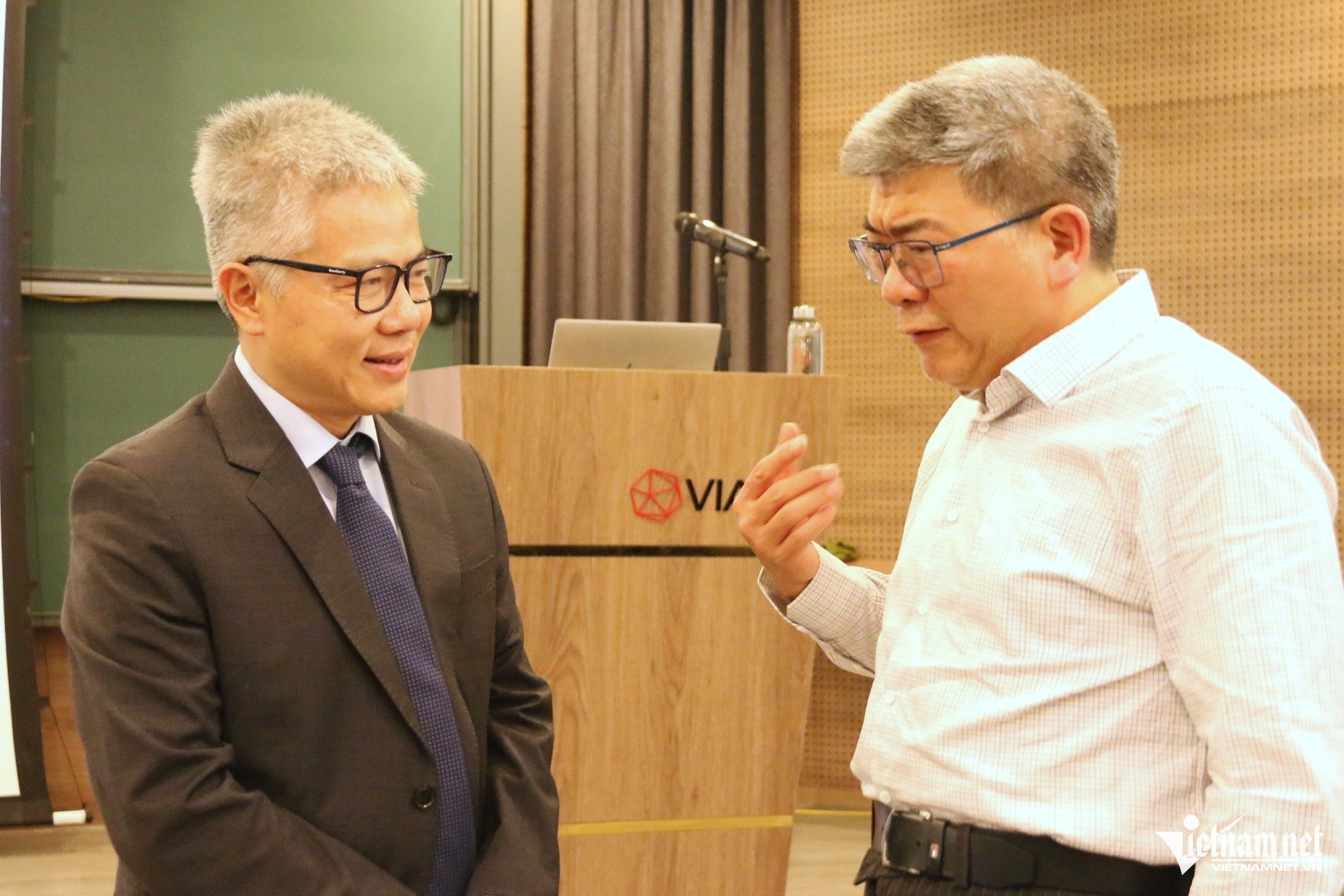
Professor Ngo Bao Chau speaks with a mathematician from a Chinese university. Photo: Thanh Hung
Chau also revealed plans to establish a mathematics summer school for school students in 2027, where participants could use AI to explore mathematical concepts independently.
Through the summer school, he hopes to offer an alternative to conventional training for Mathematical Olympiads.
“There is nothing wrong with preparing for Mathematical Olympiads, but some students are highly gifted in mathematics without necessarily excelling in Olympiad competitions. The summer school will give these students a space and an opportunity to develop their mathematical talents. They will be able to explore mathematics and science and discover pathways into research, rather than focusing primarily on academic competitions,” Chau said.
 Vietnamnet.vn

 Podcast