 Vietnamnet.vn

 Podcast



The event formed part of a series of activities marking the 50th anniversary of relations between Vietnam and UNESCO (1976–2026). It was jointly organised by the Vietnam National Commission for UNESCO, the Hanoi People’s Committee, and the Permanent Delegation of Vietnam to UNESCO on the occasion of the 950th founding anniversary of Quoc Tu Giam, Vietnam’s first national university.
The programme brought together more than 200 participants, including UNESCO Director-General Khaled El-Enany, ministers, heads of delegations attending the General Assembly of States Parties to the 2003 Convention for the Safeguarding of the Intangible Cultural Heritage, ambassadors, representatives from over 100 UNESCO member states, and numerous international guests.
In his opening remarks, Vietnamese Deputy Minister of Foreign Affairs Ngo Le Van, who is Chairman of the Vietnam National Commission for UNESCO, described Van Mieu – Quoc Tu Giam as a defining symbol of Vietnam’s civilisation and educational tradition. With a history spanning nearly a millennium, the site embodies the nation’s respect for learning, reverence for teachers, appreciation of talent, and enduring belief that education and knowledge form the foundation for sustainable national development.
He noted that the 82 doctoral steles preserved at the site have been inscribed on UNESCO’s Memory of the World Register, further reinforcing the monument’s significance as a symbol of Hanoi and Vietnam’s long-standing commitment to scholarship and intellectual achievement.
Van also highlighted the close cooperation between Vietnam and UNESCO in heritage preservation, citing the Imperial Citadel of Thang Long, a UNESCO-recognised world heritage site, as another success example. Together, the two heritage sites at the heart of Hanoi convey a powerful message to the world that culture and education are essential pillars of peace, sustainable development, and humanity’s future.
Marking five decades of Vietnam – UNESCO relations, the deputy minister affirmed that the partnership has grown increasingly comprehensive, substantive, and effective. He described UNESCO as a trusted companion that has supported Vietnam throughout the country's post-war reconstruction, renewal, international integration, and development process, while Vietnam has become an active and responsible member contributing to UNESCO’s shared objectives.
UNESCO Assistant Director-General for Culture Nayef Al-Fayez praised the special significance of Van Mieu – Quoc Tu Giam as one of Vietnam’s most prominent cultural and historical symbols. Beyond its architectural and historical value, he said, the site stands as a living testament to Vietnam’s long tradition of valuing education and scholarship, demonstrating that heritage is not merely about preserving the past but also about inspiring future generations.
He stressed that the values represented by Van Mieu – Quoc Tu Giam – the fondness for learning, cultural continuity, and the pursuit of knowledge – closely align with UNESCO’s mission to advance education, safeguard heritage, and foster dialogue among nations. In a rapidly changing world, culture remains a vital resource for resilience and sustainable development, and Van Mieu – Quoc Tu Giam demonstrates the role of heritage as a bridge connecting the past with the present.
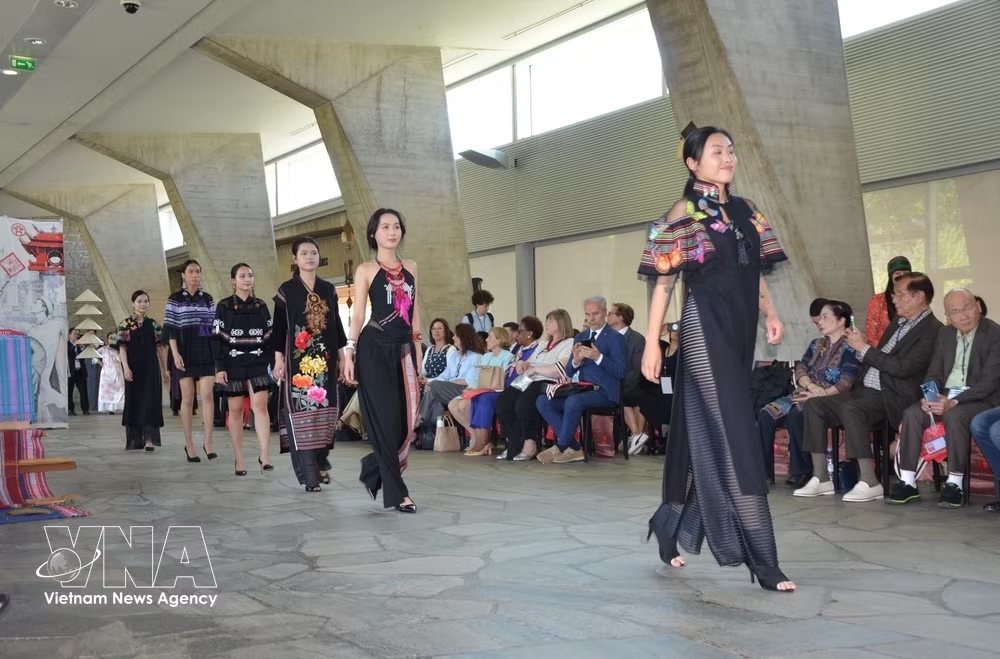
A highlight of the event was the artistic programme “Dao Hoc”, which showcased the depth and diversity of Vietnamese culture through exhibitions, music, traditional costumes, and performing arts. Collections of “ao dai” (Vietnam’s traditional long dress) by designer Minh Hanh, inspired by Vietnam’s educational heritage, promoted the values of humanity, propriety, righteousness, wisdom, and integrity.
The programme also featured interactive heritage experiences, enabling international guests to engage directly with traditional Vietnamese materials, techniques, and cultural symbols. Participants had the opportunity to explore the nation’s scholarly traditions, historical documents, and fine arts, while also sampling signature dishes from Hanoi and other localities of Vietnam, celebrating cultural values shaped over thousands of years of history./. VNA
.svg)
