 Vietnamnet.vn

 Podcast



The man standing in the middle of endless fields
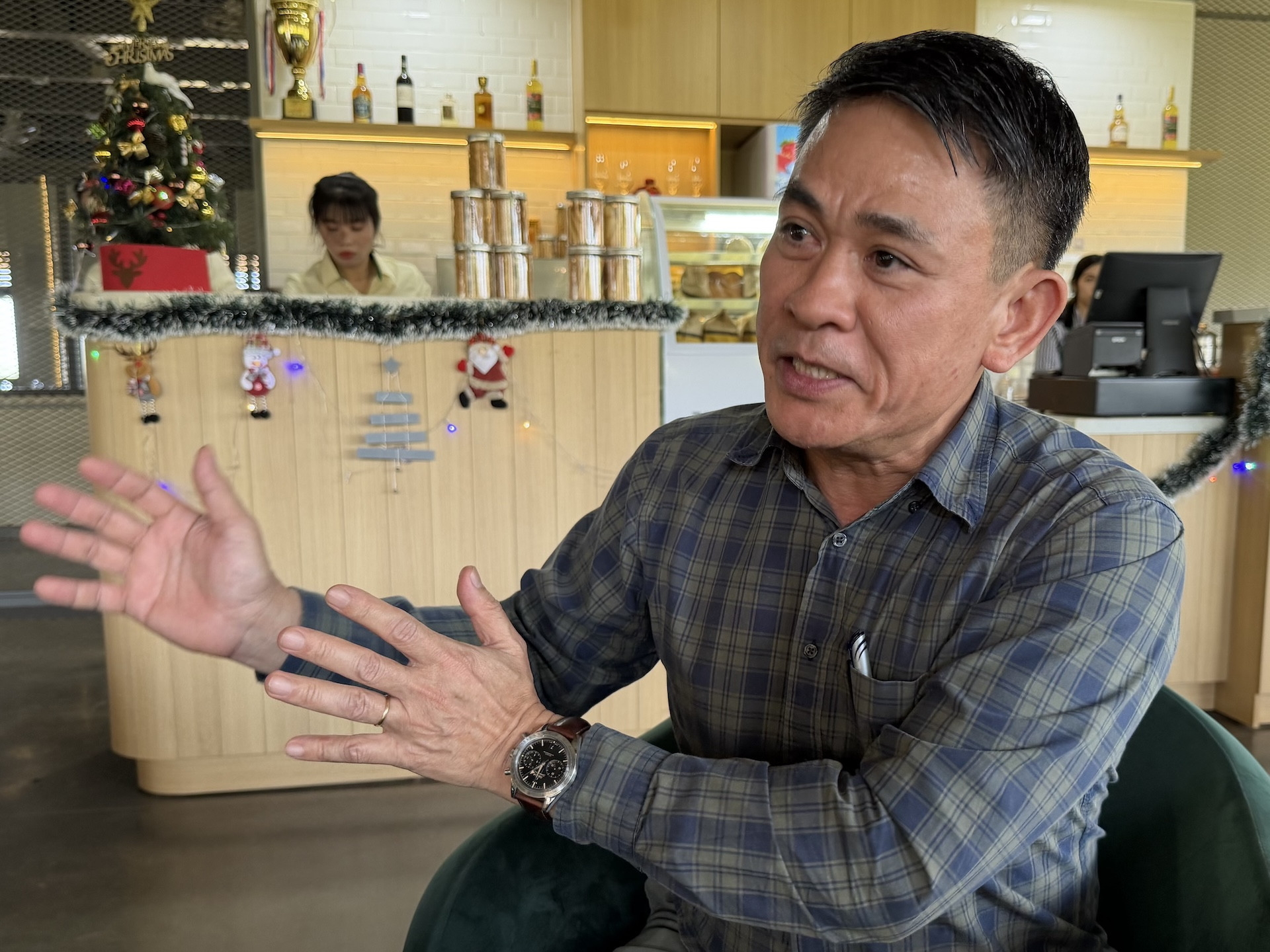
Tran Bao Son, CEO of THACO AGRI, was standing on the edge of a canal, hands on hips, squinting into the distance under the midday sun in Snoul (Kratie province, Cambodia), a border area adjacent to Vietnam.
Before him were deep-green artificial reservoirs linked one after another, endless banana plantations and vast, lush grasslands stretching to the horizon. Scattered across this open landscape were cattle farms housing hundreds of thousands of heads.
The scale of the farm, tens of thousands of hectares, seems difficult to describe in words, as few people in the world have the opportunity to witness such a vast space.
"To create the landscape for large-scale agriculture, when we met mountains, we dug through them; when we met swamps, we filled them and dug reservoirs," Son recounted.
Behind that brief account is a long story of sweat, passion and capital from Son and many others, especially THACO Group Chair, billionaire Tran Ba Duong.
The letter from Boss Duc to automobile billionaire
Nearly a decade ago, Minister of Agriculture and Rural Development Nguyen Xuan Cuong invited Tran Ba Duong to the Ministry headquarters. The Minister stated that Vietnam needed a capable industrialist to invest in agriculture so the sector could become a production industry competitive in the international market.
Duong did not make the investment decision immediately. But that cordial meeting sowed the seeds of agricultural thinking in the mind of the industrial billionaire behind several major auto brands in Vietnam.
If he engaged in agriculture, he believed, he must accumulate land large enough to organize production in an industrial style. The problem was, land accumulation was not easy.
The opportunity came in early 2018 in an unpredictable way. One day, Tran Ba Duong received a letter from Doan Nguyen Duc, Chair of Hoang Anh Gia Lai Group.
"In the letter, I wrote that only Duong could save Hoang Anh Gia Lai," Duc recalled.
At the time, Hoang Anh Gia Lai was at the bottom of its cycle. Rubber prices had plunged since late 2016 and remained depressed. Agricultural projects covering tens of thousands of hectares in Laos and Cambodia, once hailed as “gold mines”, had become heavy financial burdens.
Hoang Anh Gia Lai’s total debt had reached nearly VND36 trillion, with accumulated losses of around VND7 trillion. Banks had shut off credit.
The group had to sell whatever it could: real estate, hydropower, hotels, hospitals. Eventually, only agriculture remained, not as a strategic choice, but as the sole path to survival.
After the letter, the two businessmen met. According to Duc, Duong immediately injected around VND2 trillion into Hoang Anh Gia Lai as initial support, based on trust rather than on contractual terms.
In 2018, THACO lent Hoang Anh Gia Lai $305 million for restructuring. One year later, Hoang Anh Gia Lai transferred 44,869 hectares of agricultural projects in Cambodia and several Central Highlands provinces of Vietnam to THACO.
However, for Tran Ba Duong, this was not a “rescue deal” in the conventional sense.
“From the beginning, I did not see this as a financial transaction,” he said. “If we only calculated short-term profit and loss, there would have been no reason to enter. I saw it as a large-scale agricultural restructuring challenge – one that had to be tackled with industrial thinking.”
The 2019 milestone
Things were not simple for Tran Bao Son, Director General of THACO AGRI, who was tasked with taking over the project in Cambodia.
At that time, the banana, palm, rubber, and mango projects were all inefficient, not organized into a cultivation model tight enough to operate a large plantation. Water was entirely dependent on nature: lacking in the dry season and flooded in the rainy season.
"At that time, one hectare of bananas only brought about 28 tons with Grade-A products under 10 percent. The waste rate was up to about 32 percent," he said.
Then COVID-19 hit broke out.
Tu Giang
to be continued...
.svg)
