 Vietnamnet.vn

 Podcast



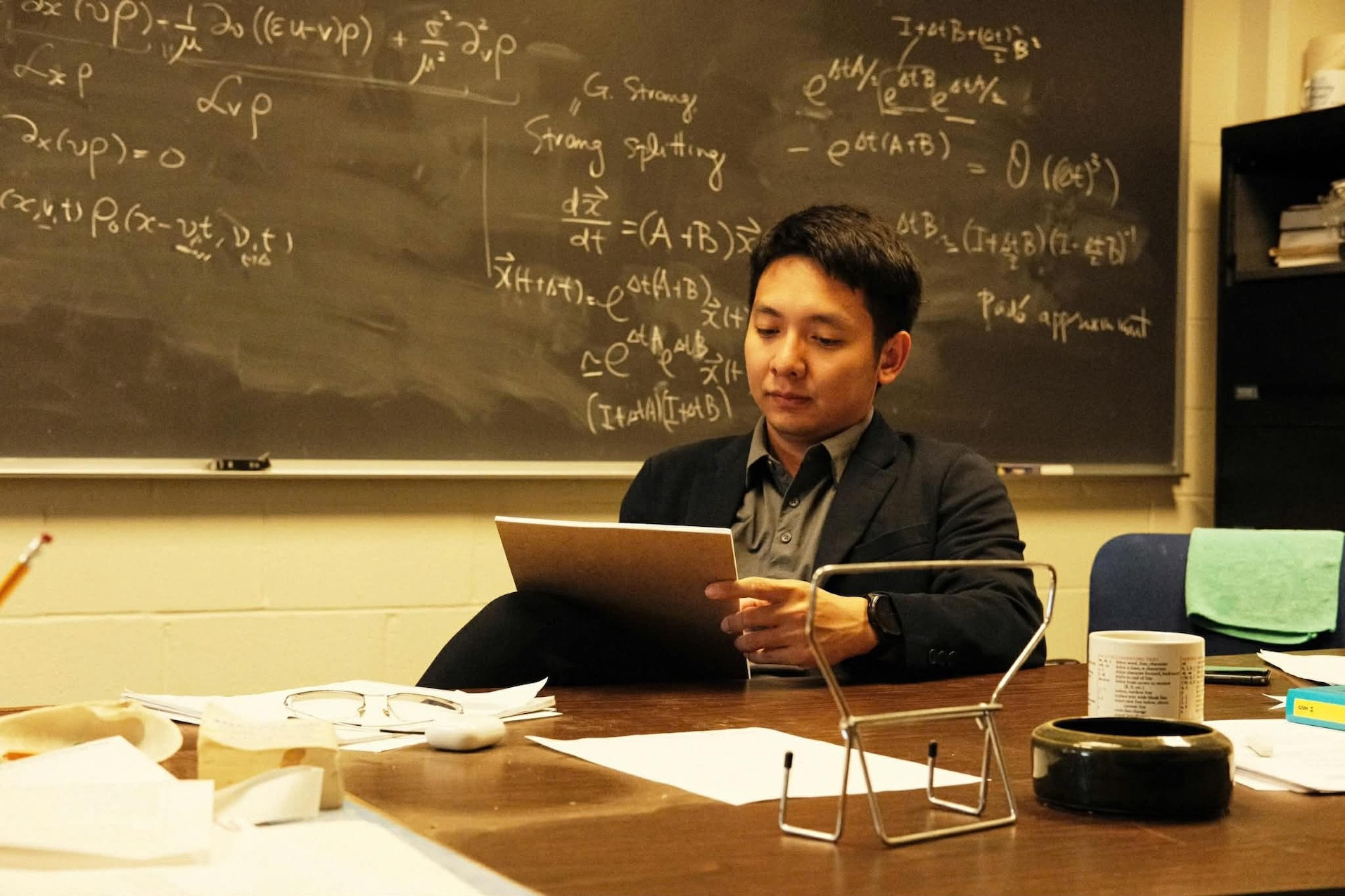
Son has been selected for the VNU350 Program, which attracts outstanding young scientists and leading experts to work at Vietnam National University, HCMC. He will work at the University of Technology, VNU-HCM, in Applied Mathematics.
Behind Dr. Son’s decision to return is a long journey pursuing basic science.
At Carnegie Mellon University in the US, Dr. Son studied applied mathematics, focusing on areas such as partial differential equations (PDE), probability, and stochastic dynamical systems. Though interested in AI, he focuses more on the mathematical foundations behind these systems, especially optimization problems and energy-efficient computation.
One research direction he pursues is "Physical Learning," which explores the self-adaptive capacity of physical systems such as materials or electrical networks.
With an engineering environment like the University of Technology (VNU-HCM), Dr. Son believes that this is a very natural direction because it lies at the intersection of mathematics, physics, engineering, and AI.
Besides, he continues to dig deep into researching the Langevin dynamics equation, an important research direction in the process of his collaboration with colleagues at the University of Pennsylvania.
What gets Dr. Son excited when working in an engineering environment is the specific problems from reality set forth by engineers. According to him, it is precisely these issues that keep mathematics from being detached from life, and at times even open up completely new research directions.
When asked what the biggest opportunity is for foreign-trained young scientists upon returning to Vietnam, Dr. Son does not mention infrastructure or investment programs, but instead emphasizes the role of students.
He believes Vietnamese students have sharp thinking and great scientific potential. If they can study in the right environment, many can go very far. According to Dr. Son, they are like "rough gems" waiting to be polished.
The rough gems that will shine when polished
Son thinks that Vietnam needs to solve two major issues to attract and retain young scientists: income and research environment.
All scientists want time and space to do research and freely exchange ideas with strong colleagues.
Recalling his graduate school years, Dr. Son said his friends could spend an entire afternoon debating problems that outsiders might think were trivial. Those discussions nurtured creativity and trained thinking and problem-solving skills.
According to him, the challenge for Vietnamese science is not only funding or equipment but also building a vibrant academic community where researchers can freely exchange ideas and pose new questions.
"I always hold a dream that mathematical activities in HCMC will become as vibrant as any major academic center in the world," he said. In his vision, students in HCMC will have opportunities to attend cutting-edge scientific seminars almost weekly and regularly encounter the world’s newest ideas.
He believes Vietnam in general and HCMC in particular have many talented mathematicians. However, to create a deep, regularly active, and attractive academic network, there needs to be academic spaces that are large enough, reputable, and sustainable.
He concretizes that dream with a very clear image: an international-level applied mathematics research institute in HCMC, similar to the Courant Institute in the US.
According to Dr. Son, in most countries with developed science, such institutes always serve as the nucleus, gathering talent, connecting internationally, and nurturing generations of young researchers. He also hopes Vietnam National University, HCMC can become a pioneer on that journey through the VNU350 program.
In training, Son believes students need to be equipped with a solid theoretical foundation before chasing technology trends. According to him, technology can change very quickly, but foundational knowledge in mathematics, probability, calculus, optimization, and modeling will be the long-term toolkit that helps learners adapt.
He also wants to leverage his international network to bring the world’s current problems to Vietnam, while expanding cooperation with strong universities and research institutes in the region.
But the biggest aspiration of Dr. Van Phung Truong Son is that one day Vietnam can set its own problems. These are problems arising from the country’s practical needs, from issues Vietnamese society faces, and from an independent intellectual foundation of Vietnamese people themselves.
Returning to Vietnam is not simply choosing a workplace. It is placing his scientific future into the country’s future. It is also the belief that Vietnamese students can absolutely conduct world-class science right at home if given the opportunity and a good enough environment to develop.
Le Huyen
.svg)
