 Vietnamnet.vn

 Podcast



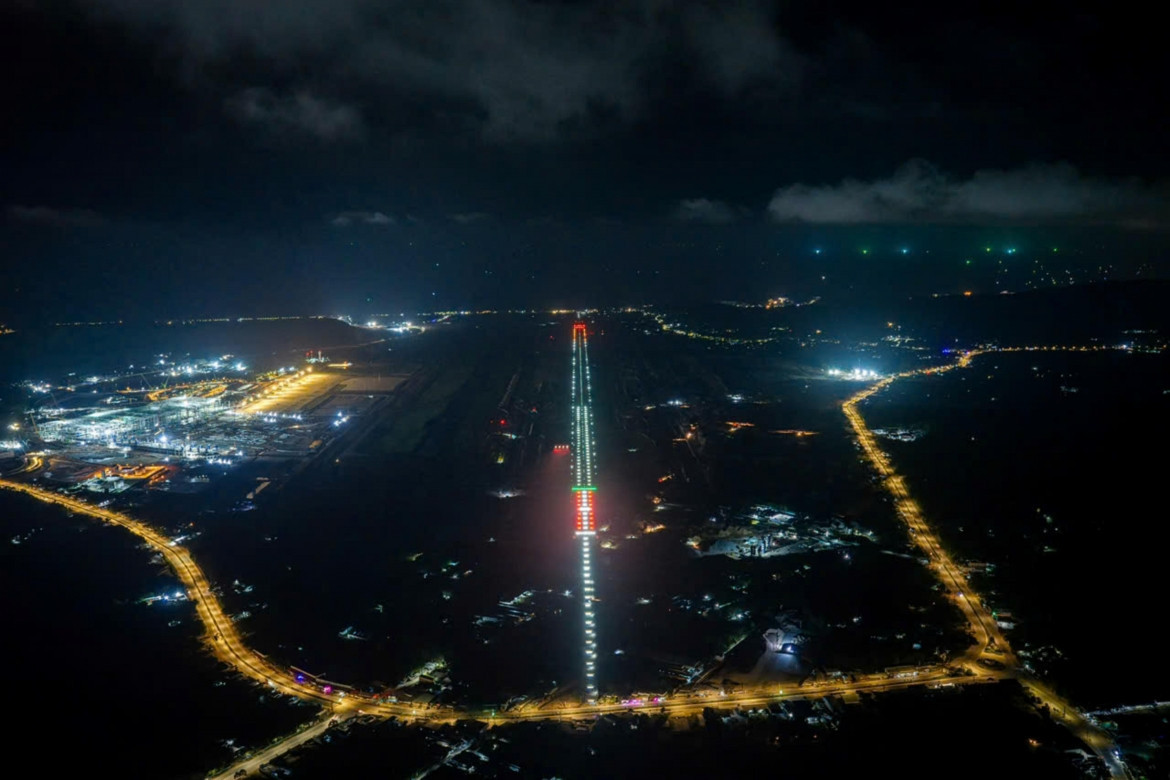
This is one of the final calibration stages before the second runway officially enters operation.
According to Phu Quoc International Airport, the second runway is 3,300 meters long and 45 meters wide and is designed to regularly accommodate wide-body aircraft including the Boeing 787, Airbus A350 and Boeing 777.
The runway was completed in around eight months, including six months for structural and concrete pavement construction and another two months for the installation, connection and calibration of aviation equipment. Once operational, the new runway will strengthen the airport’s capacity to handle wide-body aircraft, supporting the APEC 2027 Economic Leaders’ Week and the airport’s subsequent stages of development.
In the initial phase, around 1,500 airfield lights and nearly 400 signs have been installed across the airfield. The CAT II lighting system uses LED technology with a designed lifespan of approximately 50,000 hours, providing consistent illumination while reducing maintenance costs.
Two PAPI systems are installed at opposite ends of the runway, helping pilots accurately determine their approach angle. In addition, the ILS/DME precision landing system provides information on approach direction, glide path and distance to the runway, helping aircraft land safely in low-visibility weather conditions.
A representative of Phu Quoc International Airport said the calibration flight scheduled for July 27 will test and assess the accuracy of the entire navigation and airfield lighting system before procedures are completed to put the second runway into operation.
The second runway is part of a broader aviation infrastructure investment and expansion project at Phu Quoc. The project is being developed in tandem with taxiways, aircraft parking aprons, the T2 passenger terminal, a VIP terminal and VIP apron, as well as navigation, security, emergency and rescue systems and other supporting facilities. Together, these projects are intended to meet the requirements of the APEC 2027 Economic Leaders’ Week while strengthening the airport’s long-term operating capacity.
Under the proposed development plan, Phu Quoc airport will eventually have two runways built to international standards, together with modern terminals and aviation infrastructure. In the longer term, the airport is targeted to reach a capacity of 50 million passengers per year.
The new infrastructure is expected to meet operational requirements for the APEC 2027 Economic Leaders’ Week while creating opportunities to expand international routes using wide-body aircraft, strengthening direct connectivity with markets in the Middle East, Northeast Asia, South Asia and Europe.
Vu Diep
.svg)
