 Vietnamnet.vn

 Podcast



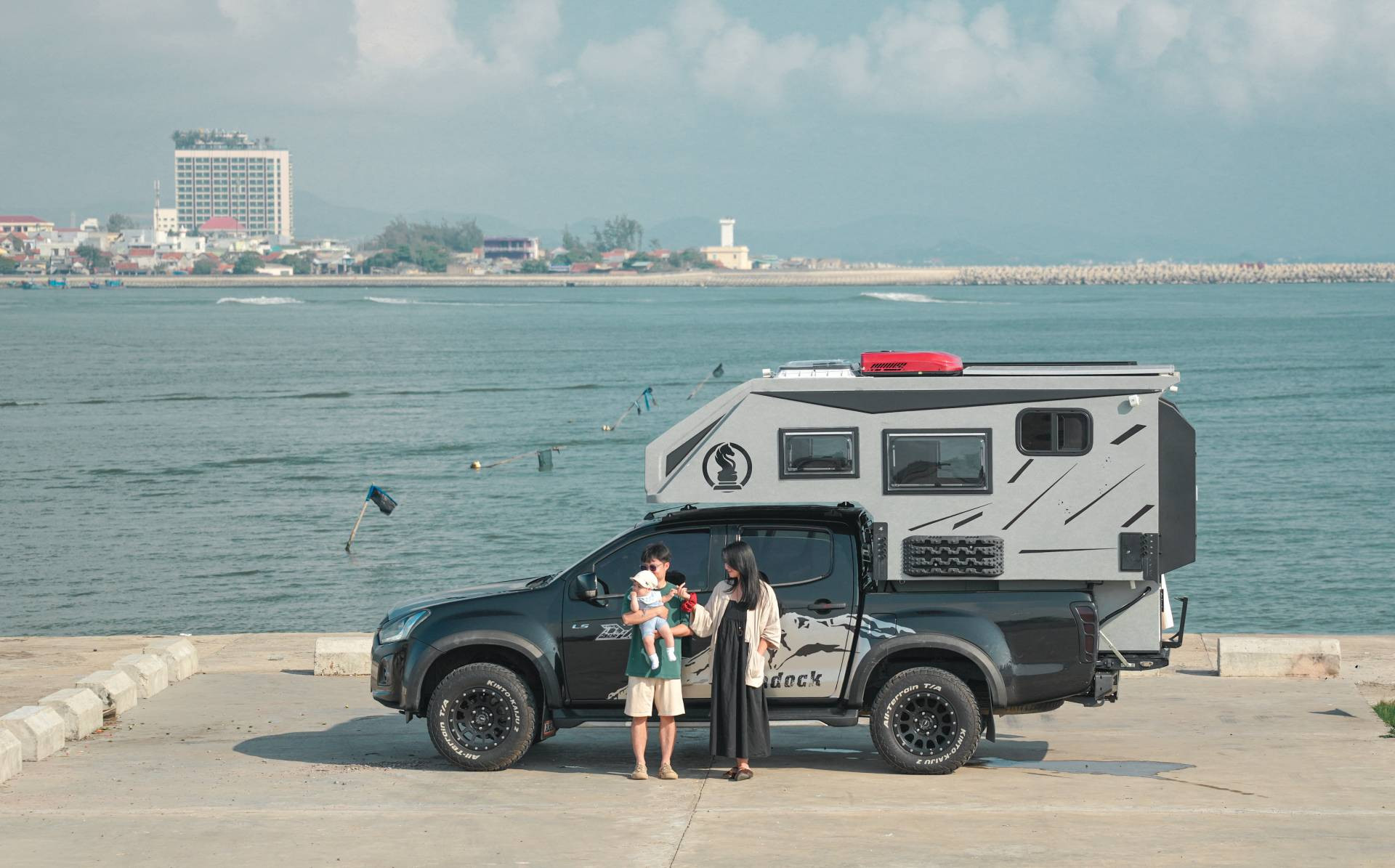
The craze of transforming pickups into "mobile homes" is booming in Vietnam, particularly within the camping and self-driving travel communities. Recently, numerous pickup models modified into "mobihomes" or "mini campers" have surfaced on social media, packed with amenities such as beds, kitchen stoves, solar batteries, water tanks, and even mini toilets.
Yet, behind these vehicles capable of taking a small family anywhere lies a host of legal and safety issues that not every owner clearly understands.
Legal risks in traffic
According to legal experts, mounting a "camper" style cabin onto a pickup truck is not currently prohibited. However, the vehicle must still fully meet technical safety, weight load requirements, and must not arbitrarily alter the vehicle's structure compared to its original registration profile.
Many people assume that simply placing a cabin onto the truck bed makes it a mere "additional item of cargo" that can freely circulate. Nevertheless, the boundary between "cargo carried on a vehicle" and "vehicle modification" is incredibly thin.
Under current regulations in Circular No 39 issued by the Ministry of Transport, for pickup trucks, if the cabin is a standalone, easily detachable module that is safely secured and does not alter the dimensions, functionality, or technical specifications of the vehicle, it can in principle be viewed as cargo transported on the truck bed.
Vehicle owners must still ensure that the overall dimensions and weight remain within permissible limits. If the cabin causes the vehicle to exceed its registered height, width, or mass, the vehicle can still be penalized.
Specifically, for trucks (including pickups) with a designed cargo payload capacity under 2.5 tons as recorded in the certificate of technical safety and environmental protection, the cargo stacking height must not exceed 2.8 meters. Furthermore, the allowable cargo stacking length must not exceed 1.1 times the overall designed length of the vehicle.
Conversely, if the cabin is permanently fixed to the vehicle body, interferes with the cargo bed structure, or alters the original technical specifications, the vehicle will be classified as a modified vehicle. If so, the owner is legally required to undergo procedures for design approval, evaluation, re-registration, and update paperwork in accordance with regulations.
Some owners even install beds, kitchens, electrical and plumbing systems, or high-capacity storage batteries inside the cabin space.
According to specialists, these are no longer standard accessories but are directly tied to the vehicle's functionality. If executed improperly, the vehicle could be cited as illegal structural alteration. This is precisely why many DIY "camper" models, despite looking eye-catching, cannot pass registration inspections.
Additionally, a "mobihome" style vehicle is essentially a hybrid of a transport vehicle and a living space. Aside from traffic regulations, owners also must pay attention to standards regarding electrical systems, fire prevention and fighting, and wastewater treatment to ensure safety for both users and the community.
Safety hazards
Many pickup truck owners in Vietnam currently opt for removable modules designed for short trips in order to avoid inspection-related complications. This is generally regarded as a legally safer solution than welding or permanently attaching a cabin to the vehicle.
Automotive enthusiasts believe that the mobihome and car-camping trend will continue to grow strongly in the coming years as demand for independent travel increases. However, for the trend to develop sustainably, the legal framework governing converted-purpose vehicles will need to be further clarified.
Beyond paperwork and inspection requirements, these mobile-home vehicles also present several operational safety risks that drivers should be aware of.
Pham Xuan Thanh, owner of an Isuzu D-Max converted into a mobihome and operator of the social media channels “Nguoi lon Thong dong” and “Xe Bon Bon,” said legal concerns are generally manageable because the mobihome units currently available are typically supplied by professional mobile-home design and assembly companies, ensuring compliance with size requirements and structural reinforcement standards.
Even so, with this special type of vehicle, the driver and user remain the most critical factors in achieving safe trips.
According to Thanh, a cabin mounted on a truck bed usually raises the vehicle's center of gravity, altering its balance when cornering or traveling at high speeds.
"My vehicle is designed to carry up to 400 liters of water for showering and cooking on the road, but in reality, I only maintain around 100 liters to prevent the vehicle from being heavily loaded and swaying due to centrifugal force during sharp turns or sudden braking. Additionally, when in motion, passengers must absolutely never remain inside the module," Thanh explained.
Ha Nguyen
.svg)
