 Vietnamnet.vn

 Podcast



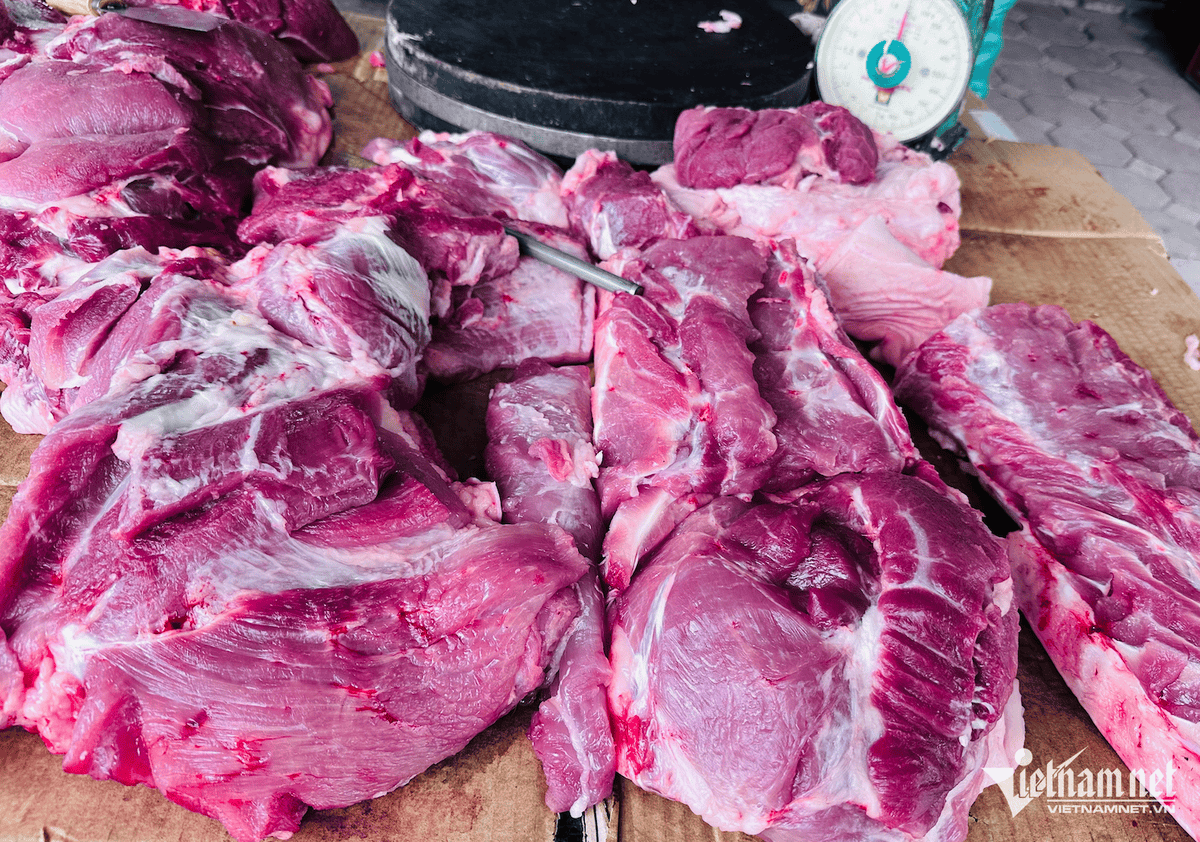
Tran Quoc Toan, a pig farm owner in Trieu Viet Vuong commune (Hung Yen province) told VietNamNet on December 22 afternoon that the farm-gate price for live hogs has increased to VND70,000/kg. Traders are searching everywhere to buy, but farmers ran out of pigs to sell a long time ago.
He said that previously, his family's farm usually raised more than 2,000 pigs. However, for more than a year, unstable live hog prices combined with the raging ASF forced him to narrow the scale of farming.
More than a month ago, he sold a batch of 200 pigs at a price of only over VND53,000/kg. Even though this price was at break-even point, he still did not dare to start a new herd for fear of disease.
Currently, there are only more than 200 meat pigs and sows in the barn. The meat pigs must be raised until after the Lunar New Year to be sold. After selling, Toan has no plans to start a new herd, because investing in raising a batch of pigs costs a large amount of capital, while the disease risk is very high. If the herd is infected with ASF, he will suffer a big loss.
In this area, many farms have left their cages idle, not daring to raise pigs because previous prices were very low and they fear the disease. This is also the reason why live hog prices have increased sharply despite slow consumption in the market.
Currently, live hog prices in Northern provinces are still in a strong upward trend to about VND68,000-VND70,000/kg. Meanwhile, live hog prices in the Central region fluctuate from VND63,000-VND69,000/kg, and in the South, they remain stable at VND60,000-VND63,000/kg.
Nguyen Van Thanh, a sales employee in charge of Phu Tho province for a large livestock enterprise, admitted that farm-gate live hog prices have increased quite quickly in recent days.
“Three days ago, for pigs weighing 120 kg/head, the farm-gate price increased to VND67,000-VND68,000/kg. Now the company is considering adjusting to a new price level,” Thanh said.
According to him, the main cause pushing live hog prices high is the outbreak of ASF. In fact, not only small-scale farming households are affected; even livestock farms of enterprises are struggling due to the disease and are forced to reduce their herds.
Along with that, widespread flooding caused heavy damage to pig farms. Therefore, these days, the local supply shortage has pushed live hog prices up sharply.
"With the current supply developments, after the 2026 New Year holiday, live hog prices may exceed the VND70,000/kg threshold," he predicted. Meanwhile, the market is entering the peak season, and consumer demand for pork is increasing strongly. Even when market demand is slow, the price of this item still tends to increase if the supply is not improved.
Small traders at traditional markets in Hanoi also admit that these days, purchasing power for pork is still very weak, but prices have still increased by VND5,000-VND15,000/kg.
At Dai Tu market (Dinh Cong, Hanoi), Xuan quoted the price increase of VND10,000/kg for all kinds of meat compared to mid-November.
“Farm-gate live hog prices have soared very strongly. However, at the market, pork is still sluggish, so sellers do not dare to increase prices sharply,” Xuan said, emphasizing that if pork prices are too high, people will cut back on portions. At that time, pork will become even more stagnant.
Prior to that, Nguyen Kim Doan, Vice Chairman of the Dong Nai Livestock Association, predicted that live hog prices could reach about VND70,000/kg near the Lunar New Year 2026 (February 2026). This level is considered harmonious for both farmers and consumers. However, live hog prices are unlikely to increase as sharply as in 2020 because although the supply is short, it is not too serious.
Doan believes this upward trend is unlikely to last long. If live hog prices rise too high, management agencies will implement market stabilization measures such as increasing imports.
At a regular press conference on December 4, Phung Duc Tien, Deputy Minister of Agriculture and Environment, informed that the pig herd is recovering. In recent days, pork prices have increased quite high, but not to the extent of affecting the supply for Lunar New Year. However, Tien emphasized the need to try to ensure food supply to contribute to stabilizing CPI.
Tam An
.svg)
