 Vietnamnet.vn

 Podcast


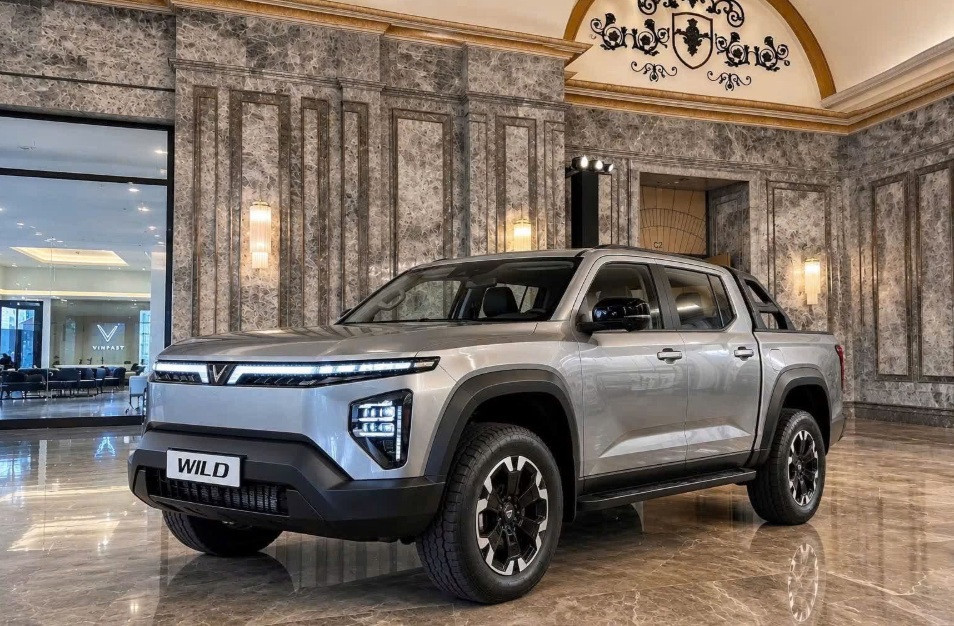
REEV, also referred to as EREV, uses electric motors to drive the wheels exclusively, while retaining a gasoline engine that functions strictly as an onboard generator to supply electricity or recharge the battery when capacity drops.
With this setup, REEVs are expected to deliver an EV driving experience while alleviating range anxiety on long-haul journeys. Multiple automakers are introducing these models locally to expand their current electrified lineups.
Among them, VinFast VF Wild debuted on September 19 as the first REEV pickup truck in the Vietnamese market. Listed at a starting price from VND860 million, it projects a combined driving range of up to 1,000 km.
In the premium SUV segment, German automaker Volkswagen began taking deposits in September for its new ID. Era 9X, with a slated November launch and an estimated price under VND3 billion.
Volkswagen ID. Era 9X is positioned as a full-size 6-seater SUV featuring a 65.2 kWh battery pack paired with a 1.5L turbocharged gasoline generator engine. According to the German automaker, the ID. Era 9X delivers a maximum combined range of up to 1,651 km under CLTC test cycles.
Meanwhile, iCaur, a new brand under Chery Group, revealed plans to assemble its D-segment REEV SUV, the V27, at its joint-venture plant with Geleximco in Hung Yen province. The model is scheduled for local retail release by year-end.
According to manufacturer specifications, the iCaur V27 utilizes a 449 hp REEV powertrain delivering 505 Nm of torque and electric all-wheel drive. Its 34.41 kWh battery pack supports fast charging from 20 percent to 80 percent in roughly 30 minutes, claiming a combined range of up to 1,200 km.
Beyond the three models confirmed for Q4 arrival, Chinese automaker Li Auto is also expected to enter Vietnam by year-end with three REEV-powered models: the L6, L7, and L9.
The arrival of these models demonstrates that REEV technology is expanding across diverse segments, spanning commercial pickup trucks, large luxury SUVs, and off-road-style SUVs. This trend broadens options for Vietnamese consumers amid growing market interest in green vehicles.
How does REEV differ from standard EVs and hybrids?
REEV stands for Range-Extended Electric Vehicle (or EREV in certain technical documentation).
The core principle of this technology lies in its drivetrain arrangement: electric motors serve as the sole source of motive power to propel the wheels, while the gasoline engine acts purely as an engine-generator to power the electrical system or charge the battery. The vehicle can still be plugged into external power sources like a Battery Electric Vehicle (BEV).
This distinction prevents REEVs from relying entirely on charging infrastructure. When the battery holds sufficient charge, the vehicle operates purely on electric power. As battery capacity drops, the gasoline engine starts up to generate electricity, allowing the vehicle to continue driving without needing an immediate charging stop.
For pure BEVs, operating energy is stored strictly in the battery without an internal combustion engine to generate power. Standard Hybrid Electric Vehicles (HEVs) can use a gasoline engine, an electric motor, or a combination of both to drive the wheels directly. Plug-in Hybrids (PHEVs) can also recharge via external power, but their gasoline engines retain the ability to directly drive the wheels.
In practice, REEVs share similarities with the e-Power technology found in the Nissan Kicks, a crossover sold in Vietnam since 2022.
The Kicks utilizes a 1.2L gasoline engine to power a generator, while a 136 hp electric motor with 280 Nm of torque drives the wheels directly.
However, the Nissan Kicks e-Power does not support external plug-in charging. Its battery is replenished solely through the generator and regenerative braking, classifying it as a standard hybrid rather than a REEV under plug-in capability definitions.
Technically, newer REEV models feature larger battery packs, allowing longer pure-electric driving ranges before requiring the gasoline generator engine to kick in.
According to automotive experts, REEVs offer long-distance driving convenience and signature EV performance characteristics, though they do not inherently guarantee better fuel economy than standard hybrids.
When battery capacity drops and the gasoline engine operates continuously to generate electricity, fuel consumption hinges heavily on system efficiency, speed, and driving conditions.
The appeal of REEV-powered vehicles in Vietnam will depend not only on advertised driving ranges, but also on pricing, operating costs, maintenance expenses, and after-sales service accessibility provided by automakers.
Hoang Hiep

