 Vietnamnet.vn

 Podcast



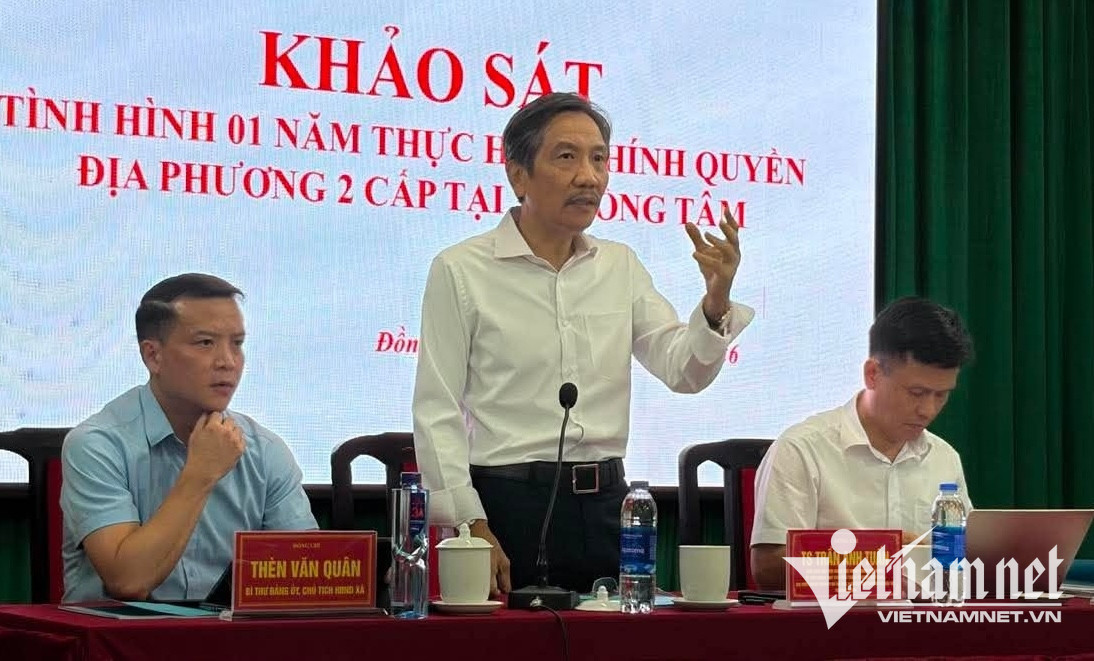
Only a structure that is fit for purpose can meet practical operational requirements, ensure smooth and effective governance, and avoid the mechanical mindset that “the fewer organizations, the better.”
The organization of institutions and personnel at the commune level has emerged as one of the key issues under the two-tier local government system after one year of implementation. It is also a matter of concern for many localities, which have proposed recommendations to improve operational efficiency, strengthen governance quality, and ensure the implementation capacity of the two-tier local government system, as requested by General Secretary and State President To Lam.
Under the principle, when implementing the two-tier local government, a commune-level People's Committee can set up a maximum of four specialized divisions and equivalents, tailored to urban, rural, and island (special zone) characteristics.
These include: The Office of the People's Council and People's Committee; the Division of Economy (for communes and special zones) or the Division of Economy, Infrastructure, and Urban Affairs (for wards and the Phu Quoc special zone); the Division of Culture and Social Affairs; and the Public Administrative Service Center.
Each division handles the workload of 6-7 departments and sectors
Through field surveys at several communes and wards in some localities, Dr. Tran Anh Tuan, chair of the Vietnam Association of Administrative Sciences and former Deputy Minister of Home Affairs, stated that in a two-tier local government, the functions, tasks, and powers of the commune level absorb those of both the former district and commune levels, along with several additional tasks delegated by the provincial level.
However, under current regulations, the commune level has only three specialized divisions, squeezing numerous sectors into a single division (not counting the Public Administrative Service Center). Meanwhile, compared to the former district level, the functions, tasks, and powers of the commune level now are broader and much heavier.
Previously, the district level comprised 9-10 divisions. Nowadays, the commune level only has three.
Surveys found that a current commune-level head of division must make decisions on various technical matters equivalent to four to five specialized divisions at the former district level combined. They also operate under the guidance of six to seven provincial departments and sectors.
This situation has created an overwhelming workload, hindering the professionalism and specialization of commune-level civil servants.
Vice Chair of the National Assembly Nguyen Doan Anh also stated that through voter contacts, many opinions expressed deep concern over the specialized divisions of communes and wards today.
He pointed out that the economic division has to answer to seven provincial focal departments and sectors, while the division of culture and social affairs deals with six provincial focal points. Consequently, the sheer volume of work, tasks, and procedures hitting the commune level is heavily concentrated on these two divisions.
Division heads are expected to be 'superhuman'
The head of the Economic Division of a commune in Hanoi said: “With the responsibilities of a leader since taking up office under the two-tier local government, I have left the office before 8pm exactly twice, just to attend my village party cell meeting”.
“Five communes have been merged into one, and with added tasks from the district level, the commune's workload has skyrocketed, especially regarding land matters with a massive volume of highly complex documents and dossiers.”
Currently, commune-level economic divisions in most localities have to shoulder a massive workload covering highly distinct sectors such as economic development, urban management, technical infrastructure, construction, transportation, environment, and agricultural production.
A commune economic division receives professional directives from six provincial departments and sectors: finance, agriculture, environment, construction, planning and architecture, and industry and trade.
Commune officers complained that concentrating so many highly specialized fields within a single division has created some problems. These include difficulties in ensuring in-depth professional expertise, excessive workloads and a high risk of staff overload.
Monitoring and managing each sector has not always been sufficiently timely or thorough, while the quality of policy advice and implementation has sometimes fallen short of practical requirements.
Meanwhile, fields such as construction, transportation, environmental management and agriculture all require officials with specialized expertise who can update themselves on new legal regulations and technical standards issued by central and provincial authorities.
In addition, many officials are currently responsible for multiple fields simultaneously, leaving them with little opportunity to develop deep expertise in individual areas. This makes it increasingly difficult to meet rising management requirements, particularly in localities undergoing rapid urbanization and digital transformation.
Thu Hang
.svg)
