 Vietnamnet.vn

 Podcast



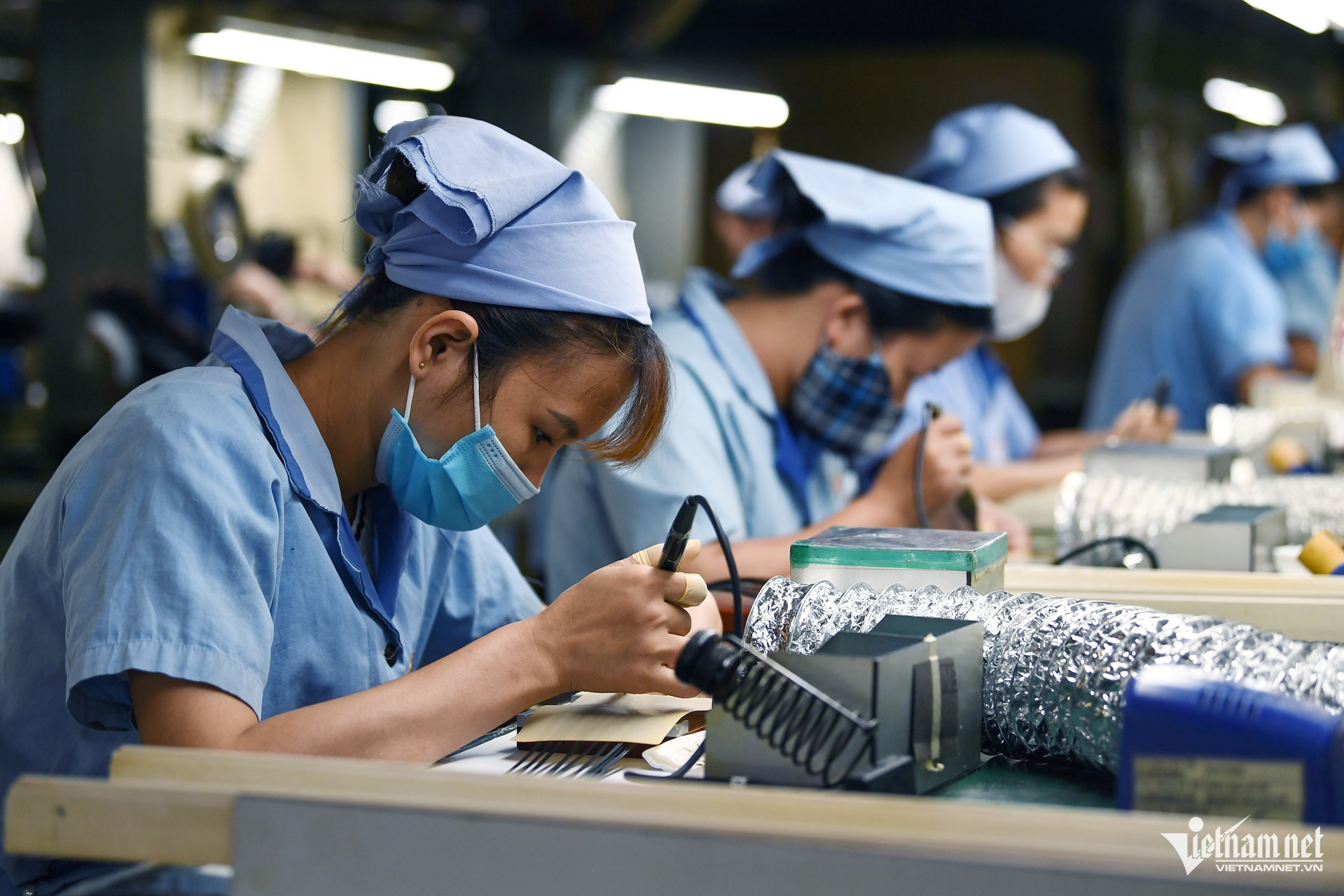
The country has drawn nearly $550 billion in foreign investment, hosts more than 46,000 active FDI projects, and has achieved total import-export turnover equivalent to nearly 200 percent of GDP.
While attracting FDI capital is proving favorable, a new question arises: To what extent have international resources helped strengthen the Vietnamese economy?
Fares Al-Hussami from the OECD said Vietnam no longer needs to care how many billions of USD in foreign investment capital it can attract, but how much value the foreign-invested economic sector has generated for the rest of the economy.
Assessments from the OECD indicate that this spillover effect remains rather limited.
First and foremost is supply chain linkage. Approximately 40 percent of inputs for FIEs in Vietnam must still be imported, while domestic private enterprises only supply around 25 percent.
This demonstrates that many FDI factories still primarily import components, assemble them in Vietnam, and then export products, while Vietnamese enterprises are only present in segments characterized by low added value.
The second is technology spillover. According to the expert, FIEs in Vietnam invest relatively little in R&D, while high-value-added activities such as research, design, or technological development remain quite modest.
When R&D is not heavily conducted on-site, opportunities for domestic enterprises to learn technologies, upgrade management, and participate more deeply in global value chains are narrow.
The next bottleneck is technology absorption capacity. At the 2026 Strategic Dialogue Forum recently organized by the Ministry of Foreign Affairs, international speakers argued that FIEs frequently face a shortage of skilled labor because the training system has not kept pace with the speed of technological development.
Meanwhile, digital infrastructure, energy infrastructure, and certain regulations in the digital sphere have not yet met the requirements of high-tech projects such as AI and data centers.
In general, the success of FDI in Vietnam is still mainly reflected through production and export scales, while it has yet to generate a spillover effect to local enterprises.
That is also the gap that Resolution 10 aims to narrow: transforming foreign investment inflows into a driver to elevate the internal strength, technological capacity, and competitiveness of the economy.
The OECD's assessment is also one of the reasons compelling Vietnam to alter its approach toward FDI. And it is not only Vietnam that is changing; international investment flows themselves are entering a new cycle of shifting.
Dr. Phan Huu Thang, former Director General of the Foreign Investment Agency (Ministry of Planning and Investment, now under the Ministry of Finance), said the world has transitioned into a phase of "selective globalization," in which technology, security, and sustainable development become decisive factors dictating where capital flows will head.
Advantages regarding cheap labor or tax incentives will no longer hold the same level of attractiveness as before.
In the coming decade, global corporations will continue to restructure their supply chains while accelerating investments in semiconductors, AI, data centers, green energy, and knowledge-intensive technology industries.
Competition among nations is thus also shifting, moving from cost-based competition to competition based on institutional quality, human resources, infrastructure, and innovation ecosystems.
It is precisely against this backdrop that Resolution 10 marks a crucial shift in Vietnam's developmental mindset.
According to Thang, if the core task over the past nearly 40 years was to open up to attract international resources, the new phase is to leverage those resources effectively to work alongside the country's internal strength to create new developmental capabilities, elevate technological capacity, competitiveness, and the self-reliance of the economy.
Instead of regarding capital scale or project volume as the primary metrics, Resolution 10 on FDI targets the quality of capital flows through indicators such as the ratio of capital from developed economies, localization rates, the number of Vietnamese enterprises participating in the supply chains of FIEs, and the capacity for technology transfer and innovation.
Competitive labor costs or investment incentives remain important but can hardly retain a decisive role when multinational corporations care increasingly more about innovation ecosystems, the capability to supply high-quality human resources, and the level of local enterprise participation in value chains.
Without elevating the absorption capacity of the economy, Vietnam may continue to attract FDI but will find it difficult to attract the highest-value-added links in the chain.
To realize this objective, international experts at the 2026 Strategic Dialogue Forum all agreed that Vietnam needs to shift its focus from investment incentives to enhancing the capacity to receive high-quality capital inflows.
Lan Anh
.svg)
