 Vietnamnet.vn

 Podcast



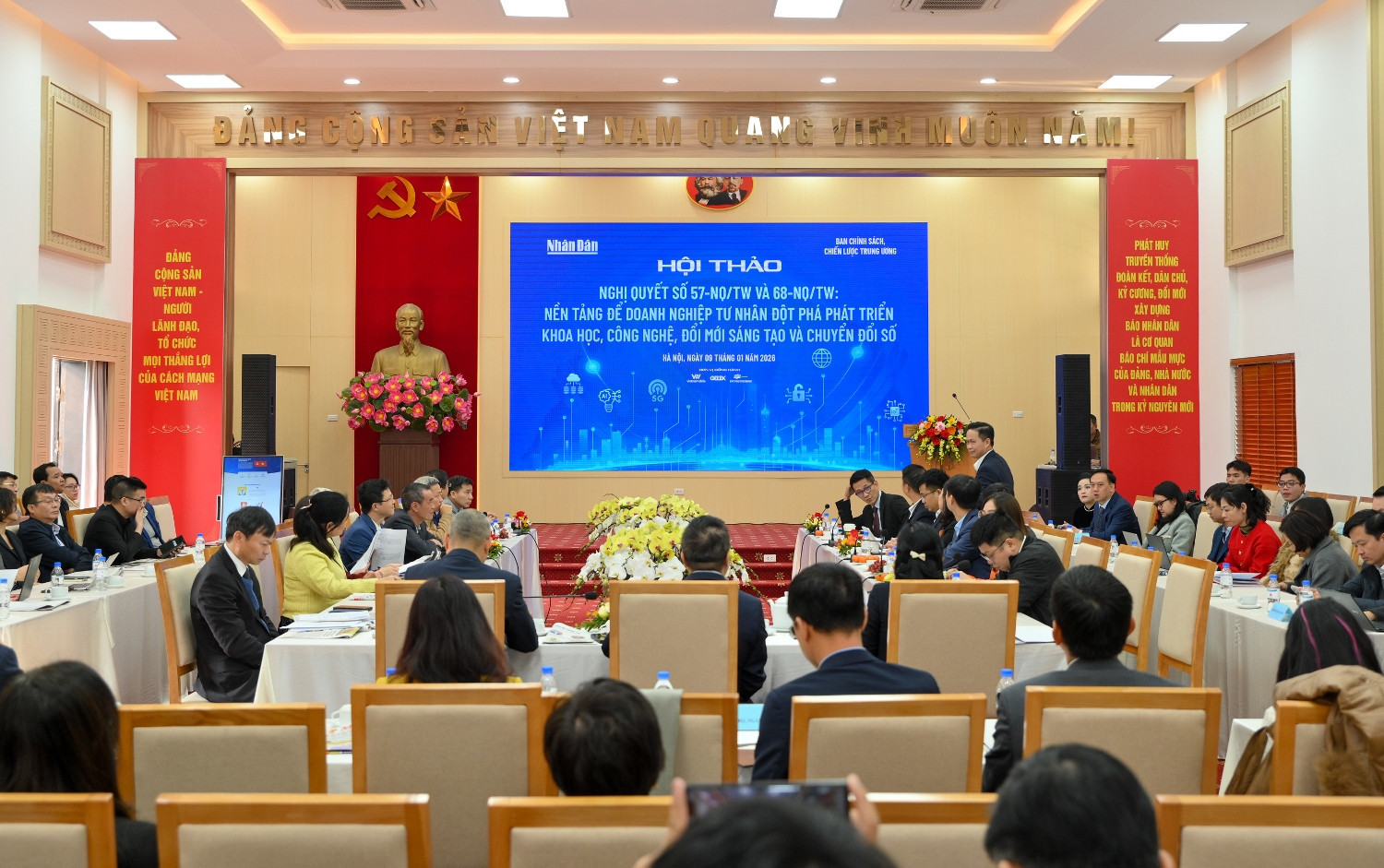
On the morning of January 9, Nhan Dan Newspaper, in coordination with the Central Policy and Strategy Commission, held a seminar themed “Resolution 57-NQ/TW and Resolution 68-NQ/TW: A foundation for private enterprises to break through in science, technology development, innovation and digital transformation.”
As Vietnam enters a new development phase with higher demands for rapid, sustainable and self-reliant growth, science, technology, innovation and digital transformation are increasingly affirming their role as key drivers of the economy.
Two major resolutions issued by the Party Central Committee - Resolution 57 on science, technology and innovation development, and Resolution 68 on private economic development - not only demonstrate the Party’s strategic vision, but also set out practical requirements to unlock social resources, especially from the private sector. The goal is for science and technology to truly move into production and the marketplace, becoming a core engine of economic growth.
Speaking at the seminar, Le Quoc Minh, Editor-in-Chief of Nhan Dan Newspaper, noted that one of the most important drivers of the socialist-oriented market economy in the coming period has been clearly identified by the Party as the private economy. This sector is regarded as the most important engine of the national economy, working alongside the state sector to create breakthroughs in innovation, develop the digital economy, green economy and circular economy, and participate deeply in global value chains to realize the aspiration of a prosperous and happy nation.
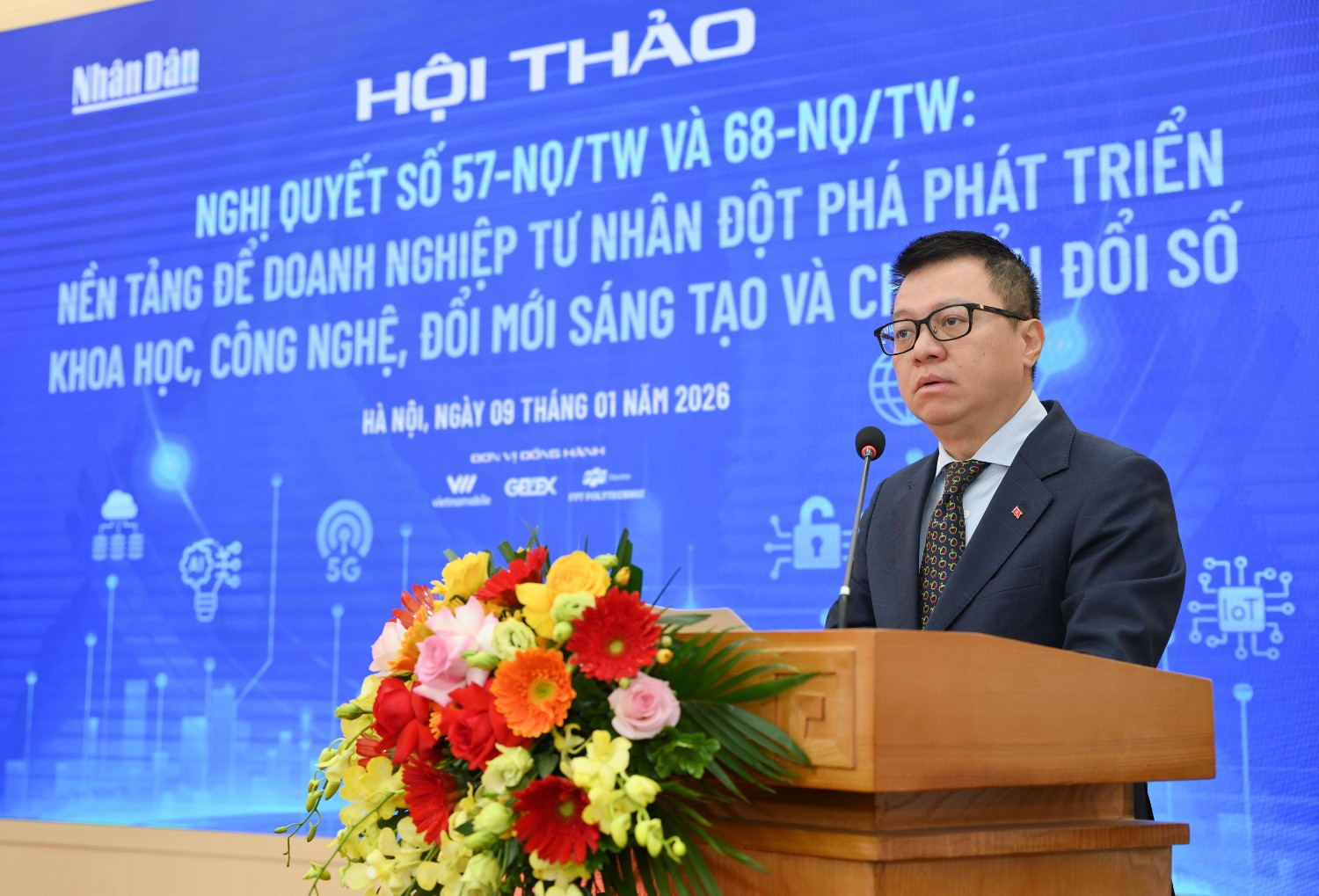
Le Quoc Minh, Editor-in-Chief of Nhan Dan Newspaper, delivers the opening remarks at the seminar.
In particular, the spirit of the draft documents for the 14th National Party Congress underscores strong determination to carry out national digital transformation, viewing it as a comprehensive revolution. The target is for the digital economy to account for more than 40% of GDP by 2035, with the formation of 10–15 “Make in Vietnam” digital technology conglomerates leading the innovation ecosystem. Many private enterprises are expected to pioneer the application of artificial intelligence, big data, blockchain and fintech to boost productivity and integrate into global supply chains.
From the business perspective, Nguyen Hien Phuong, CEO of Vietnamobile, said enterprises clearly see major opportunities and momentum from Resolutions 57 and 68.
According to Phuong, under Resolution 57, telecommunications companies are evolving into digital infrastructure and technology enterprises. Their roles are expanding, creating stronger incentives to apply new technologies and foster a more open innovation environment.
Resolution 68, meanwhile, affirms the status and equal rights of private enterprises. It emphasizes the role of the private economy in strategic infrastructure, ensures freedom of business and non-discrimination, and moves toward fair competition in access to resources.
For a private network operator, Phuong said, this is particularly important in terms of access to resources such as radio frequencies, shared infrastructure, data, and opportunities to participate in public-private partnerships for digital infrastructure, data centers and cloud computing.
Despite the clear opportunities, reality shows that most businesses remain cautious about investing in science and technology.
A survey by the Vietnam Chamber of Commerce and Industry (VCCI) indicates that 59.3% of enterprises expect to make profits in 2025. However, only 11.2% are projected to achieve profits as planned, while 40.7% generate no capital accumulation, merely break even or incur losses. About 69% report annual revenues below USD 400,000, and 51% plan to maintain their current scale over the next two years, reflecting a cautious mindset.
In this context, investment in science, technology and innovation - which requires large resources, long timeframes and entails high risks - has yet to become a priority for most businesses, especially small and medium-sized enterprises.
Notably, according to VCCI, 93% of enterprises say they struggle to predict changes in laws and policies. When policies shift rapidly and lack stability or predictability, businesses find it extremely difficult to develop medium- and long-term technology strategies and R&D investments. This represents an invisible but substantial barrier to innovation.
From this reality, VCCI observes several bottlenecks, including an institutional framework that leans more toward management and control than encouragement and risk-sharing. Incentive policies for R&D and technological innovation remain insufficiently attractive and difficult to access, while the legal framework for new technologies and business models has failed to keep pace with practice.
To unlock investment in science, technology and innovation, VCCI representatives argue that reform must begin with institutions, guided by three major orientations: shifting from a science and technology management mindset to building an innovation ecosystem; creating sufficiently strong financial incentives for enterprises to invest in technology; and ensuring a stable, transparent and predictable legal environment.
Dang Tung Son, Vice President and Chief Strategy Officer of CMC Technology Group, proposed assigning private enterprises to make focused investments in core technologies such as artificial intelligence, semiconductors, cybersecurity and national digital infrastructure. This approach would reduce pressure on public investment while attracting high-quality domestic and international capital. He also suggested building shared high-performance computing infrastructure operated under public-private partnership models.
In addition, he called for prioritizing public procurement of “Make in Vietnam” products developed by enterprises that have mastered core technologies, in order to create an initial market. Fair competition should be ensured, with priority given to private enterprises for projects they are capable of delivering, in line with the spirit of Resolution 68.
Nguyen Le
.svg)
