 Vietnamnet.vn

 Podcast



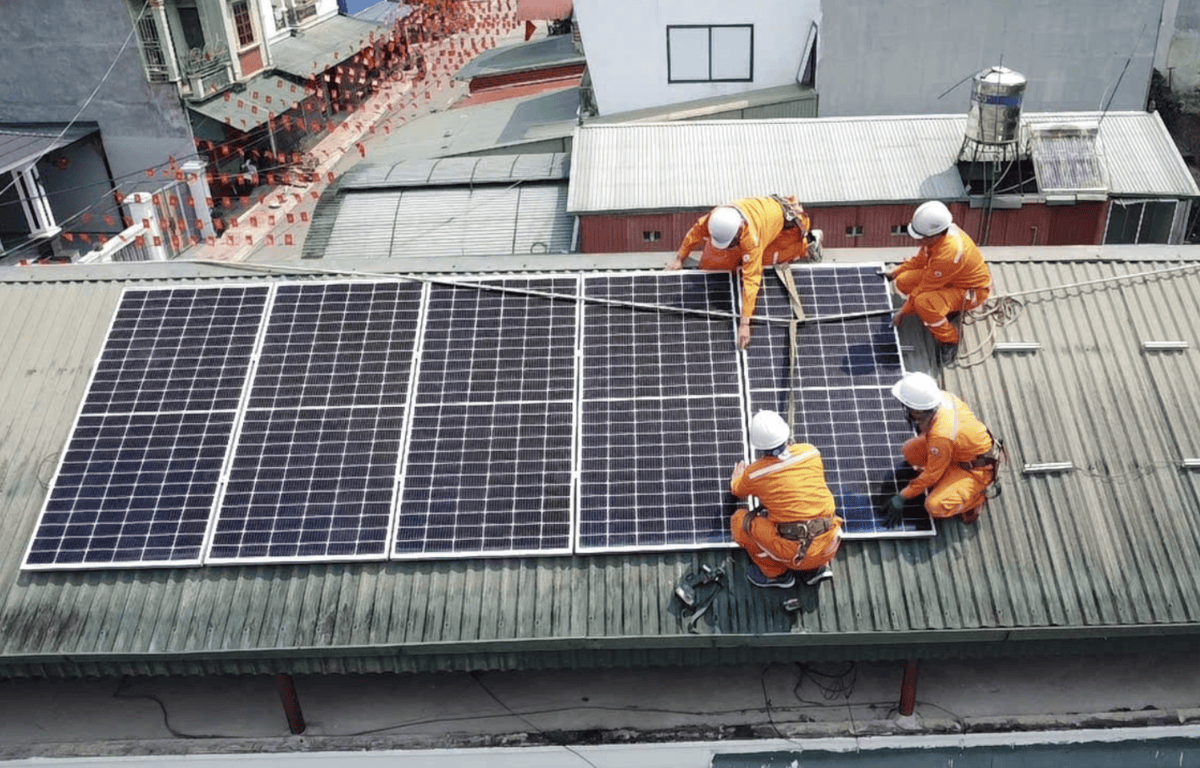
Hoang said that during days of scorching heat, the output harvested from solar power is sufficient for his family to use electrical appliances.
Hoang spent VND170 million to install a rooftop solar power system coupled with a BESS four years ago to capitalize on the solar energy source and reduce monthly electricity costs.
Currently, his family uses a large number of electrical appliances, including electric stoves, dishwashers, washing machines, clothes dryers, lighting systems, cooling fans, refrigerators, televisions and four large-capacity air conditioners. The elevator and electric vehicle charging also consume a massive amount of electricity each month.
Without rooftop solar power coupled with battery storage, his family’s electricity bill could escalate during peak hot months due to surging demand for electricity for cooling. The electricity prices are calculated on a progressive tiered tariff, peaking at 3,460 VND/kWh (excluding VAT).
Thanks to rooftop solar power, Hoang’s family can use electrical appliances during the day and use electricity from the storage battery at night. During the midday intense sunshine, his family takes advantage of the time to fully charge their electric car.
“At the end of the month, the electricity bill still drops sharply despite the scorching hot weather,” he said.
His family only spent about VND2 million on electricity in April. Prior to installation, his family’s summer electricity bills usually fluctuated from 5 to 6 million VND/month.
During the winter, although the intensity of solar radiation is lower than in the summer, the system still maintains a significant electricity output. Thanks to this, his family’s electricity bill only fluctuates from 700,000 to 900,000 VND/month.
The Northern Power Corporation (EVNNPC) reported that the development program for self-produced and self-consumed rooftop solar power continues to be heavily promoted, with 1,839 newly developed customers last April, with the total capacity to 62.9 MW.
For the first four months of this year, the entire corporation has 5,639 self-produced rooftop solar customers with a total capacity of 528.1 MW.
After the Government and the Ministry of Industry and Trade issued encouragment mechanisms, particularly Directive No10 of the Prime Minister, the movement of developing self-produced rooftop solar power has grown visibly across many localities.
Not only households, but many industrial manufacturing enterprises, commercial establishments, and service facilities have researched and deployed on-site energy solutions to reduce the pressure of electricity costs and increase autonomy in production and business activities.
Alongside the development trend of rooftop solar power, many households, enterprises, and manufacturing facilities have chosen to use battery energy storage systems (BESS) to maximize daytime solar power output while enhancing backup power capabilities when necessary.
In the 17 provinces and cities managed by EVNNPC, there are more than 1,450 rooftop solar power systems invested with integrated BESS, featuring a total storage capacity of approximately 8,600 kWh.
EVNNPC believes the combined model of rooftop solar power and storage systems is becoming a new energy trend for customer groups that have large load demands during the day or high requirements for power stability to serve production.
In addition, integrating a storage system not only helps customers enhance the harvesting efficiency of the solar power source, but also helps to optimize the operation of the internal electrical system, contributing to energy savings and improving electricity consumption efficiency.
EVNNPC stated that the investment and operational efficiency of a rooftop solar power system as well as a BESS depend on actual load demands, building technical conditions, and the electricity utilization plans of each individual customer. Therefore, customers need to carefully study their load demands, select appropriate technologies, and ensure full compliance with technical and safety requirements during the deployment process.
Recently, the Ministry of Industry and Trade issued Decision 963 regulating peak hours, off-peak hours, and normal hours of the national power system. Peak hours are in the evening from 5:30pm to 10:30pm daily, while off-peak hours are from midnight to 6am.
Accordingly, when the new electricity timeframes are applied, investing in and installing a rooftop solar power system coupled with a BESS will further help manufacturing enterprises and business establishments secure an autonomous power source for use in the evening, the peak time that commands the highest electricity prices ranging from VND3,640 to VND5,422/kWh.
Tam An
.svg)
