 Vietnamnet.vn

 Podcast



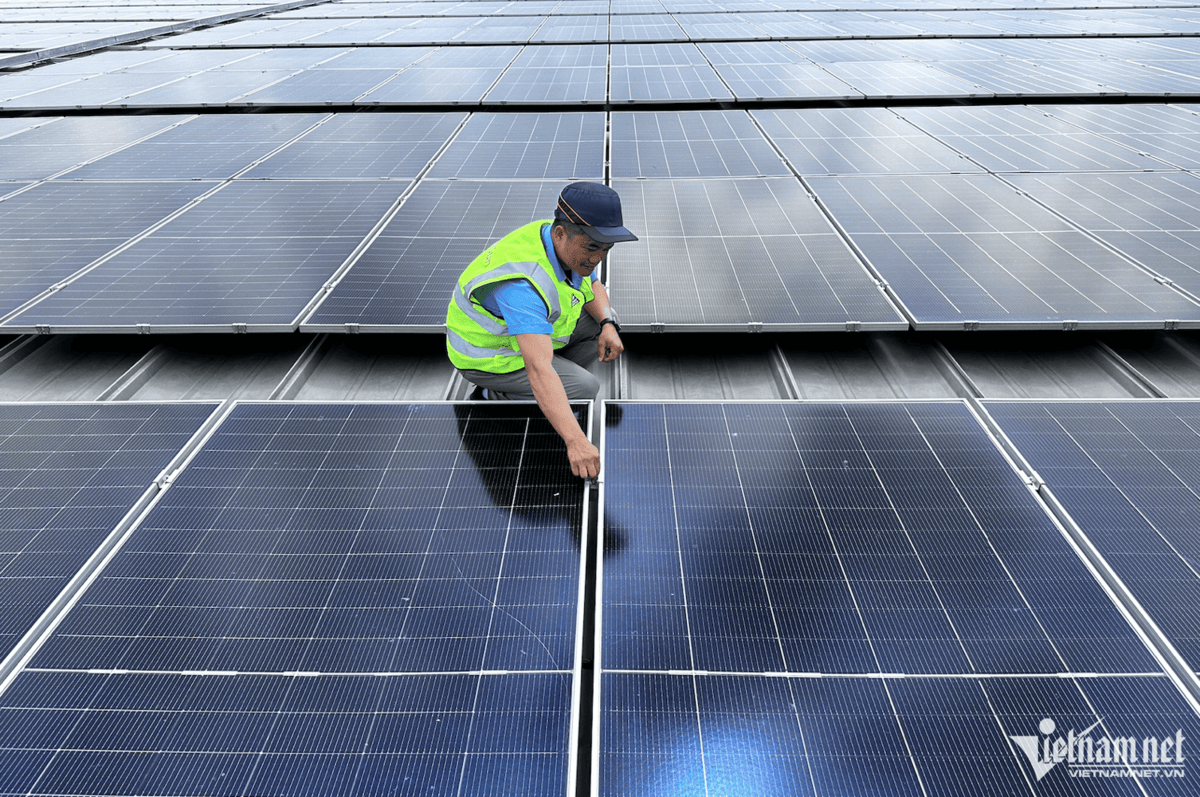
At Hai Yen Industrial Park (Quang Ninh province), most roof areas of five production factories of Ngan Long Science and Technology were fitted last September with thousands of solar panels.
With a capacity of nearly 20 MWp, the enterprise calculates this system can reduce monthly electricity expenses by VND 6–7 billion.
Self-generated power not only enables the business to secure energy for yarn production lines for export, but also contributes to meeting renewable energy and emissions reduction mandates.
At FLAT Vietnam (DEEP C Industrial Zone Complex, Hai Phong city), a rooftop solar system with a capacity exceeding 11 MWp has operated consistently for several months.
Typically, from around 6am to 5:00–6:00pm, production line operating hours coincide with peak solar generation windows.
FLAT reported that on hot, sunny days, the rooftop solar system achieves peak output exceeding 9 MW, equivalent to 80–85 percent of designed capacity, supplying roughly one-third of total factory electricity demand, which ranges between 30 and 35 MW.
On an average day, power generation maintains around 6.5–7 MW, depending on weather conditions.
Under current electricity tariffs, self-generated power from this system saves the company an average of roughly VND100 million per day, amounting to about VND3 billion over a 30-day month.
According to power corporations, through August 2026 the entire system recorded 134,410 self-producing and self-consuming rooftop solar installations with total installed capacity exceeding 11,450 MWp.
In industrial parks, export processing zones, industrial clusters and factories, over 12,200 rooftop solar systems with total capacity of 5,600 MWp account for roughly 48.9 percent of total self-producing and self-consuming rooftop solar capacity nation-wide.
Headquarters and government agency buildings account for an estimated 9,200 systems with total capacity near 940 MWp, representing about 8.2 percent of total rooftop solar capacity.
Remaining rooftop solar installations belong to households and business establishments.
Electricity of Vietnam (EVN) emphasized that total installation numbers and total self-producing and self-consuming capacity may be higher, as certain organizations and individuals have not yet submitted required notifications or registrations.
Rooftop solar installation currently attracts strong investment interest from citizens, enterprises, and government agencies. The clean energy source significantly reduces monthly power bills while granting partial energy autonomy for daily living and industrial production.
Do Van Nam from Northern Power Corporation (EVNNPC) said there are millions of square meters of industrial park rooftops in the north. However, the proportion of factory roofs fitted with self-producing and self-consuming solar systems remains disproportionate to thecpotential. A similar situation applies to residential households.
He noted that solar energy represents a green, clean power source for the North. During hot summer months, intense solar radiation in Northern Vietnam can supplement localized power supplies during peak heat periods.
In a recent report on electricity supply solutions for 2026–2030 and adjustments to Power Development Plan VIII, the Ministry of Industry and Trade (MOIT) assessed that national power grid supply in 2026 is expected to meet countrywide demand.
However, based on updated calculations determining annual peak capacity (Pmax) and output requirements, the ministry voiced concern over substantial power supply shortages, particularly across the Northern region. Specifically, deficits could reach approximately 4,256 MW in 2027 and nearly 14,000 MW in 2030 under adverse scenarios.
To ensure adequate power supply, one of the solutions proposed by MOIT is to assign targets to individual localities, particularly those in northern Vietnam, for developing self-generated, self-consumed rooftop solar power under Decree No243 and Directive No10 issued by the Prime Minister.
As an immediate measure, the state budget would be used to install self-generated, self-consumed rooftop solar systems at hospitals, schools and public agencies housed in state-managed properties, with a combined capacity of around 2,800 MW.
At the same time, the ministry encourages the installation of self-generated, self-consumed rooftop solar systems combined with battery energy storage systems (BESS) at industrial parks and industrial clusters, with a target of 3,000-5,000 MW across localities before the 2027 and 2028 dry seasons.
The ministry also requires rooftop solar systems to be installed at power plants and substations nationwide wherever suitable roof space is available.
MOIT has therefore proposed that the Ministry of Finance prioritize the allocation and approval of state budget estimates to develop self-generated, self-consumed rooftop solar systems at public agencies, administrative offices, production and business facilities, service establishments and households.
Tam An
.svg)
