 Vietnamnet.vn

 Podcast



 |
|
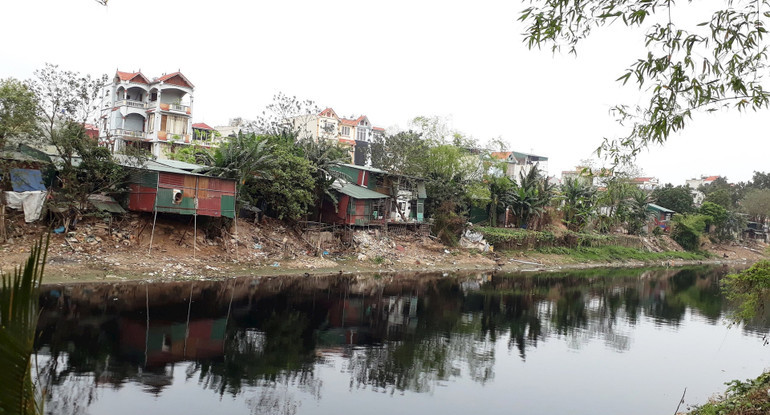
The Nhue River in Thanh Tri District, Hanoi, suffers from pollution and encroachment. Photo: Hai Mien/Nhan Dan |
Rivers and canals thickened with sludge, their waters black and slow, trash floating endlessly-that is the scene repeated across many provinces: Hanoi, Bac Ninh, Hai Duong, Ha Nam… Authorities have tried numerous measures, yet the rivers remain sick and gasping.
“It’s been years since I’ve known a day when the river didn’t reek,” sighed Le Van Viet, a resident of Lang Thuong Ward in Dong Da District, Hanoi, when speaking of the To Lich River-a waterway once immortalized in poetry and song. Historical records describe To Lich as one of Thang Long’s four vital waterways, essential to transport and fishing. Viet’s father once bathed there and carried its water to irrigate lush green herb gardens. Today, it is a dead river, its water perpetually black, rain or shine.
Hanoi’s other rivers-Set, Kim Nguu, Nhue-share the same fate. The Nhue, in particular, has been encroached upon and clogged with construction debris. Downstream in Ha Nam Province, the river is further poisoned by untreated wastewater. Despite countless inspections and meetings with local authorities in Thanh Oai and Thanh Tri districts, no lasting solution has emerged.
The Day River, originating in Hanoi’s Phuc Tho District and flowing through several provinces before emptying into the East Sea, fares no better. Data from the Center for Natural Resources and Environmental Monitoring (under Ha Nam’s Department of Natural Resources and Environment) show ammonium concentrations exceeding national limits by at least 53 times, while dissolved oxygen levels fall to just a third of safe thresholds.
The Bac Hung Hai irrigation system-once the pride of the Red River Delta, nourishing vast farmlands in Hanoi, Bac Ninh, Hung Yen, and Hai Duong-is now blackened and choked with garbage.
The Cau River and its tributary, the Ngu Huyen Khe, have long been the anguish of Bac Ninh residents. Elsewhere, waterways like the Pho Day (Vinh Phuc), Tra Giang and Ma (Thanh Hoa), Ba Bo Canal (Binh Duong), Dong Nai River, and the Tham Luong–Ben Cat–Rach Nuoc Len Canal in Ho Chi Minh City all struggle under mounting pollution.
Why are these arteries of life being poisoned daily? Nguyen Minh Khuyen, Deputy Director of the Department of Water Resources Management under the Ministry of Natural Resources and Environment, explained that domestic wastewater remains the main pollutant in major river basins. Industrial wastewater is somewhat controlled-about 89% of 280 industrial parks have treatment systems-but only 16.8% of 698 smaller industrial clusters have them operational. Even worse is wastewater from traditional craft villages, often dumped directly into canals and rivers without treatment, contaminating drinking water and fouling the air.
Agricultural runoff adds another layer of threat. By the end of 2023, Vietnam had over 12,000 livestock farms and more than 3,000 crop farms, producing an estimated 260 million cubic meters of wastewater annually-up 4.5% from 2022. Farm runoff carries pesticides, fertilizers, and other toxic residues. Each year, around 70,000 kg and 40,000 liters of pesticide chemicals, along with 70,000 kg of discarded containers, seep into the environment, worsening water pollution.
Experts also point to climate change and the lack of infrastructure to regulate water flow as key factors intensifying drought and stagnation. Combined with widespread littering and illegal dumping, river channels have become increasingly blocked, further degrading water quality.
A chronic illness and goals on paper
Cleaning up rivers and canals has never been easy. Some are briefly “treated” only to relapse; others seem to worsen after each intervention.
Take the case of the Cau River. In July 2006, the Prime Minister approved the “Master Plan for Protection and Sustainable Development of the Cau River Basin,” aiming to make the river “clean again by 2020.” A special interprovincial environmental committee was established to oversee its implementation.
At a review conference in December 2020, the Ministry of Natural Resources and Environment admitted that violations of environmental laws along the basin remained rampant. Many factories and craft villages continued to discharge waste illegally, often evading inspection through increasingly sophisticated tactics. Some local leaders still prioritized economic growth over environmental protection.
Authorities identified more than 4,000 pollution sources along the Cau River basin, including nearly 1,000 in Bac Ninh alone. Most were craft villages and industrial facilities releasing untreated wastewater. To this day, residents say the water has barely improved. “Sometimes I just wish we could stop chasing profit,” said Nguyen Van Lai from Phong Khe paper village, where the stench of chemicals fills the air. “It’s hard to breathe, hard to live.”
In Hanoi, efforts to clean and restore the city’s inner rivers-such as embankment works and limited sewage collection-have brought little visible improvement. According to Ngo Thai Nam, Deputy Head of Hanoi’s Environmental Protection Agency, about 90% of the city’s 400,000 cubic meters of daily wastewater and over 1,000 cubic meters of solid waste still flow untreated into lakes and rivers. The Yen Xa wastewater treatment plant, expected to open in 2022, has yet to begin operation. Four other major projects remain stuck in early investment phases.
Nam added that funding shortages continue to hinder progress. Although the city’s master plan envisions large-scale wastewater treatment plants capable of handling all domestic sewage, the budget cannot support them. For now, the targets that could transform daily life remain only on paper.
Associate Professor Dao Trong Tu, head of the Vietnam Rivers Network, summed it up bluntly: “The root problem is a lack of political will. If Hanoi truly wanted to, it could have restored the To Lich River years ago. The capital should lead by example. We have a heritage of rivers, but we have failed to protect and honor it.”
Nhan Dan
.svg)
