 Vietnamnet.vn

 Podcast



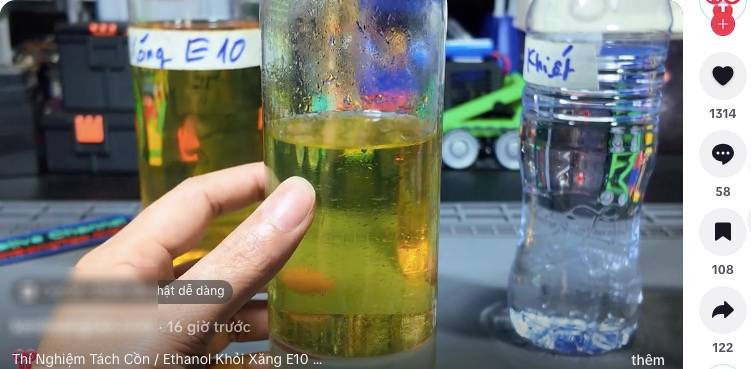
In recent days, E10 biofuel gasoline has become a hot topic across automobile and motorcycle forums as the roadmap to expand its use and eventually replace traditional A95 mineral gasoline draws closer.
The video clips have provocative titles such as “turn E10 into pure gasoline,” “remove alcohol to make your vehicle more powerful,” or “how to protect your engine from biofuel.”
In the videos, creators typically prepare a transparent plastic bottle, pour E10 gasoline into it, then add water and shake the mixture vigorously for several minutes. After the mixture settles, the liquid layer at the bottom is claimed to be a mixture of water and ethanol, while the upper layer is described by many as “pure gasoline”.
Some videos even provide detailed instructions on water ratios, shaking duration, or the use of salt and desiccants to “completely separate the alcohol”. Several clips have reached hundreds of thousands of views and thousands of interactions within only a few days.
Many comments under these videos claim that removing ethanol helps “restore clean gasoline,” allowing vehicles to run more powerfully, reduce fuel consumption, or avoid damage to older engines. The process is also portrayed as a simple yet effective way to reduce ethanol content in E10 fuel.
These videos clearly tap into the concerns of some users, particularly because ethanol absorbs moisture, while many vehicle owners have long been accustomed to conventional mineral gasoline. In particular, many drivers of older vehicles believe that E10 may make engines feel less responsive or affect rubber components and fuel lines.
However, according to experts, the “tips” spreading on social media oversimplify the nature of biofuel gasoline and could create a range of risks if people attempt to use these “self-extracted” fuels.
Experts warn of risks
Vu Thi Tan from the School of Chemistry and Life Sciences at Hanoi University of Science and Technology explained that ethanol is indeed soluble in water. However, in E10 gasoline, ethanol is blended according to specific technical standards and ratios to create a stable fuel mixture. Using water to extract ethanol out of gasoline is not as simple as many videos suggest.
In other words, when users add water to gasoline and shake it vigorously, they are actually altering the fuel’s structure. The resulting mixture no longer meets the original technical standards of E10 gasoline established by manufacturers. Even if part of the ethanol can be separated, this does not mean the engine will become more powerful or operate more efficiently.
“Once ethanol has been blended into gasoline at a certain ratio, it is very difficult to completely separate it simply by shaking it manually for a few minutes,” the expert explained.
Ethanol in E10 gasoline is not included solely for environmental purposes; it also plays a role in optimizing combustion performance. Removing this component manually may alter the fuel’s octane rating, volatility, and stability.
More concerningly, adding water or chemicals into gasoline may contaminate the fuel. If residual water or ethanol enters the fuel system, vehicles may stall, misfire, or suffer corrosion of internal components.
Beyond technical risks, fire and explosion hazards are also major concerns because gasoline evaporates easily and is highly flammable. Most instructional videos are filmed using plastic bottles, enclosed spaces, or areas near heat sources without proper safety measures.
Experts warn that attempting to mix or separate fuel at home could result in fires, explosions, or health hazards from prolonged exposure to gasoline and ethanol vapors.
From a legal perspective, E10 gasoline is a fuel product blended according to technical standards and quality inspections before being distributed on the market.
According to lawyer Duong Duc Thang from the Hanoi Bar Association, once users alter the fuel composition themselves, the original technical properties can no longer be guaranteed. As a result, if an engine is damaged due to the use of modified fuel, the vehicle owner may lose warranty or insurance coverage.
Notably, unauthorized fuel extraction, mixing, or trading of non-compliant fuel products may lead to administrative penalties ranging from several million to hundreds of millions of Vietnamese dong, depending on the severity and scale of the violation, under Decree 99/2020/ND-CP. In serious cases, criminal liability may also apply.
Hoang Hiep
.svg)
