 Vietnamnet.vn

 Podcast


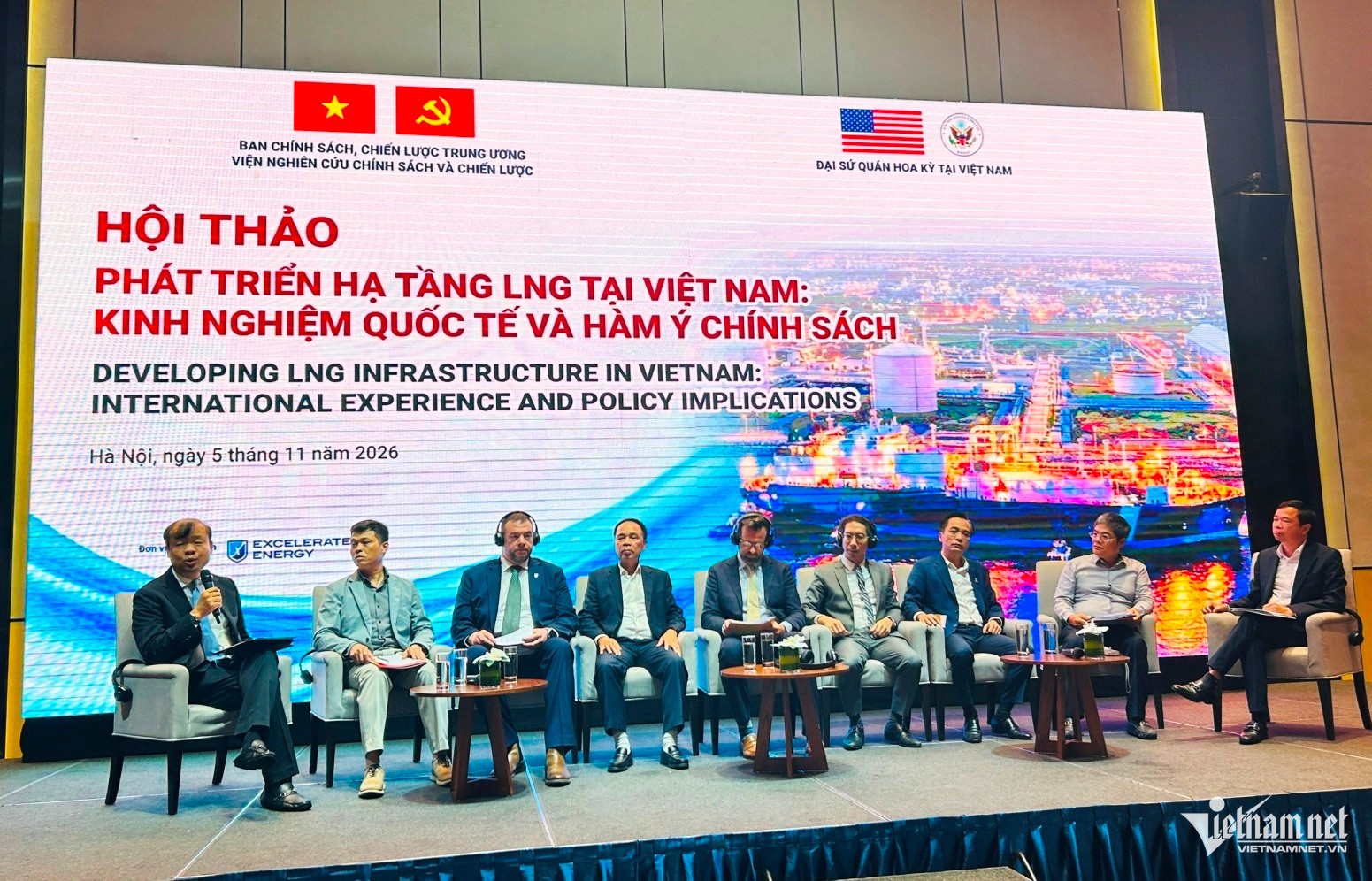
To develop LNG-fired power generation, Vietnam needs coordinated LNG infrastructure, improved policies, shared import terminals, and connectivity across the entire supply chain.
Nguyen Van Phuong, Deputy Head of the Central Commission for Policy and Strategy, said Vietnam has made important progress in developing its LNG supply chain in recent years.
The Thi Vai LNG terminal and Nhon Trach 3 and Nhon Trach 4 power plants have entered operation, providing a practical foundation for LNG development. Many domestic and international energy corporations are also pursuing investments in LNG terminals and power generation facilities while seeking to secure long-term gas supplies.
However, compared with the requirements of the revised Power Development Plan VIII, these achievements represent only an initial step, with many projects still facing delays.
Phuong pointed out several major challenges in developing LNG infrastructure. These include determining the appropriate scale of development amid market volatility and the energy transition; ensuring coordination across the entire supply chain, from LNG terminals and pipelines to power plants, transmission grids and end-user markets; and mobilizing capital while allocating risks for projects involving substantial investment and long payback periods.
He said such projects require stable and predictable policy frameworks. It is necessary to select appropriate investment models and establish transparent, stable institutional frameworks based on the principle of balancing benefits and sharing risks among the State, businesses, investors and energy consumers.
Huynh Quang Hai, Deputy General Director of PV GAS, identified several bottlenecks in Vietnam's LNG infrastructure development.
He said investment models remain fragmented, failing to fully capitalize on shared infrastructure. Connectivity between regions is limited, and operational arrangements lack flexibility in handling unexpected situations. This could create risks of boil-off gas (BOG) being flared, storage tanks reaching capacity or fuel shortages.
Another issue is that LNG supplies currently rely mainly on spot contracts, with few long-term arrangements to secure stable supplies. As a result, supply operations face risks from price volatility and disruptions, particularly amid geopolitical instability.
There are regulations on minimum long-term contracted volume (Qc) for LNG power plants, but Hai said there is still no mechanism guaranteeing that this contracted output will be dispatched. This has left businesses without a sufficient basis to enter into long-term LNG supply agreements.
Centralized LNG terminals and coordinated pricing and contracts needed
To address these bottlenecks, Hai proposed investing in centralized LNG terminals, together with backbone pipeline systems connecting the terminals to one another and to power plants and other consumers.
He said this would help establish national technical infrastructure for LNG-fired power generation and develop energy and eco-industrial hubs, in line with the direction set out in Resolution No70-NQ/TW.
Regarding policies, he proposed introducing regulations to guarantee the dispatch of the contracted Qc output, giving businesses a basis for securing long-term LNG supply agreements that ensure stable, continuous supplies at competitive prices. He also called for a strategy to diversify LNG sources through long-term contracts, ensuring national energy security amid geopolitical disruptions.
Sharing the view that infrastructure must be developed in a coordinated manner, Nguyen Tai Anh, Deputy General Director of Vietnam Electricity (EVN), said three factors are crucial to effectively dispatching LNG projects and ensuring reliable power system operations.
First, LNG projects must match the power system's requirements in terms of capacity, location and scale, while being supported by synchronized grid infrastructure to transmit electricity.
Second, synchronization must be ensured across the entire LNG supply chain, from fuel sources and LNG terminals to regasification facilities, gas pipelines and power plants.
Anh said each power plant should not have to develop its own LNG import terminal, as the investment costs are enormous and could reach billions of US dollars. Instead, projects should take advantage of economies of scale while considering energy security and safety requirements, as well as connectivity among facilities across the entire system.
Third, electricity pricing mechanisms, gas supply contracts and power purchase agreements (PPAs) must be aligned with electricity market regulations.
Deputy Minister of Industry and Trade Nguyen Viet Son said LNG infrastructure development must be linked to planning and actual consumption demand, with investment scale, locations and phases determined in line with power plant construction schedules and industrial demand in each region.
In addition, synchronization between the gas and electricity markets needs to be strengthened. LNG supply contracts, infrastructure service agreements and power purchase agreements must be aligned in terms of volumes, durations and implementation schedules.
Nguyen Le

