 Vietnamnet.vn

 Podcast



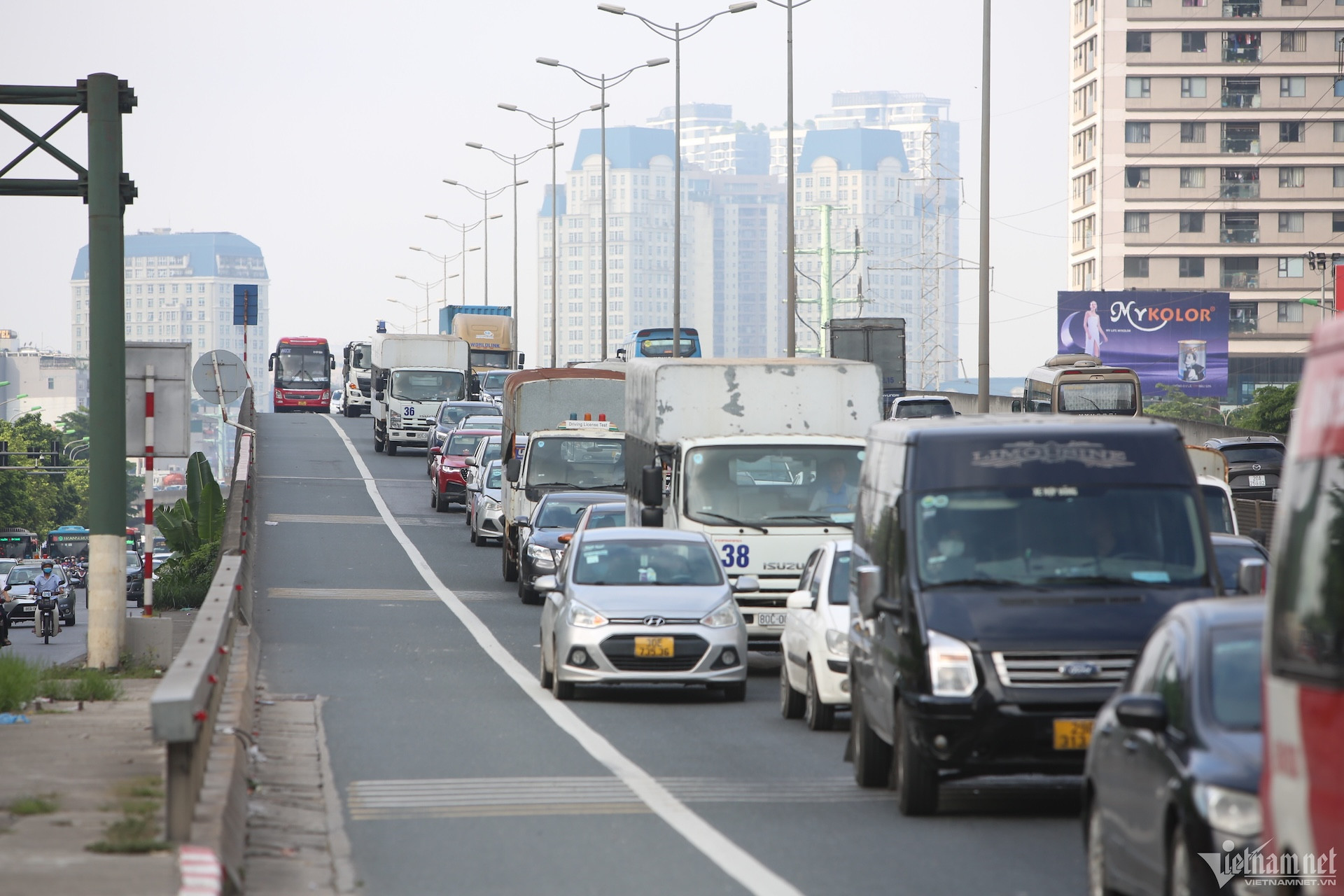
Hanoi should consider this option and review the design documents and assess the infrastructure’s load-bearing capacity.
Shortly before Tet this year, I drove my car into the emergency lane on Ring Road 3. The friend sitting beside me reminded me, “You’re in a restricted lane.” I explained that on that day, authorities allowed vehicles to use the lane until 6 am the following morning to ease traffic for people heading home for Tet.
Those who regularly travel on Ring Road 3 understand why such a measure is sometimes introduced. During rush hours or ahead of long holidays, the two traffic lanes can be packed for several kilometers while the emergency lane on the right remains empty.
The Traffic Police Department recently proposed that Hanoi study the organization of three traffic lanes in each direction, remove the emergency lane, and lower and standardize the operating speed across the entire route.
The proposal stems from daily traffic pressure. According to the Traffic Police Department, on peak days, traffic volumes on Thanh Tri Bridge and Ring Road 3 can reach around 122,000 vehicle trips per day, nearly 8.1 times the designed traffic volume. For a route that is frequently congested, making better use of the existing road surface is an option worth studying.
The figure of 8.1 times the design volume shows that the total number of vehicles using the route has far exceeded initial projections.
Sustained high traffic volumes can cause the bridge deck, expansion joints, bearings and other components to deteriorate more quickly. When an additional lane is opened, loads on the bridge deck will also be redistributed. The most important issue is what happens during congestion, when three rows of trucks could potentially be stationary on the same bridge span.
The emergency lane may already have been taken into account in the original design documents. However, the number of lanes marked on the road surface alone is not enough to determine whether the structure can safely support three regular traffic lanes. This must be confirmed through technical design documents and inspections of the structure’s current condition.
The Phap Van-Mai Dich section was put into operation in 2012. After years of carrying extremely heavy traffic, the route has undergone several rounds of maintenance and repairs.
In 2020, media reports revealed over 50 displaced bridge bearings and roughly half of expansion joints showing signs of damage, prompting subsequent repair work. Through 2024–2025, Hanoi continued road surface resurfacing and structural repairs on the bridge.
Such repair work is normal for infrastructure subject to heavy use. The maintenance history also provides important data for assessing the current condition of the bridge before changing the way traffic is organized.
The Traffic Police Department monitors traffic flows on a daily basis, giving it the ability to identify bottlenecks and propose traffic-management measures. Assessing load-bearing capacity, however, requires the involvement of infrastructure management agencies, inspection units and structural engineers. A traffic-management proposal will be more convincing when it is accompanied by technical conclusions.
The main viaduct sections of Ring Road 3 were invested in under the system managed by the Ministry of Transport and were later handed over to Hanoi for management, operation and maintenance. The city needs to coordinate with the agencies that previously managed the projects to collect design documents, as-built drawings, repair records and monitoring data.
Pilot trial during peak hours
The review should clarify several issues: What load conditions was the structure originally designed for? To what extent can the emergency lane be used regularly? What is the current condition of the bridge spans? And would three rows of vehicles stopping simultaneously on a bridge fall within the safety limits?
Once these questions have clear answers, Hanoi will have sufficient grounds to consider the Traffic Police Department’s proposal.
If the infrastructure meets technical requirements, Hanoi could select several suitable sections for a pilot during peak hours. Initially, only five-seat passenger cars should be allowed to use the lane, with all other vehicles, including buses, container trucks and trucks, strictly prohibited.
A lower speed limit should also be applied, while electronic signs could be used to control when the lane is opened or closed. Rescue and emergency response arrangements would also need to be carefully prepared.
Tu Giang
.svg)
