 Vietnamnet.vn

 Podcast



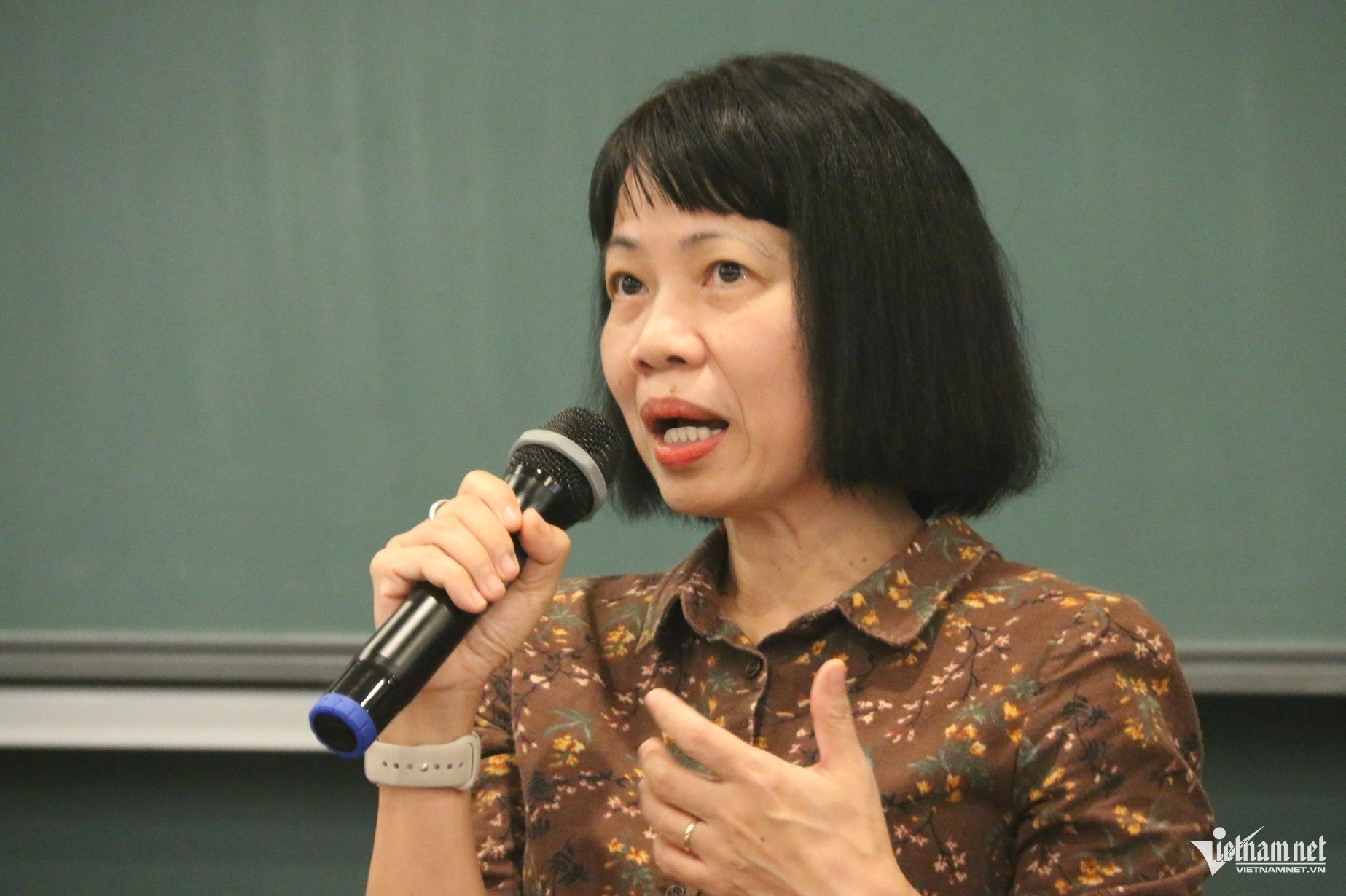
Speaking at the event organized by the Institute for Advanced Studies in Mathematics and Anbooks on November 1, Le Thi Mai Huong, principal of Ban Mai Primary School (Hanoi), said that AI has penetrated schools at different levels.
“Since AI came into play, the gap in teachers’ competence has increased greatly. Some teachers use AI effectively and skillfully, but others make me genuinely worried when I observe their classes. They think they are using AI correctly or teaching properly, but they’re not,” Huong said.
According to Huong, AI is used now as a tool in education, especially for teachers, from lesson planning and idea generation to designing tests and using games for assessment.
At her school, 3-4 training sessions have been organized so that teachers have a general view and understanding of AI, learn each software and application, and practice and report.
“The issue is then controlling how teachers act after the training. Some teachers return to traditional teaching because they lack IT capacity to continue, or have no time to build a lesson, often taking ready-made and processing it. That is a worrying reality. In the school management role, I must accompany teachers by practicing, checking and daily controlling,” Huong said.
Dr. Nguyen Phu Hoang Lan, a lecturer at University of Education, a member school of Vietnam National University Hanoi, believes that currently, students can be lazy to think and reflect; but a portion of teachers are also lazy.
“When we read lesson plans or even theses prepared by teachers, we detect many parts written by AI. Even simple titles are sometimes unedited by them. Members of the review council often complain that students could not have worked in certain fields, and the titles were likely generated by AI,” Lan said.
Lan warned that using AI incorrectly for a long time will gradually lose thinking ability.
Prof Ho Tu Bao (Advanced Institute for Mathematical Research) believes that whether people like it or not, AI is still positioned in daily life. According to Bao, if humans can cooperate with AI correctly, they will be much stronger than humans alone, otherwise, it will cause harm.
“In my classes, I often tell my students that if they rely on AI to answer questions or do assignments for several years in school, it will become a habit. After graduation, they still have decades of learning and working ahead. If they misuse AI and are not honest with themselves, misunderstanding how to use it, the consequences will last a lifetime,” Bao said.
Hoang Anh Duc, a researcher at RMIT Vietnam, noted that information or solutions people generate themselves are remembered 30–50 percent better than information they read passively. When using AI, they skip that process. This means that the brain receives the answer instantly, bypassing the cognitive consolidation stage.
“It’s like laying bricks with mortar, You need time for the mortar to dry for the wall to be solid. If we depend too much on AI and rush the process, our brains become ‘soft,’ like a wall that never sets,” Duc said.
He also pointed out another risk: forgetting that AI is only a support tool, and gradually becoming dependent on it. This dependency weakens people’s resilience in the face of challenges.
“The brain’s addiction cycle goes like this: face a difficult problem → use AI → fail to develop problem-solving skills → face a similar issue and rely on AI again → lose confidence. As a result, we cannot master skills that require long-term effort and practice, such as languages or musical instruments. Children, too, tend to give up easily when facing difficulties,” Duc said.
Le Thi Mai Huong said the question she always ponders most is what and how to teach. “Now, the answer for ‘what to teach’ must change. Now we need to not only teach knowledge but also to teach students how to think and develop skills,” Huong said.
To do that, teachers also need experience, practice and capacity before teaching students. Even parents must learn and be taught to accompany teachers and schools.
Experts all believe that suggestions and guidance from AI should only be seen as initial openings. Then students and teachers need to read more materials and supplementary knowledge, especially ask more critical questions about information AI provides.
Thanh Hung
.svg)
