 Vietnamnet.vn

 Podcast



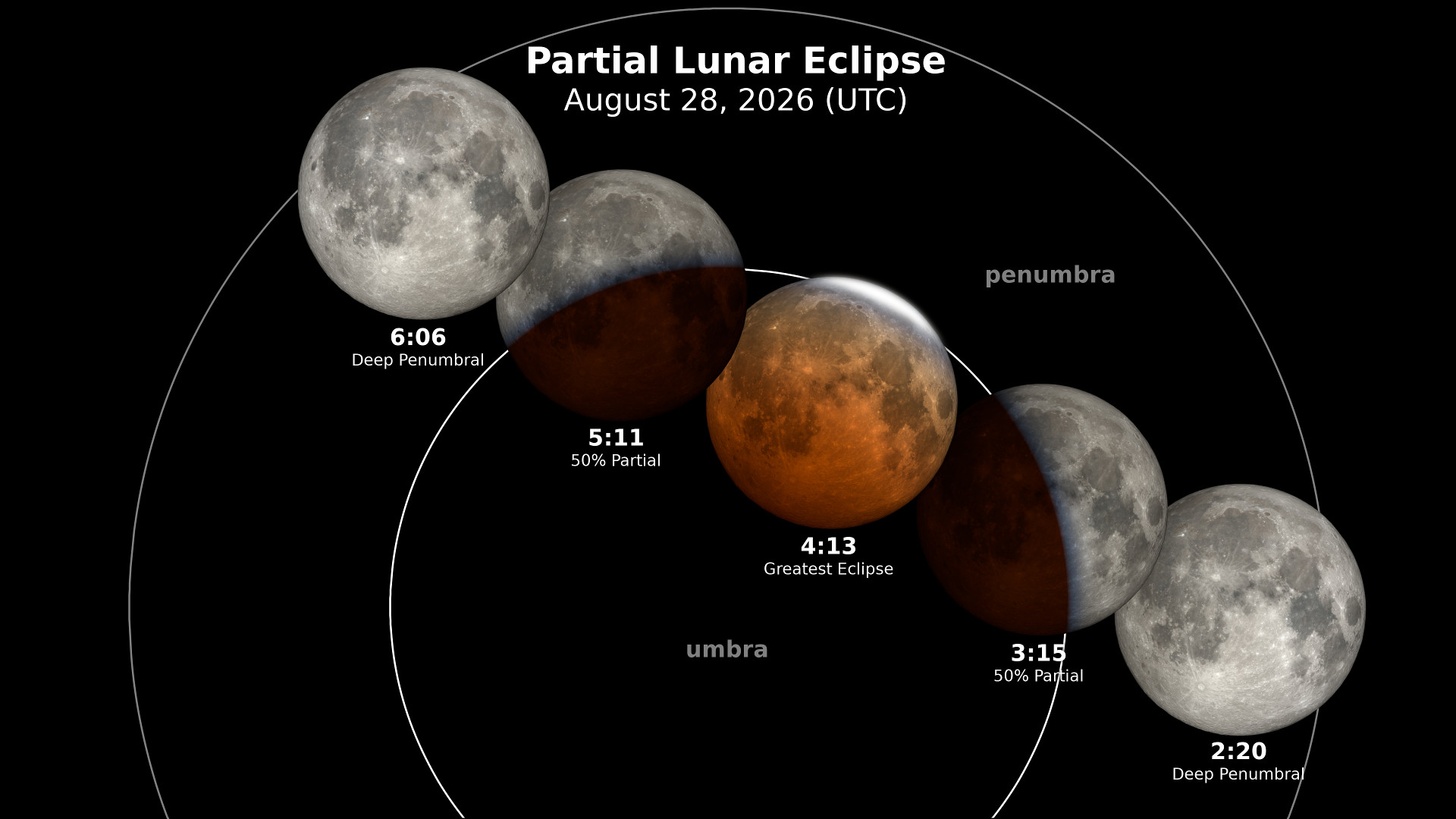
During the night of August 27 into the early hours of August 28, Earth’s shadow will cover as much as 96% of the Moon’s surface, creating one of the most remarkable astronomical events of 2026 - a partial lunar eclipse.
As it moves into Earth’s shadow, the Moon could take on a beautiful deep-red hue because sunlight is filtered and refracted by Earth’s atmosphere before reaching the lunar surface.
A partial lunar eclipse occurs when Earth moves between the Sun and the Moon during the monthly full moon. Earth’s dark inner shadow, which has a curved edge, then gradually sweeps across the lunar surface.
At the eclipse’s peak, almost the entire lunar disk will be enveloped by Earth’s shadow, leaving only a small crescent directly illuminated by sunlight.
Not everywhere on Earth, however, will get to witness the spectacle. Visibility depends entirely on geographical location and whether the Moon is above the horizon while the eclipse is taking place.
Around 3.3 billion people could witness the eclipse
According to forecasts, the partial lunar eclipse on August 27-28 will be visible from large parts of North and South America, as well as portions of Europe and Africa, putting around 3.3 billion people within the potential viewing zone.
The phases of a lunar eclipse occur simultaneously for observers around the world. However, the local times at which the Moon begins to enter Earth’s shadow, reaches maximum eclipse and then emerges will vary depending on time zone and location.
On the US West Coast, cities such as Los Angeles, California, and Portland, Oregon, are expected to enjoy relatively favorable viewing conditions.
The eclipse will reach its maximum only a few hours after sunset, making it easier for observers to follow the Moon as it hangs in the night sky.
In US East Coast cities such as New York and Jacksonville, meanwhile, astronomy enthusiasts will have to stay up later.
Maximum eclipse is expected around midnight local time, producing a striking astronomical display in the middle of the night.
For the United Kingdom, much of Europe and many parts of Africa, the eclipse will unfold in the early morning.
By then, the Moon will be fairly low above the western horizon and moving closer to moonset.
Observers in these regions will therefore need to find a location with an unobstructed view toward the west if they hope to follow the event in full.
Tall buildings, mountains or other terrain blocking the horizon could make viewing more difficult, particularly during the final stages of the eclipse.
Those who want to know the exact timing of each phase and the Moon’s altitude above the horizon at their location can consult detailed astronomical schedules on TimeandDate.
This can help viewers determine when to begin watching and which direction to face.
No protective glasses needed for a lunar eclipse
Unlike a solar eclipse, a lunar eclipse is completely safe to watch with the naked eye. Viewers do not need special filters or protective eyewear.
During the eclipse, the Moon can create a particularly striking sight as its illuminated surface is gradually swallowed by Earth’s shadow.
Once most of the lunar surface is immersed in shadow, its color may shift to red, orange or deep crimson.
The effect comes from the way Earth’s atmosphere interacts with sunlight.
As sunlight passes through the atmosphere, shorter blue wavelengths are scattered more readily, while redder wavelengths are better able to pass through and are bent into Earth’s shadow.
Some of that red light then reaches the Moon, giving it its distinctive reddish appearance.
The eclipse can be enjoyed entirely with the naked eye. Binoculars or a telescope, however, can make the experience even more rewarding, particularly for watching the boundary between light and shadow slowly move across the Moon’s craters, plains and other surface features.
Not everyone around the world will be able to witness the August 2026 lunar eclipse.
In places experiencing daylight while the eclipse is underway, the Moon will be below the horizon and therefore impossible to see directly.
That leaves a number of countries, including Australia, India, China and Japan, outside the eclipse’s direct viewing zone.
This is an inherent feature of lunar eclipses. Although an eclipse can last for several hours and, in theory, half the Earth may be facing the Moon, only regions experiencing nighttime with the Moon above the horizon can actually see it.
As a result, at the same moment, people in one country may be watching the Moon turn red overhead while those elsewhere see no sign of the phenomenon at all.
August 2026 eclipse offers rare chance to see a red Moon
With maximum coverage reaching 96%, the partial lunar eclipse on August 27-28 is expected to produce a remarkable sight.
Although it will not technically be a total lunar eclipse, most of the Moon’s disk will be immersed in Earth’s shadow, making the event appear remarkably close to a total eclipse from locations with favorable viewing conditions.
The Moon’s red color could be an especially dramatic feature.
Just how red it becomes will depend on conditions in Earth’s atmosphere at the time of the eclipse.
Dust, clouds and atmospheric particles can influence how much red light reaches the Moon, causing its color to range from pale orange to deep crimson.
Astrophotography enthusiasts can also use the event as an opportunity to capture images of the Moon.
A DSLR or mirrorless camera paired with a long focal-length lens, a tripod and suitable exposure settings can record the progression of Earth’s shadow as it gradually moves across the lunar surface.
The eclipse will also be one of the more notable lunar events before an even more unusual spectacle arrives on New Year’s Eve 2028-2029, when a total lunar eclipse is expected.
Hai Phong
.svg)
