 Vietnamnet.vn

 Podcast



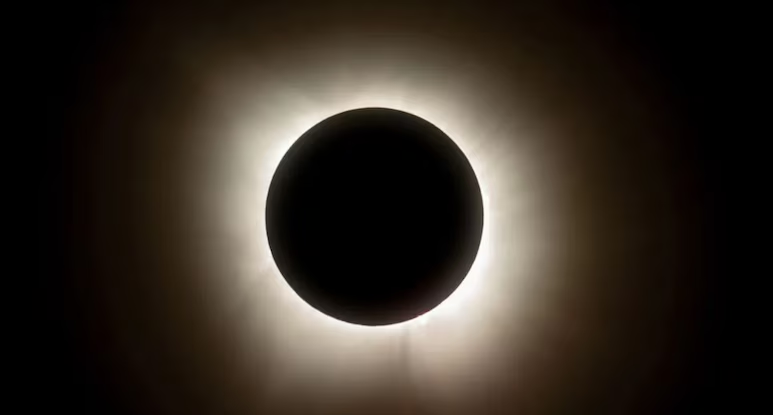
A solar eclipse occurs when the Moon moves between Earth and the Sun, casting its shadow onto our planet. During a total solar eclipse, the Moon completely covers the Sun's visible disk.
The phenomenon is possible because of an extraordinary coincidence of size and distance. The Sun's diameter is roughly 400 times that of the Moon, but it is also around 400 times farther from Earth. As a result, the two objects appear almost the same size in our sky.
Jack Welch, a guide at the Robert Ferguson Observatory in Sonoma County, California, explains that this similarity allows the Moon, under the right circumstances, to cover the Sun almost perfectly and create a total eclipse.
So why does this not happen every month?
The answer lies in the Moon's orbit. Its orbital plane is tilted by about five degrees relative to Earth's orbit around the Sun. During most new moons, therefore, the Moon does not pass precisely along the line between Earth and the Sun. Its shadow usually passes above or below our planet.
Only when the three celestial bodies align closely enough does the Moon's shadow sweep across Earth's surface and produce an eclipse.
The distance between Earth and the Moon also matters. The Moon follows a slightly elliptical orbit, meaning its distance from Earth changes over time. When it is farther away, it can appear too small to completely cover the Sun even when the three bodies are almost perfectly aligned.
Instead of a total eclipse, this produces an annular eclipse, leaving a brilliant circle of sunlight around the Moon commonly known as the “ring of fire.”
Where will the Aug. 12 eclipse be visible?
The Aug. 12, 2026 eclipse will begin over remote parts of the Arctic before the path of totality crosses Greenland, Iceland, part of northern Russia, the Atlantic Ocean, Spain and a small area of northwestern Portugal.
Totality will begin at the first location at around 4:58 p.m. UTC and end at the final location at around 6:34 p.m. UTC. The eclipse will reach its maximum at approximately 5:46 p.m. UTC, or 12:46 a.m. on Aug. 13 in Vietnam.
Near the center of the path, totality can last for up to around two minutes and 18 seconds.
The Sun's position in the sky will vary considerably depending on the viewing location.
Emily Watson, an astrophysicist and planetarium supervisor at the US Space & Rocket Center, said Iceland and Greenland will experience totality while the Sun remains relatively high in the late-afternoon sky. In Spain, by contrast, totality will occur shortly before sunset.
A low Sun near the horizon could make the eclipse in Spain particularly dramatic. But it also presents challenges: mountains, buildings, trees or clouds near the horizon could easily block the view. Observers will therefore need a location with an unobstructed view toward the west.
Outside the path of totality, a partial eclipse will be visible across a broad area of the Northern Hemisphere. In Alaska and northern Canada, it will occur in the morning.
Parts of the northern US and eastern Canada will see the eclipse around midday and into the afternoon, while much of Europe and West Africa will experience it in the evening.
Vietnam is entirely outside the eclipse's visibility zone.
Where to watch the total solar eclipse live online
Those unable to reach the eclipse path - or anyone facing cloudy skies - can follow the event through several free livestreams.
NASA will host a dedicated eclipse broadcast beginning at 5:15 p.m. GMT on Aug. 12, or around 12:15 a.m. on Aug. 13 in Vietnam.
The broadcast will feature live images from multiple cameras positioned along the eclipse path, allowing viewers to follow totality from different locations rather than relying on a single observation point.
NASA will also provide scientific context, explaining how eclipses occur and what researchers can learn about the Sun during the event.
The broadcast will be available through NASA's YouTube, Twitch, NASA+, Facebook and Instagram channels.
Time and Date will also livestream the eclipse, beginning at 5 p.m. GMT, or midnight on Aug. 13 in Vietnam.
Its coverage will feature live images from León in northwestern Spain and the island of Mallorca, both offering favorable locations for observing the eclipse.
Journalist Anne Buckle and astrophysicist Graham Jones will provide live commentary, combining views of the eclipse with explanations of the astronomy behind the phenomenon.
The European Space Agency (ESA) will offer another official broadcast through ESA Web TV and YouTube, beginning at 5:30 p.m. GMT, or 12:30 a.m. on Aug. 13 in Vietnam.
The livestream will combine expert scientific commentary with telescope images from the Javalambre Astrophysical Observatory near Teruel, Spain.
The observatory lies close to the path of totality, giving online viewers an opportunity to experience one of the eclipse's most spectacular phases through professional telescopes.
Why is a total eclipse so different from a partial one?
During a partial solar eclipse, the Moon covers only part of the Sun. Even if 99% of the solar disk is obscured, the tiny portion that remains visible is bright enough to keep the sky relatively illuminated and overwhelm the Sun's faint outer atmosphere, known as the corona.
During totality, everything changes.
Daylight rapidly fades to something resembling twilight. The Moon appears as a completely black disk surrounded by the ethereal white glow of the corona. It is one of the rare opportunities to clearly see the Sun's outer atmosphere, normally hidden by the intense brightness of its surface.
Animals may also react to the abrupt change in light. Birds can suddenly fall silent and then begin singing again as the light returns, almost as if dawn has arrived regardless of the actual time of day.
Watson describes totality as an almost “all-or-nothing” experience. Seeing it firsthand can be extraordinary and awe-inspiring, while even a deep partial eclipse cannot reproduce the same effect.
Are total solar eclipses really rare?
On a global scale, total solar eclipses are not exceptionally rare. On average, one occurs somewhere on Earth roughly every 18 months.
What makes them seem rare is the narrow path of totality, which is typically only tens of kilometers wide. The chance of any one person happening to be in exactly the right location is therefore very small.
The path also shifts with each eclipse. Because it covers such a tiny portion of Earth's surface, the probability of the same location repeatedly falling under the Moon's shadow is extremely low.
A city may have to wait hundreds of years, or even longer, before experiencing another total solar eclipse. People willing to travel and “chase the Moon's shadow,” however, may witness several during their lifetimes.
The next total solar eclipse will occur on Aug. 2, 2027, crossing parts of southern Europe, North Africa and the Middle East. Totality could last as long as six minutes and 23 seconds, nearly three times the maximum duration of the August 2026 eclipse.
What can scientists learn from an eclipse?
Solar eclipses have played an important role in the history of science.
According to Jason Steffen, a professor of physics and astronomy at the University of Nevada, Las Vegas, scientists organized expeditions in the early 20th century to measure the positions of stars during eclipses.
Those observations were used to test Albert Einstein's theory of gravity, contributing to one of the most celebrated milestones in modern astronomy.
Total solar eclipses remain valuable research opportunities today. When the Moon blocks the bright solar disk, the corona becomes much easier to observe.
Astronomers can study its structure and temperature, as well as its relationship with the solar wind. Such data can improve scientists' understanding of solar activity and how events on our star affect the space environment around Earth.
How to watch the Aug. 12 eclipse safely
For those planning to see the eclipse in person, the first step is finding a location within or near the appropriate viewing area. Anyone hoping to experience totality must be inside the path of totality and should closely monitor weather forecasts.
Cloud cover can quickly ruin the view, so choosing the right location - and being prepared to move if necessary - can be crucial.
Photographers and videographers should prepare and test their equipment in advance, as totality passes remarkably quickly.
Most importantly, never look directly at the Sun without proper eye protection. Certified eclipse glasses or appropriate solar filters are essential. Ordinary sunglasses do not provide sufficient protection against the Sun's intense light.
Only observers standing inside the path of totality may remove their eclipse glasses, and only while the Sun is completely covered by the Moon. The moment sunlight begins to reappear, protective glasses must be put back on immediately.
For everyone else, watching a livestream offers a safe and convenient alternative - particularly in countries such as Vietnam, where the eclipse will not be visible.
With cameras and professional telescopes positioned across multiple locations, online viewers will be able to switch between perspectives and follow the eclipse more completely than from any single observation site.
Whichever way people choose to experience it, the most important thing may simply be to take in the moment. Totality lasts only a few minutes, but the sight of the Sun disappearing behind the Moon's black disk can remain a lifelong memory.
Hai Phong
.svg)
