 Vietnamnet.vn

 Podcast



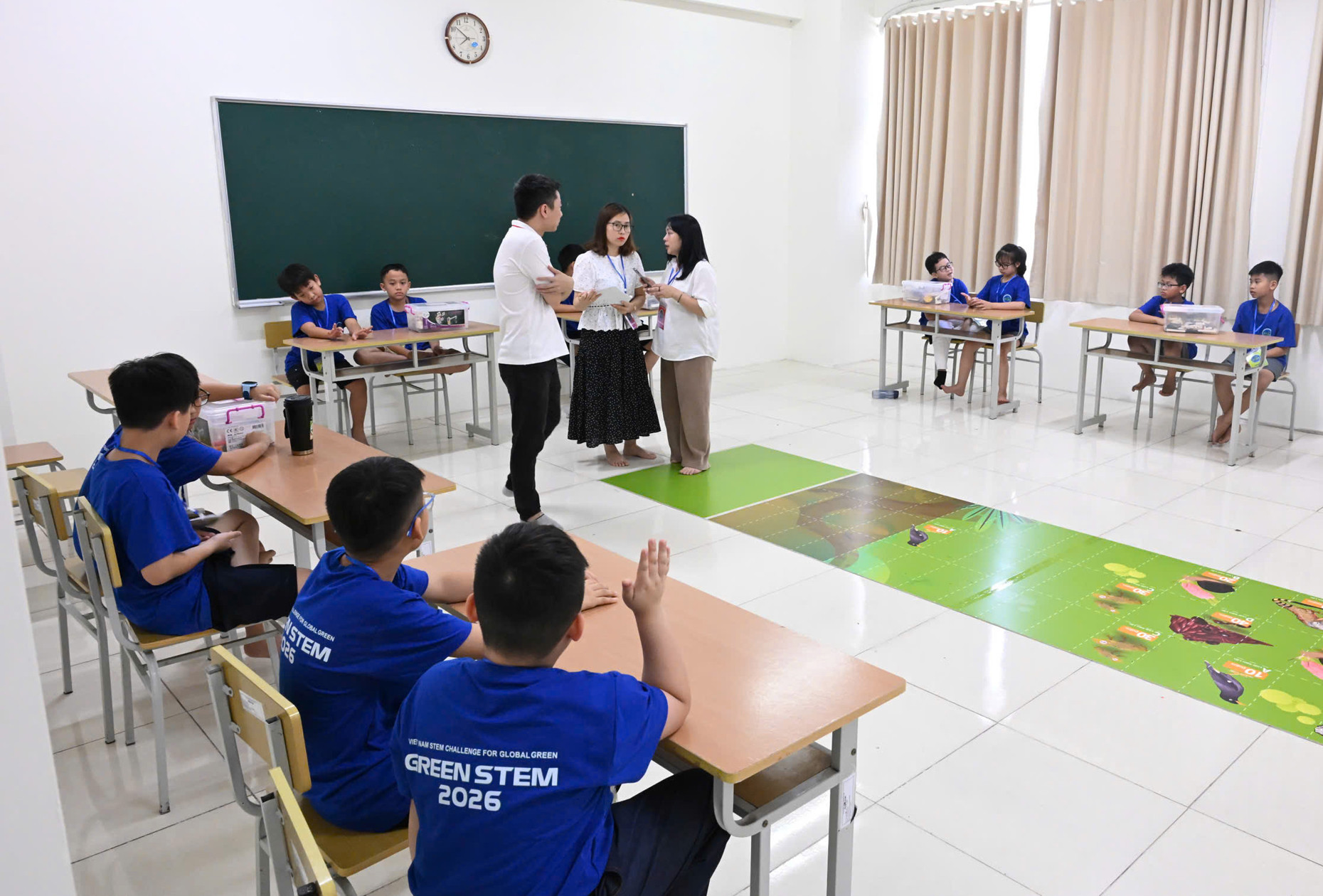
On May 24, the 2026 National STEM Competition - Vietnam STEM Challenge for Global Green (Green STEM 2026), was organized by the Institute of Educational Sciences and Skill Development, under the Association of Vietnam Universities and Colleges. The event aimed to foster scientific thinking, creative capacity, and technological skills for K-12 students amid Vietnam's push for science, technology, innovation, and national digital transformation.
The competition targets a substantive STEM approach tied to sustainable development, green technology, and the emerging requirements of the digital economy. This year's competition gathers 33 teams from 19 schools across localities including Hanoi, HCMC, Hung Yen, and Vinh Phuc.
Speaking at the event, Nguyen Quan, head of the competition’s professional committee, noted that Green STEM 2026 takes place as Vietnam is implementing Resolution 57 of the Politburo on science, technology, innovation, and national digital transformation, along with Resolution 71 on educational development and reform.
According to Quan, one of the major concerns among parents and students today is improving digital capabilities and equipping learners with foundational technological knowledge. To achieve this, STEM education should be introduced into schools starting from the primary level.
He noted that recently the Ministry of Education and Training (MOET) has strongly promoted STEM integration into the national curriculum while also developing STEM teaching staff and related textbooks and reference materials.
“I am very pleased that recently MOET has been highly determined to integrate STEM education into the general education curriculum. Today’s Green STEM 2026 competition is one symbolic activity reflecting that effort.
“It is also a stepping stone for us to later introduce AI into general education, so that all students graduating from K-12 education will have the minimum knowledge of digital technology, AI, and STEM. From there, they can continue higher education or enter the labor market with a basic yet important foundation of knowledge,” Quan said.
According to MOET, in 2024 Vietnam recorded more than 218,000 newly enrolled students in STEM-related majors, accounting for around 36 percent of total nationwide university admissions. STEM training scale increased by 10.6 percent compared to 2023.
STEM is more than robotics and coding
One current limitation is that STEM in many places is still narrowly understood as robot assembly or programming, whereas the core of STEM is developing scientific thinking, creativity, and practical problem-solving skills.
Green STEM 2026 is designed to help students learn through hands-on experiences: observing, questioning, experimenting, improving, and refining solutions.
Competition activities combine science, technology, engineering, and mathematics to solve problems related to the environment, energy, green technology, and sustainable development.
The “Green” spirit of the competition goes beyond environmental themes, aiming to foster green thinking, social responsibility, and innovation capacity among students amid global digital and green transitions.
The organizers said the competition includes multiple categories and approaches to enable students to showcase their individual strengths. Evaluation criteria focus not only on the final product but also on thinking processes, collaboration, solution improvement, and creativity.
STEM ecosystem linked to innovation
Green STEM 2026 also aims to build a more practical STEM education environment in schools. According to the organizers, STEM teachers should not merely act as technical instructors but also know how to inspire scientific thinking and guide students in observation, experimentation, analysis, and solution refinement.
Through the competition, teachers can gain exposure to more practical STEM activity models while helping schools develop STEM, robotics, and applied science clubs suited to different educational levels.
The organizers believe sustainable STEM development requires collaboration among schools, experts, research institutions, universities, and technology enterprises to create an education ecosystem connected to innovation.
One highlight of Green STEM 2026 is its connection to the World GreenMech Contest, an international STEM competition for students featuring teams from multiple countries and territories across the region.
Outstanding teams may be selected, trained, and nominated to participate in the World GreenMech Contest based on their scientific thinking, practical skills, teamwork, creativity, and presentation abilities.
Thai Khang
.svg)
