 Vietnamnet.vn

 Podcast



Phan Hoang Lam, a 12th-grade student in Math 1 class at Hanoi - Amsterdam High School for the Gifted, has been admitted to several leading universities in the US, including the University of Pennsylvania - one of the eight Ivy League institutions - and Duke University. Both schools are ranked among the top seven national universities in the US in 2026.
“I feel both happy and relieved. After a long journey, I’ve finally reached this milestone,” Lam shared.
Rooted in concerns from his hometown

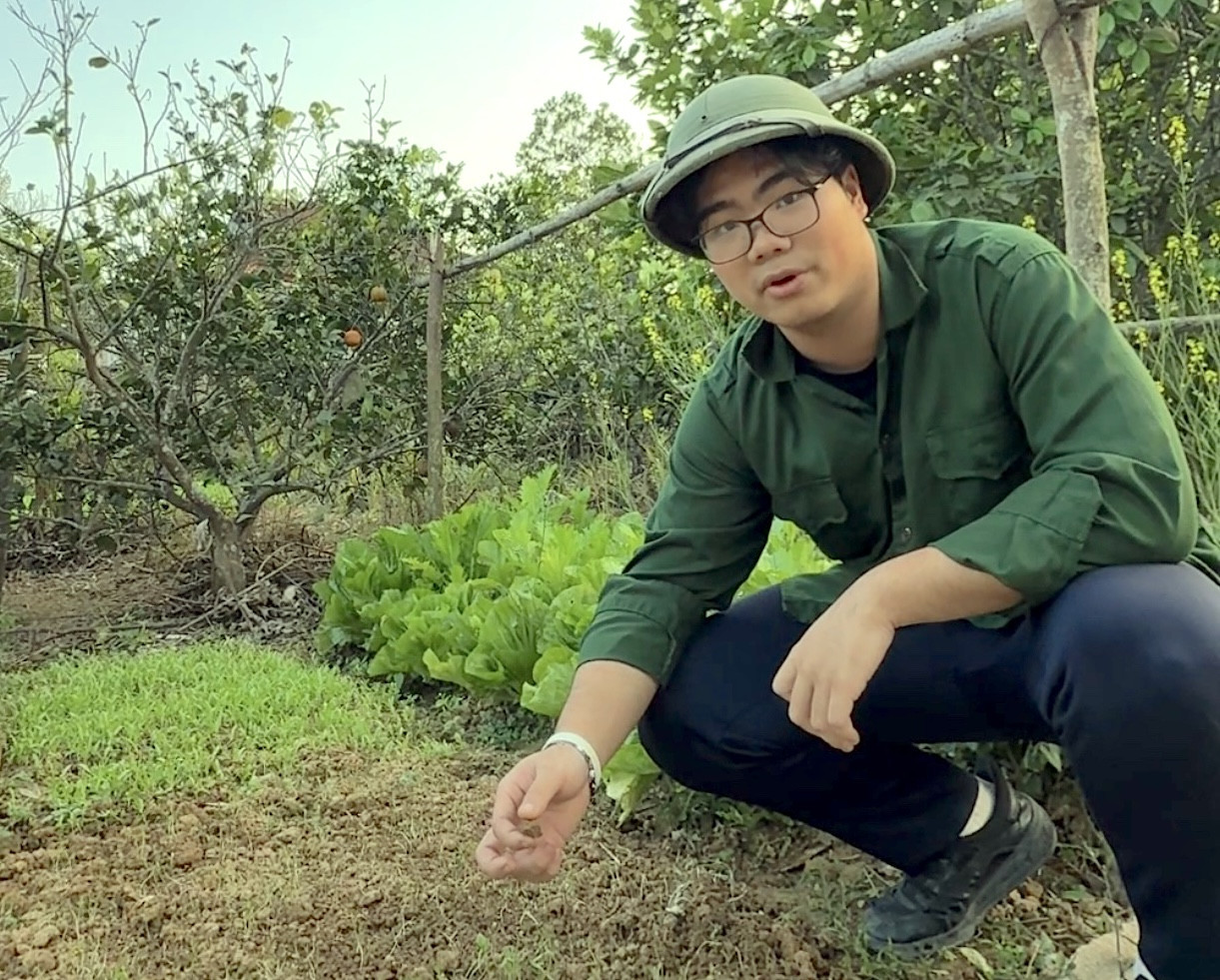
Originally from Ha Tinh, Lam spent many summers with his grandparents, where he witnessed firsthand the harsh realities of the region’s climate. Prolonged droughts could crack the soil, while sudden storms and floods could wipe out an entire season’s work overnight.
“Just a small shift in the weather can directly affect crops and the livelihoods of many families,” Lam recalled. These observations gradually became the seed of a larger ambition - to help farmers in his hometown become more resilient in the face of nature.
Throughout high school, Lam shaped a clear direction: applying mathematics and artificial intelligence to analyze soil data, generate predictions about soil conditions and nutrients, and support farmers in making better cultivation decisions.
Planning his study abroad journey early, Lam aims to deepen his knowledge in mathematics, AI, and data science in the US, while learning how to integrate these disciplines to solve real-world problems.
He began preparing his application as early as the end of 9th grade, focusing not on doing “as much as possible” but on building a consistent and meaningful narrative.
That narrative started with mathematics - a foundation that helped him develop quantitative thinking and approach fields such as linear algebra, multivariable calculus, and optimization. From there, he expanded into AI, exploring how machine learning models process sensor data, predict soil moisture, and assist in decision-making.
At the core of it all was a persistent question: how to better understand and manage agricultural land.
A defining thread in his application
Driven by a passion for mathematics, Lam has achieved notable accomplishments, including ranking first in the entrance exam for the specialized math program at Hanoi - Amsterdam High School, winning a bronze medal at the 2024 National Mathematics Olympiad for university and high school students, and securing second prize in the Hanoi city-level mathematics competition.
“These achievements have been an important stepping stone toward my dream,” he said.
Lam also conducted research on matrix methods for recurrence sequences, extending the use of matrices to analyze and prove properties of familiar sequences such as Fibonacci and Pell.
“This research helped me realize that the beauty of mathematics lies not only in solutions but in how algebraic structures reveal deeper patterns behind numbers. It also trained me to move from intuition to rigorous proof, laying the groundwork for future pursuits like optimization and AI,” Lam explained.
In his personal essay, Lam explored two seemingly contrasting perspectives: the logical world of mathematics, models, and data, and the lived experiences of farmers who understand the land through intuition and practice.
“Knowledge only truly matters when it listens to life,” he wrote. For Lam, an elegant solution is not only technically correct but must also resonate with the people behind the problem.
This consistency and depth helped his application stand out to US universities. Reflecting on his journey, Lam believes students should not begin with the question of what top schools want, but rather with what they genuinely care about.
Over the next four years, Lam hopes to position himself at the intersection of AI, applied mathematics, optimization, and soil science. In the long term, he aims to return to Vietnam or collaborate internationally to address challenges related to agricultural land.
“My ultimate goal is to help farming in Vietnam, especially in places like Ha Tinh, become less dependent on the unpredictability of nature,” he said.
Thuy Nga
.svg)
