 Vietnamnet.vn

 Podcast



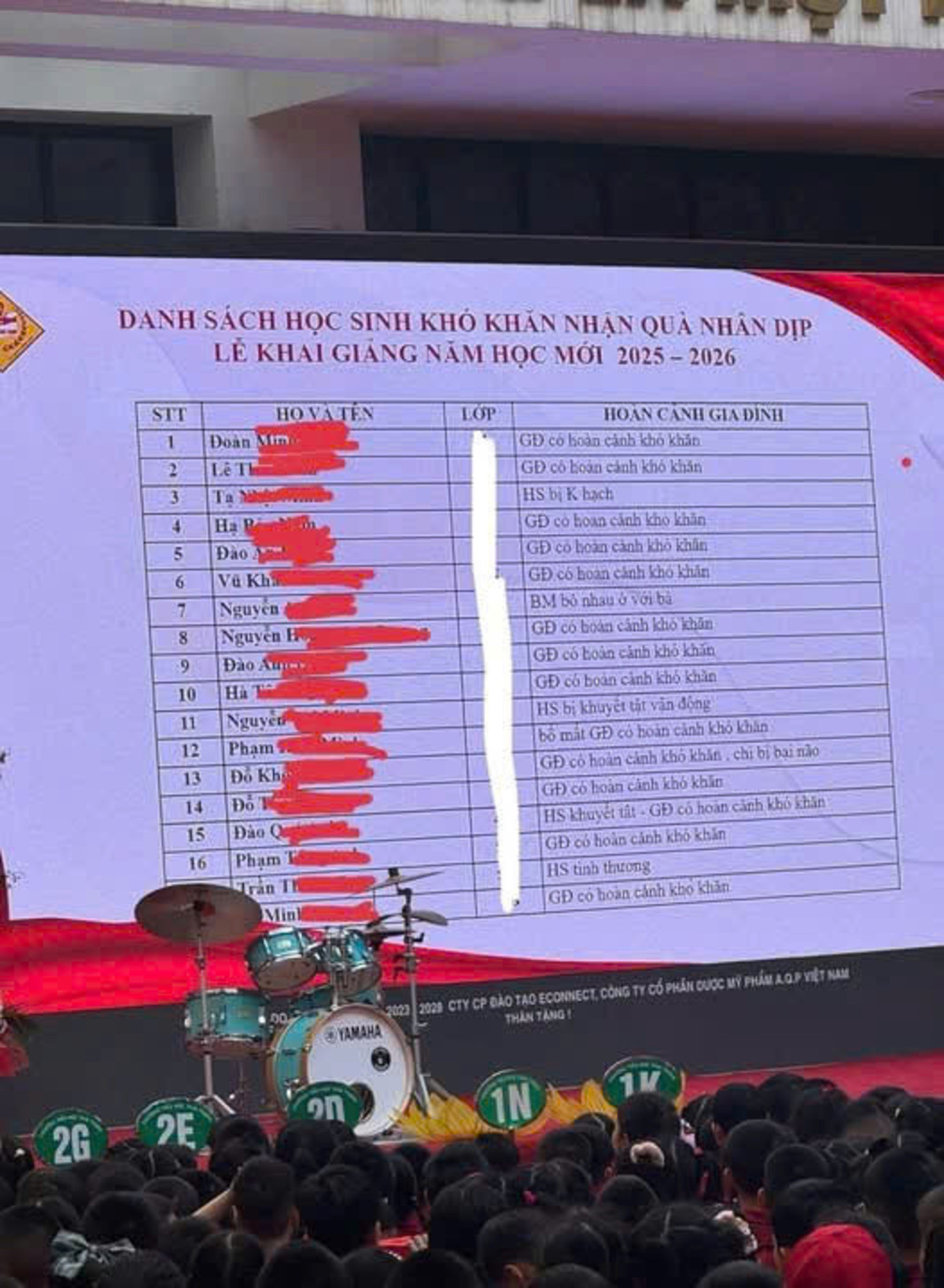
Images of the list showing disadvantaged students receiving gifts, presented on a large LED screen in front of students and parents, have been shared on social media, attracting widespread attention and mixed opinions.
Some believe the school should have simply called students up to receive the gifts, with no need to show their difficult family circumstances, while others argue that the transparency may have been the school's intention.
"The way you give is more important than the gift itself"
Ho Tuan Anh, principal of Quynh Phuong secondary school (Quynh Mai ward, Nghe An province), said this approach by the school in Hanoi was inappropriate.
"I believe that when giving gifts to students in difficult circumstances, schools can take photos as evidence but absolutely must not publish them in any form.
The school giving gifts to students and then publicizing each student’s situation is not only tactless but also loses the humane meaning of the behavior. Not to mention, this can also be an invasion of the privacy of the students’ families, making them feel more guilty than excited. What if one of them has a father or mother serving a prison sentence?” said Anh.
He revealed that every year, his school organizes gift-giving events for underprivileged students, usually at the beginning of the school year, on the occasion of Teachers’ Day November 20, before the Lunar New Year break, at year-end ceremonies, and sometimes unexpectedly.
"Through these experiences, I’ve realized many students feel embarrassed or even hurt when their 'difficult circumstances' are exposed in front of classmates. The children are not at fault. Their parents are not at fault," he said.
He acknowledged that such gifts are necessary and supportive, but noted “the way you give matters more than the gift.”
"I remember one occasion after giving gifts, a ninth-grade girl came into my office. She hesitated for a long time before saying, 'Thank you for the gift today, but please don’t post about it on social media.' I was a bit surprised because, in the past, we would post photos to Facebook to thank the donors," he recalled.
That day, the ninth-grader taught him a lesson about the need for humanity, and subtlety, in education.
"She told me she appreciated the gift, but having to put her family's poverty on display to gain sympathy... That unfinished sentence stayed with me. Since then, I’ve invited students to receive gifts privately in the office, in the presence of teachers and donors. I’ve seen them become more confident in receiving support," he added.
He hopes that schools and organizations will be more thoughtful when giving gifts to disadvantaged students so that the warmth of the gesture truly reaches the recipients.
Act with educational spirit, not bureaucratic routine
Tran Thanh Nam, vice president of the University of Education (Vietnam National University, Hanoi), said that publicly showing names and family situations was insensitive and potentially harmful in terms of social and psychological impact.
"Primary education students are in a crucial stage of character development and are highly sensitive to peer perception. Publicly exposing their poverty may cause shame, inferiority, and lead them to withdraw or avoid group activities," Nam explained.
Even more concerning, he said, such practices could create invisible divisions in the classroom, where some children become subjects of mockery, and labeled or isolated. This unintentionally promotes social prejudice and discrimination within the school environment, which should be a safe, fair, and respectful space.
In the long run, these psychological wounds could damage children's self-esteem, reduce motivation to learn, and even strain relationships between parents and the school when families feel their children are being “exposed.” Some may refuse support altogether because of the humiliation.
To avoid such harm, Nam suggests schools should keep personal information confidential, offer scholarships or support discreetly and respectfully, and use positive language like “companion scholarship” or “star scholarship” to encourage student effort.
He also recommends organizing activities to teach students about empathy and community responsibility, helping them value kindness through everyday acts. That way, support efforts remain transparent while preserving dignity, confidence and equality for all.
"Helping students in need is important, but it must be done with humanity and in the true spirit of education, not through bureaucratic methods. Without that sensitivity, we risk turning goodwill into emotional wounds for the children," Nam said.
Thuy Nga
.svg)
