 Vietnamnet.vn

 Podcast



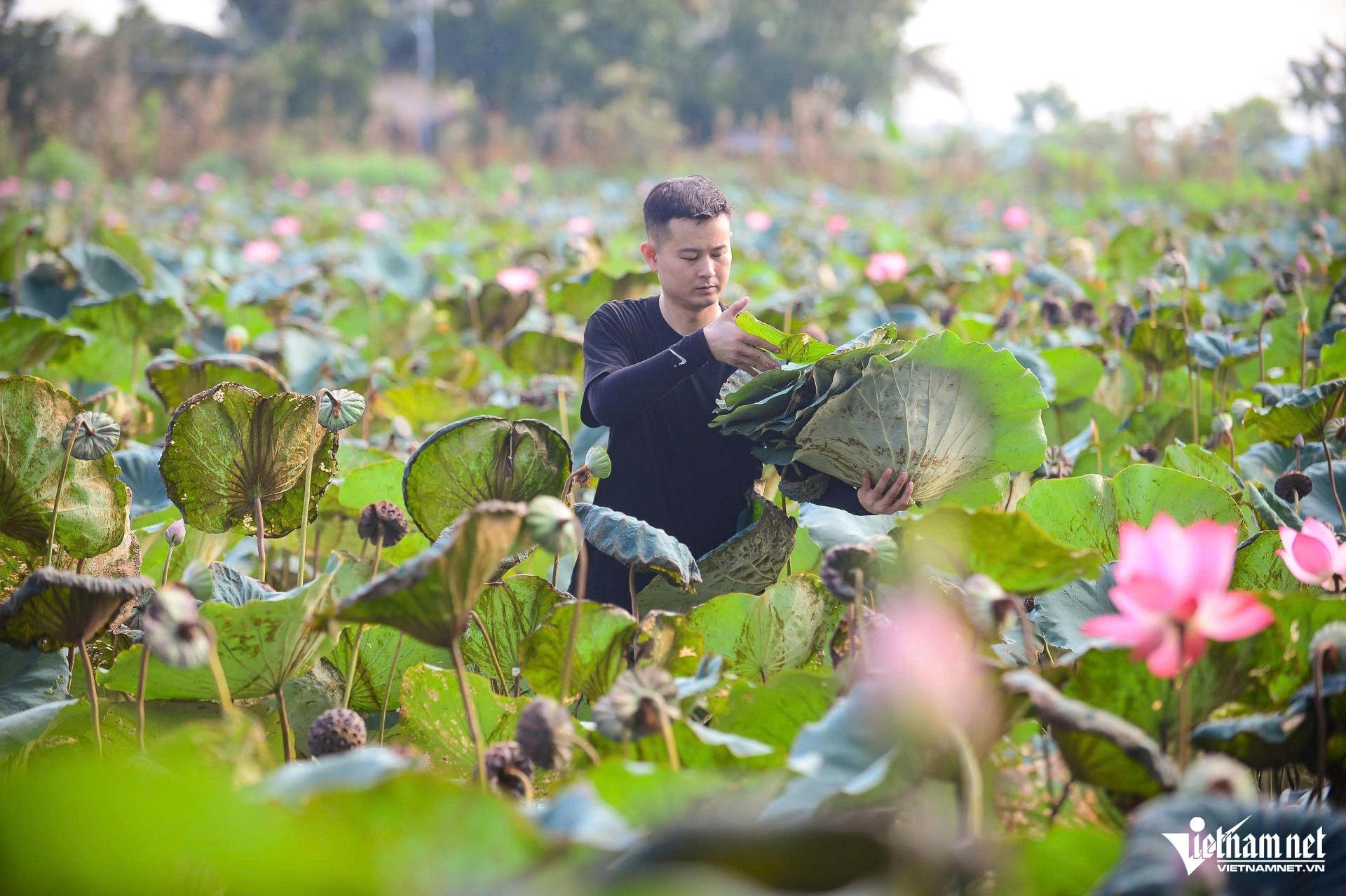
Following a business failure, Duong (born 1992, residing in Village 1, Thieu Van, Dong Tien Ward) experienced a period of uncertainty, unsure how to restart his life.
Having completed general education, he engaged in various jobs to make a living. A turning point occurred when he began visiting the art studio of his brother-in-law, artist Hoang Tuyen, to assist with routine tasks.
Surrounded by paint scents, brushes, and emerging paintings, the young man found himself drawn to fine arts. From observing to learning paint mixing and shaping, Duong wantrf to create a product line featuring his personal mark.
"After my business failed, I lost my direction. Initially, assisting in my brother-in-law's studio was simply a way to stay employed and learn. However, as I engaged more with painting, I realized my genuine love for creative work," Duong said.
Lacking formal art training, Duong thought about how to craft a material rich in Vietnamese identity using his own intuition. Observing blooming lotus ponds fade quickly, he regretted the transient nature of that beauty and wondered: "Why not preserve it in a different way?" That question sparked his idea for lotus-leaf art.
In late 2020, he began researching lotus leaf material. Initially experimenting with both flowers and leaves, Duong quickly realized lotus flowers were difficult to preserve long-term. After careful consideration, he decided to focus solely on leaves.
To gather optimal raw materials, Duong wakes up around 4am daily to travel across local and neighboring lotus ponds. He noted that as early morning dew evaporates, lotus leaves remain firm, fresh, and hold their best shape.
According to Duong, transforming delicate leaves into durable artworks involves significant challenges. Once detached from stalks, lotus leaves mold, rot easily, and discolor. Consequently, his initial products peeled and blistered after a few weeks, ruining his efforts.
"During the early days, almost no product succeeded. Freshly processed leaves molded, discolored, or peeled within weeks. At times, I thought I chose an impossible material. Yet, the more I failed, the more determined I became to find a solution. Entire batches had to be discarded, wasting both effort and money. Still, each failure helped me understand lotus leaf characteristics better and provided motivation to continue," Duong recalled.
Lotus-leaf artistry
It took nearly two years and hundreds of trials for Duong to develop an effective processing technique. Harvested lotus leaves are cleaned of mud and subjected to multi-stage anti-mold treatments to become specialized canvas sheets.
The unique appeal of this material lies in preserving the leaf's complete vein network. Each leaf features a distinct texture, producing a singular aesthetic that no synthetic material can replicate.
"The day I held a fully processed lotus leaf with its color and vein patterns intact, I felt deeply moved. It felt as though I had preserved a piece of nature's beauty that most assume fades with time," Duong recalled.
Once he mastered the material, Duong collaborated with artist Hoang Tuyen to create artworks. Rather than simply pressing dry leaves for decoration, a common method on the market, they combined Vietnamese calligraphy with illustrative details to establish a signature style.
Artist Hoang Tuyen noted that because the lotus symbolizes elegance and purity, every brushstroke and detail must convey that spirit. Each artwork is created based on client ideas or artist inspiration, ensuring complete uniqueness.
Upon completion, paintings receive a specialized protective coating before framing, preserving quality across many years.
Besides traditional artwork, Duong has developed Leaf Skeletonization techniques. By peeling away leaf flesh while retaining the natural vein structure, he crafts decorative lamps emitting soft light that highlights the delicate structure of lotus leaves.
"I aim to offer not just a beautiful painting, but a sense of tranquility when people view it. Every lotus leaf features distinct shapes and vein patterns, much like every individual carries their own story. I strive to make every piece a unique creation," Duong said.
Now Duong plans to expand lotus leaf applications into handcrafted items such as conical hats, souvenirs, and interior decor for residences, hotels, restaurants, and homestays.
"I hope lotus-leaf products become gifts representing Vietnamese identity. When people think of the lotus, they will remember not just a floral season, but values preserved long after," Duong stated.
Le Duong
.svg)
