 Vietnamnet.vn

 Podcast



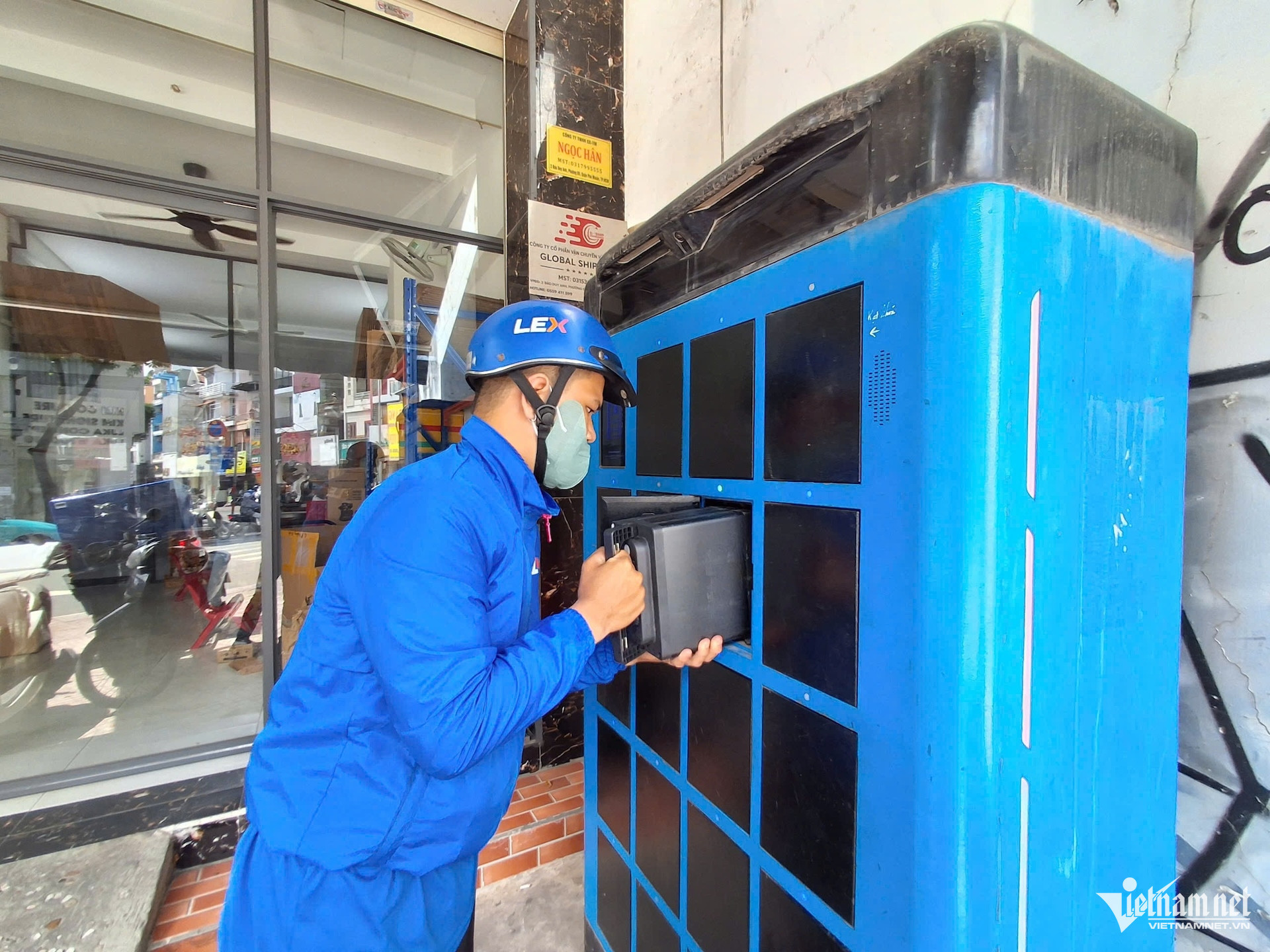
At 12 pm, Tran Tri Nam, 23, a shipper, stopped at a Selex Motors battery swap cabinet on Dao Duy Anh Street (Duc Nhuan Ward, HCMC), swapped three depleted batteries for three fully charged ones.
Selex Motors, a logistics solutions provider, has signed a cooperation agreement with Lazada Logistics to deploy electric motorcycles for delivery operations in HCMC and Hanoi. The company takes a direct approach to target transport drivers to expand the user base for battery swap cabinets.
Nguyen Huu Phuoc Nguyen, CEO of Selex Motors, said the battery swap fee at stations (including VAT) is VND8,000 per battery per swap. The company aims to have 300 battery swap cabinets nationwide by 2026 and projects 3,000 by 2028.
Currently, charging an electric vehicle battery takes an average of 6-8 hours, while swapping a battery takes only 2 minutes, faster than refueling with traditional gasoline.
Charging stations and charging time play a critical role in the electrification of transportation. A 2024 survey conducted by Cho Tot Xe in collaboration with KPMG indicates that the most critical factor for the success of a charging station system is fast-charging capability. As a result, the market for electric vehicle battery swap cabinets is considered highly promising.
According to Mordor Intelligence, the market size for the battery swap model in Southeast Asia is estimated to reach $0.71 billion in 2025 and is projected to hit $3.03 billion by 2030. The annual compound growth rate is expected to be 34.57 percent during the 2025-2030 period.
Many companies are making moves to enter the lucrative battery swap cabinet market.
In July, TMT - EGREEN (a member company of TMT Motors) announced plans to roll out a nationwide battery swap station project. The stations can flexibly scale from 5 to 72 batteries per station, suitable for various location sizes, including apartment complexes, households, rental homes, or existing fuel stations.
The stations use a 220V power source, compatible with Vietnam’s common household electrical infrastructure. The company claims the battery swap process takes only 1-2 minutes.
Honda Vietnam has also launched a battery swap service for its CUV e electric motorcycle model through 19 authorized dealers in Hanoi, HCMC, and Da Nang starting from July 2025. Customers renting CUVs can swap batteries for free at these dealers.
Can electric vehicle batteries be swapped in just 20 seconds?
V-Green Global Charging Station Development Corporation (part of Vingroup’s ecosystem) makes no secret of its ambition to rapidly develop a battery swap cabinet system.
At a recent event, V-Green’s CEO, Nguyen Thanh Duong, confirmed that hundreds of charging points will appear on sidewalks in HCMC and Hanoi in the fourth quarter of 2025.
Several localities have prepared convenient locations to attract this company to establish charging infrastructure. V-Green has partnered with major domestic retailers to utilize portions of their commercial spaces for charging stations and battery swap cabinets.
Initially, the company aims to develop 150,000 battery swap cabinets nationwide, with a distance of 150 meters between cabinets. Notably, the battery swap process takes only 10-20 seconds.
A V-Green representative stated that converting approximately 80 million two-wheeled vehicles to electric would require 500,000 battery swap cabinets nationwide. The total investment in battery swap cabinet infrastructure and batteries could exceed $60 billion, a huge figure.
To address the financial challenge, V-Green has introduced a franchise model for battery swap cabinets.
V-Green will sell one battery swap cabinet with 11 pre-chargeả batteries for approximately VND200 million to investors. Initially, the company requires investors to pay only 20 percent of the initial cost (about VND40 million) upfront to purchase a cabinet. The remaining 80 percent can be paid by interest-free installments.
Duong estimates that with a swap fee of VND9,000 per battery for users, cabinet investors can break even in 2.5-3 years.
In HCMC alone, the plan to convert 400,000 motorcycles to electric, focusing on tech-based and delivery drivers, represents a significant market for developing battery swap cabinets.
Antoine Goupille from RMIT Vietnam notes that HCM City currently has only about 600 public electric vehicle charging points and around 50 battery swap stations. This charging infrastructure meets less than 10 percent of the projected demand for 350,000-400,000 electric motorcycles by 2028.
Meanwhile, two-wheeled tech-based drivers typically travel 80-120 km per day (3-4 times more than the average user). Insufficient charging infrastructure limits their vehicle operational efficiency. Battery swapping shortens waiting times, thereby improving their income.
Hoang Hiep
.svg)
