 Vietnamnet.vn

 Podcast



Circus is a highly specialized performing art that demands years of relentless training. Behind a few minutes on stage lie countless hours of sweat and tears, along with the constant risk of unexpected accidents, some potentially life-threatening.
Yet circus artists continue to devote themselves to a profession that demands enormous sacrifices in health without necessarily providing financial security. For female performers, the challenges are even greater as they also navigate the responsibilities of being wives, mothers and caregivers.
VietNamNet presents a series on the women of Vietnamese circus, revealing the lives behind the spotlight that audiences rarely get to see.
Born into a poor family in the countryside of Thanh Hoa, Tam Chinh spent her childhood in the rice fields, transplanting seedlings and carrying bundles of young rice plants. No one in her family imagined she would one day step onto a stage, much less soar through the air beneath the dazzling lights of the circus.
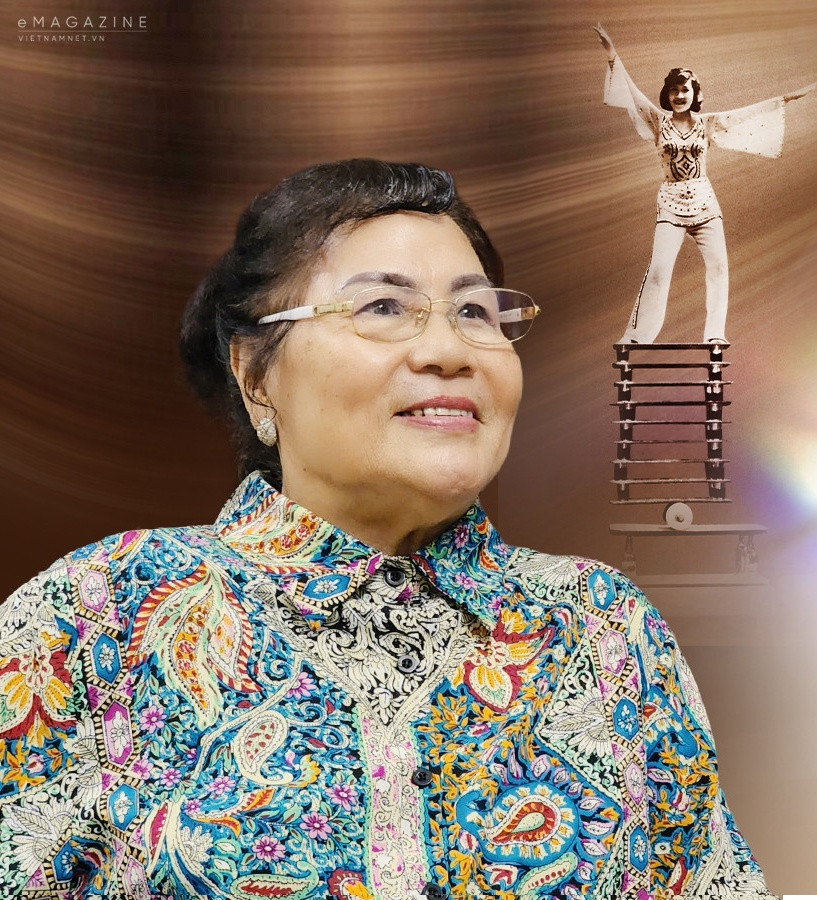
Then one day, an announcement advertising a circus performance echoed from the nearby town. “Let’s go and see what it’s like,” she thought. That simple impulse sent Tam Chinh and a group of friends cycling more than 60 kilometers to the city. They carried rice balls wrapped in areca palm sheaths, eating along the way with growing excitement.
At that performance, a single encounter changed the course of her life. A recruitment officer asked: “Would you like to perform in the circus?”
The 15-year-old answered without hesitation: “Yes, I would!”
That simple answer, given without calculation or fear, opened the door to a remarkable life - one that would give Vietnamese circus an artist celebrated for both her grace on stage and her determination as a leader.
After passing the audition, Tam Chinh left her hometown for Hanoi. But behind the excitement lay an unforgiving journey. In the early days of training, the 15-year-old felt as though her body was being torn apart. Accustomed to hard physical labor, she now had to master splits, backbends and extreme flexibility -movements almost unimaginable for a village girl more familiar with muddy fields and farm work.
“The pain was beyond anything I could imagine. There were times when I wanted to quit. Farming was exhausting, but it never hurt like this. Yet only a handful of dozens of trainees would be kept. I told myself that if I gave up, I would lose everything. So I stayed,” Tam Chinh recalled.
Quiet training sessions, forcing herself into splits until she bled, and continuing to practice outdoors even on slippery, rain-soaked nights gradually forged what she would later describe as a willingness to give herself completely to the profession.
Without the formal training institutions available today, Tam Chinh’s generation learned by watching, imitating and creating for themselves.
She recalled secretly taking equipment out to practice while her instructor was asleep. Circus acts at the time were relatively simple, focusing largely on technical skills rather than building a story or broader performance concept. Tam Chinh began by balancing on a rolling cylinder, then gradually added layers of glass cups.
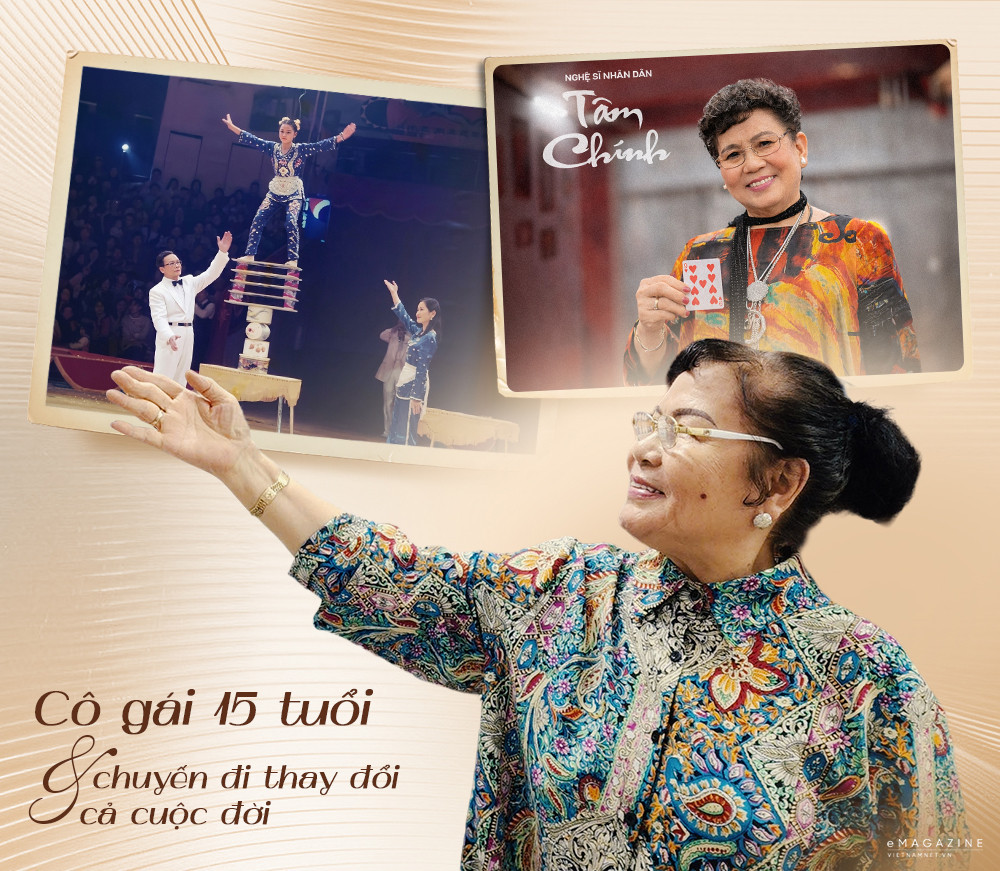
At first, she fell constantly while practicing with the glasses. On some days, she would lose her footing, shatter the glasses and tumble into the broken pieces, hitting the floor face-first and emerging covered in blood.
“If you’ve never fallen, you’re not a circus artist,” Tam Chinh said calmly.
After five grueling years of training, she graduated with distinction with her Human Pyramid on a Roller act, beginning a creative career filled with hardship, challenges, sweat and tears - but also extraordinary rewards.
Acts such as Swinging Ladder, Balancing on a Roller and, most notably, The Refreshment Seller made a lasting impression on audiences and established Tam Chinh as one of the emerging talents of Vietnamese circus during the 1960s and 1970s.
Tam Chinh said the idea for The Refreshment Seller was inherited and developed from the Balancing on a Roller act created by Hoa Vinh, who was also her teacher. The image of a young woman balancing atop eight layers of glasses, themselves positioned on a roller supported by four liquor bottles, left a deep impression on audiences and became her unmistakable signature.
One of the most profound memories of Tam Chinh’s performing career was appearing before President Ho Chi Minh at the Presidential Palace. There was no grand stage - only a small table, several glasses and a heart pounding with nerves.
She recalled that after the performance, President Ho called her over and said: “You made my heart skip a beat.”
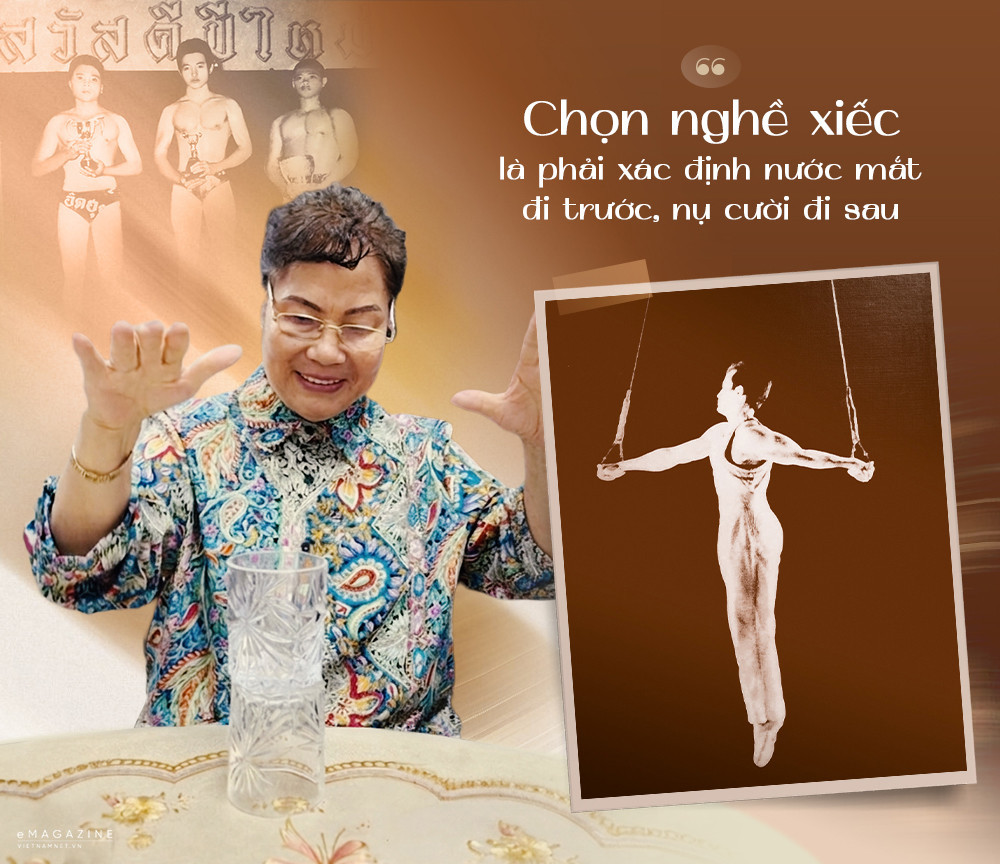
Those simple words became the greatest reward of her artistic life. From then on, whenever international guests visited, her act was frequently chosen for performances. Circus needed no common language, yet it became a cultural bridge through which she helped bring an image of Vietnam to the world.
Tam Chinh did not perform only on conventional stages. She also took circus into some of the most difficult places imaginable. During the war years, she traveled with her troupe along the Truong Son range and deep into battle zones, performing for soldiers and the wounded.
There was no stage, so she performed on bare ground. There were no spotlights, only the eyes of soldiers watching her.
“If they could smile and forget their pain for even a little while, I felt it was worth it,” she said.
Amid those difficult years, Tam Chinh also found love - private, restrained and bound by the strict rules of the time. Circus artists then faced restrictions on romantic relationships and marriage, and were even discouraged from having children early in their careers. Yet her feelings for a fellow performer endured.
At 18, artist Le The, a Vietnamese of Thai origin, returned to his homeland with plans to open a photography studio. By chance, his strong physique led to his recruitment into the circus. Training together and enduring hardship side by side gradually brought the two closer. Their love letters were carefully hidden at the bottom of their lunch containers, secretly exchanged and read away from watchful eyes.
Determined to prove the sincerity of his love, Le The resolved to master the roller-balancing act. The couple trained relentlessly to create a performance in which Le The stood on the roller playing a mandolin, with a chair balanced on his head as Tam Chinh sat above him playing the flute. After the act became a resounding success, they married in 1970.
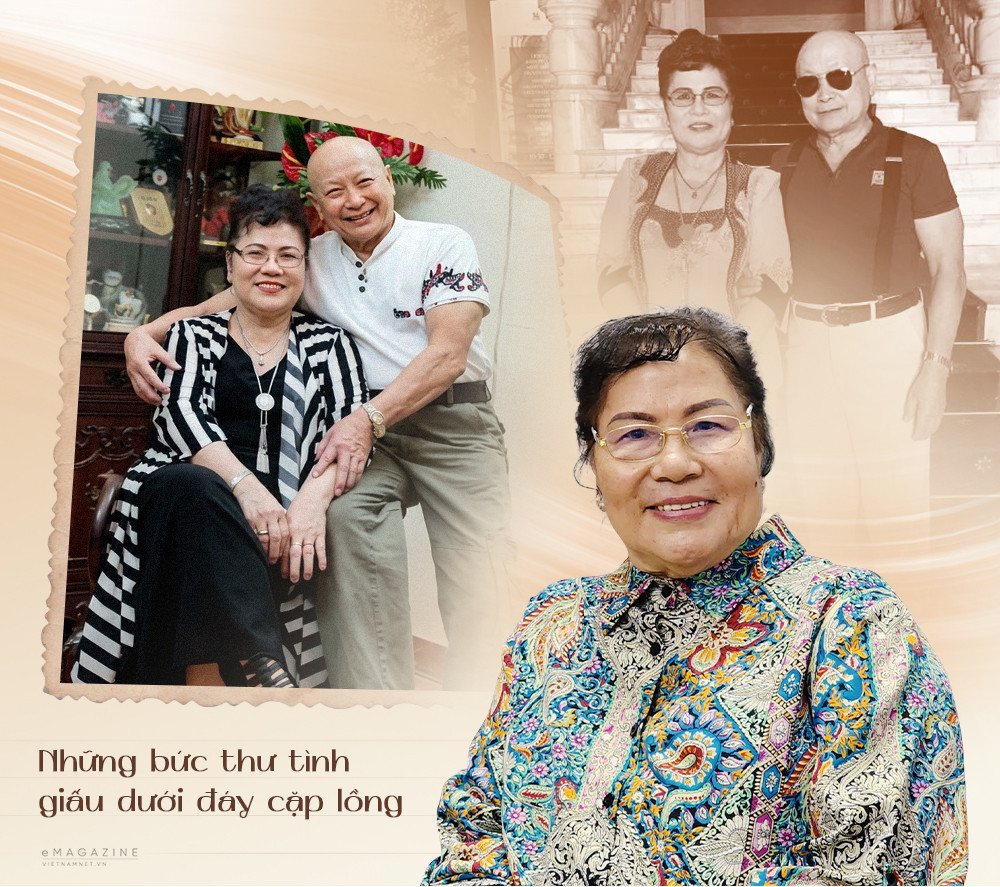
In 1987, when Tam Chinh became Director of the Vietnam Circus Federation, Le The chose to step back and take care of the family and raise their children, allowing his wife to devote herself fully to her passion.
At 80, Tam Chinh’s body carries the marks of a lifetime in the circus: aching joints, old injuries and pain that returns whenever the weather turns cold. Yet what concerns her most is not her health, but the future of the circus.
She speaks of the disadvantages faced by circus performers in a profession that “consumes your youth,” where continuing to perform beyond the age of 40 can be difficult, yet compensation and support remain inadequate.
“I only hope there can be policies specifically for circus artists, so young performers can feel secure in pursuing the profession,” she said wistfully.
Tam Chinh believes the name her parents gave her may have somehow shaped her life — a woman devoted to her profession, steadfast in her choices, and endlessly willing to create and push herself forward. After more than half a lifetime with the circus, she still carries a deep sense of responsibility.
“I don’t have much time left, so I’m trying to pass on everything I’ve accumulated over half a century in the profession to future generations. If you choose this career, you have to accept that tears come first and smiles later. You have to truly love the profession before you can find glory.”
From a farm girl who knew nothing about circus, she became a People’s Artist and the first - and, to date, only - female director in the history of Vietnam’s circus sector. Called a “legend of Vietnamese circus” by many colleagues and audiences, she took the art form around the world and created an unforgettable legacy with The Refreshment Seller, an act that no one has quite replaced.
Today, what Tam Chinh wants most is not fame, but the chance to continue inspiring others.
“Choose one joy each day. If I can do something good for someone else, that is enough.”
Perhaps for Tam Chinh, life itself resembles a circus act: it becomes truly beautiful only when the performer dares to step forward, hold their balance amid uncertainty and bring a smile to someone else.
Associate Professor Nguyen The Ky once posed a question: “Why do other fields have heroes, while the circus has none? If there is to be a first, People’s Artist Tam Chinh deserves to be recognized as a hero of the renewal era.”
Tinh Le
.svg)
