 Vietnamnet.vn

 Podcast



In early October, Thai Nguyen endured record-breaking rainfall that caused unprecedented urban flooding.
Over 560mm of rain fell within just 48 hours (October 6–7), submerging the provincial capital under water, paralyzing transportation, displacing thousands of households, and tragically claiming lives.
According to Associate Professor Vu Thanh Ca, senior lecturer at the Faculty of Environment, University of Natural Resources and Environment, the severity of this disaster stemmed not only from abnormal rainfall but from a combination of natural vulnerabilities and human shortcomings.
It is, he says, a stark warning about the limits of urban resilience in mountainous regions under intensifying climate pressure.
Terrain and outdated drainage triggered rapid inundation
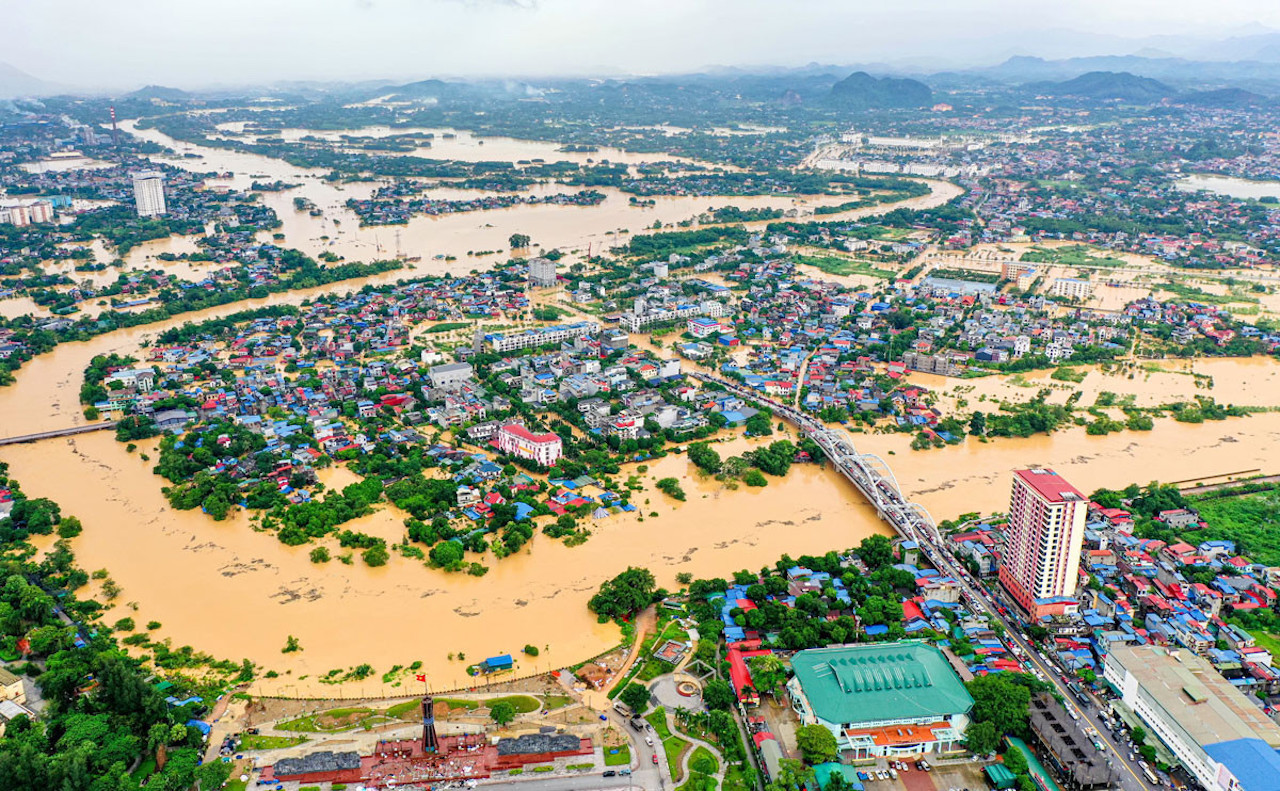
Thai Nguyen submerged after record rainfall. Photo: Bao Khanh
The Cau River, which flows through Thai Nguyen, originates in the mountainous province of Bac Kan.
Its steep gradients and narrow valleys channel rainwater rapidly downstream.
“When rain falls heavily, water rushes down the mountain slopes quickly, but drainage back out is slow,” said Dr. Vu Thanh Ca.
In Thai Nguyen, the urban drainage system relies on gravity: stormwater flows from the city into the river.
This system, however, lacks anti-backflow valves, as planners assumed water inside the city would remain at a higher elevation than in the river.
But during this extreme rainfall, the Cau River rose rapidly, reversing flow and pushing water back into the city.
Complicating matters, the city’s flood defenses are fragmented.
Levees exist in only certain areas, and many parts lack protection entirely. In others, floodwaters bypassed levees by reversing through drainage systems, rendering them ineffective.
With additional runoff pouring in from surrounding mountains, the city essentially became a giant basin filling with water.
Adding to the devastation, massive quantities of silt and mud flowed in along with the floodwaters.
“Rain eroded soil from the hillsides, and the Cau River carried silt and sediment through farmlands, leaving the city submerged in mud as well as water,” Dr. Ca noted.
A climate-altered future means more intense, more frequent storms
Climate change is intensifying both the frequency and magnitude of extreme weather events.
“Warmer seas lead to more evaporation. When that vapor condenses, it fuels violent storms and heavier rainfall,” Dr. Ca explained.
Northern Vietnam’s flood defense systems, including on the Cau River, were designed to withstand floods with a 2% annual probability - equivalent to a once-in-50-year event.
“But this flood showed that just a single day of intense rain can overwhelm outdated systems,” he warned.
In the recent storm’s aftermath, the entire Cau–Thuong–Duong river basin, spanning Hanoi to Lang Son and Cao Bang, experienced simultaneous flooding.
Water from Thai Nguyen surged downstream into Bac Ninh, while the Thuong River brought floodwaters from Lang Son. The result: widespread inundation of the lower basin.
In many areas like Bac Ninh, riverbanks and floodplains have been densely developed.
“When floodways are obstructed by construction, even moderate storms can become disasters,” Dr. Ca said.
Even Hanoi saw impacts from the upstream floods, underlining that flood mitigation cannot be handled piecemeal by individual provinces. It must be planned at the basin-wide level across all major river systems.
Safety investment is the foundation of sustainable growth

Localities like Thai Nguyen must reprioritize public spending and elevate disaster risk reduction to the top of the development agenda, Dr. Ca urged.
“Systematic investment in levees and drainage will always yield returns through reduced damage,” he emphasized.
Beyond the human toll, floods undermine economic competitiveness and deter investment.
“Investors only come when they know infrastructure is reliable in all conditions. Regular flooding not only harms residents but weakens the economic base long term,” he said.
The October deluge is a wake-up call: what were once-in-a-generation floods may now happen at any time.
Only when levees, drainage, and public awareness are strengthened in tandem can mountainous urban centers hope to withstand the storms ahead.
Practical solutions to prevent future disasters
Dr. Ca proposed several urgent interventions for Thai Nguyen:
Upgrade levees along the Cau River
Overhaul the city’s drainage system
Install forced-drainage pump stations
“When river levels rise during heavy rain, floodwaters from the mountains will naturally pool in the city. Forced pumping stations can expel water back out, dramatically shortening flood duration,” he said.
These stations, he added, can be implemented quickly and deliver immediate benefits during extreme weather.
Cities should also expand stormwater retention ponds and upgrade the network of drains and culverts.
“Investing in disaster resilience is always profitable. The cost of flood damage far exceeds the cost of preventative infrastructure,” he said.
Elevating public awareness: the cheapest, most effective solution
In addition to technical upgrades, Dr. Ca emphasized the need to educate the public.
Residents must know which areas are flood-prone, where to evacuate, and how to protect their families.
“Leaflets can be distributed to every household. Community workshops can train people in disaster response. These are low-cost, high-impact interventions,” he explained.
He also urged homeowners to consider flood risks in their designs - such as building higher floors, ensuring each floor has an escape route, and preparing for self-evacuation.
“In the recent flood, some families had to be rescued by breaking down doors. That’s dangerous and preventable,” he added.
N. Huyen
.svg)
