 Vietnamnet.vn

 Podcast


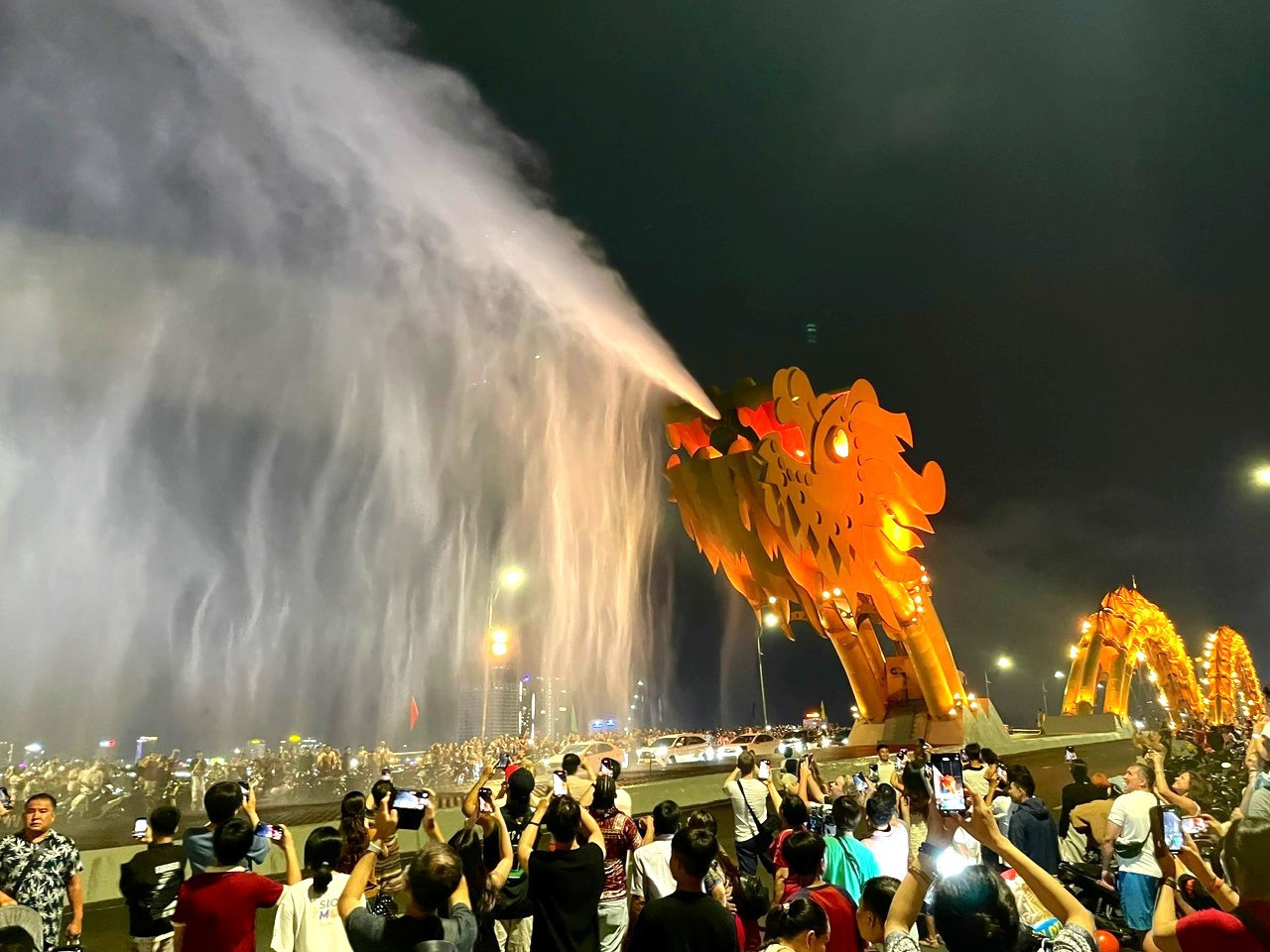
The first time he flipped the switch was the first time he tested the system on the bridge, sending a jet of water more than 250 meters into the distance.
At 9pm every weekend, crowds of tourists gather by the Han River at the Dragon Bridge to witness the fire- and water-breathing show. Amid the cheers, 75-year-old engineer Phuong quietly reflects on the project tied to his intense race against time over 13 years ago.
At the time, Phuong served as Director of An Sinh Xanh Science and Technology JSC. He and his team developed a customized water-spouting solution for the Dragon Bridge utilizing his patented technology - hydropneumatic water mist technology.
Phuong recalled that in late February 2013, Da Nang city leaders required Dragon Bridge to feature both fire and water displays at its inauguration. A foreign contractor had already developed a solution for the fire-breathing effect, but the water-spraying problem remained unsolved. When the construction team approached him, just over a week remained.
After surveying the bridge, Phuong realized that the biggest challenge was figuring out how to run pipes through the completed structure without affecting the bridge itself.
“I asked myself a big question: How could we make the dragon spray water? Surely we couldn’t tear open the structure just to install the system,” he recalled.
To deliver water to the dragon’s mouth, he calculated that he needed a steel tank more than 3 meters in diameter and over 10 meters long, capable of withstanding high pressure and holding both water and compressed air.
No company in the city was willing to manufacture it, so he turned to a lecturer at the University of Science and Technology, the University of Da Nang. Fortunately, the lecturer agreed to help, and after several days of engineering work, the enormous tank was ready.
Because the tank had to be buried underground, it needed protection against corrosion. After several proposed solutions failed to meet the requirements, Phuong and his colleagues decided to coat the metal surface with heated bitumen.
Given its enormous size, the tank was transported at midnight and then lifted into position beneath the bridge using two cranes.
The next challenge was supplying water. Instead of drawing water from the Han River, Phuong opted to use the city’s clean water supply to minimize the risk of rubbish and sediment clogging the system and to ensure visitors’ safety.
“If water is going to spray over the heads of thousands of visitors, it has to be clean water from the city. River water can be murky one moment and clear the next, and rubbish could clog the system. We couldn’t afford to be careless,” he said.
To connect the water supply to the tank, the team had to dig up Tran Hung Dao Street. Work began at midnight and was completed overnight so traffic could return to normal the following morning. The pipes had to run hundreds of meters from the tank to the dragon’s mouth, pass through narrow gaps around the bridge’s base and then be connected.
Water jet shoots 250 meters in first test
Phuong’s goal was not merely to make the dragon spray water, but to create a powerful jet that spread into a vast cloud of white mist in the air. With the hydropneumatic water mist technology, he said, one cubic meter of water can produce around 1,300 cubic meters of mist.
To generate sufficient pressure, he ordered a three-piston air compressor from Hanoi to pump compressed air into the tank. However, because the dragon’s head had already been completed, the pipes had to detour around its teeth and could not be positioned at the roughly 45-degree angle he had wanted.
Dragon Bridge was inaugurated on March 29, 2013.
When asked how far the water could travel, Phuong could not give an exact answer. The completed system had never been tested on the bridge itself.
“Honestly, the inauguration day was also the first time I tested the dragon’s water-spraying system,” he said.
The switch was flipped, and a torrent of white water suddenly shot out, traveling more than 250 meters and prompting the crowd to erupt in applause and cheers.
After that project, the company Phuong had run eventually ceased operations. At 75, he lives in a small, damp rented room tucked deep inside an alley beside the railway tracks. Perhaps his most valuable remaining possessions are the numerous patents he has obtained in Vietnam and abroad over the years.
Ho Giap

