 Vietnamnet.vn

 Podcast



This is not a project for those seeking profit. It’s a test of how the state and enterprises can work together to “unlock” infrastructure that every nation must confront on the path to transformation - expensive, risky, but foundational to the future.
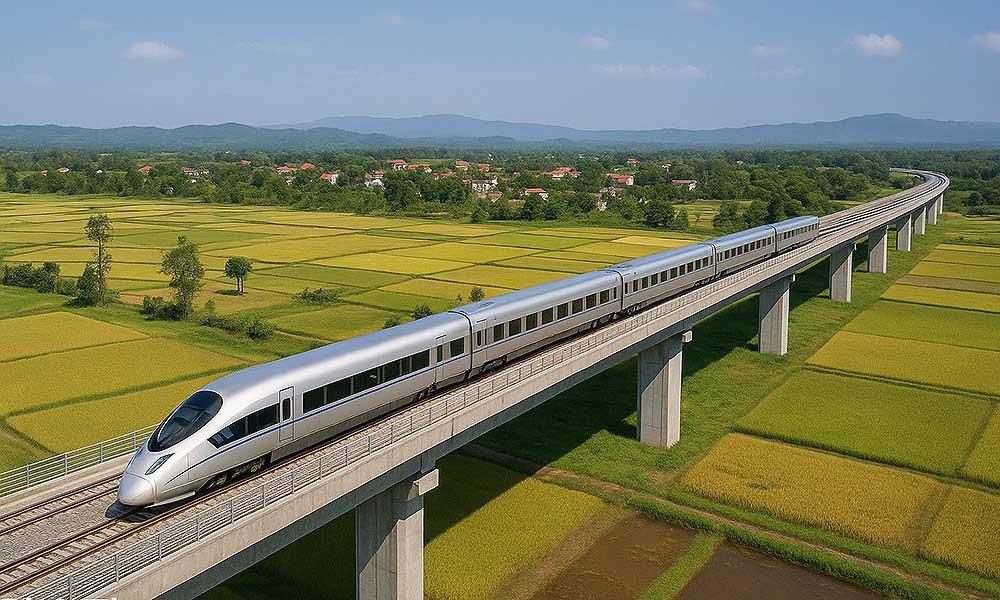
Vietnam’s North-South high-speed railway, approved by the National Assembly at a total investment of approximately USD 67 billion, stretches 1,541 km through 20 provinces. It is a true test of that question.
At this moment, VinSpeed - a Vingroup subsidiary - has stepped forward as the sole private investor expressing willingness to take on the project. Notably, the company has also proactively proposed removing TOD (transit-oriented development) from its financial model.
This decision is not only unusual in the infrastructure world but goes against the fundamental financial logic of modern rail transport.
A project both state and private sectors know will lose money
Submission No. 140/TTr-BXD to the government acknowledged an inescapable truth: no country has ever seen a private investor fully fund a high-speed rail line without massive government support.
The Ministry of Construction simulated one scenario: if the state loans 80% of the capital at a preferential interest rate of 1%, the loan’s value balloons to USD 64 billion after 30 years. At 5% interest, that figure soars to USD 182 billion. A small change in interest can collapse the financial model from the outset.
From the business side, VinSpeed painted an equally grim picture: average annual operating revenue is projected at just USD 5.6 billion, while direct operating costs alone would hit USD 4.2 billion annually.
To meet projected passenger demand, the investor would need to inject an additional USD 18.06 billion beyond the USD 61 billion project budget. Over 30 years, total cash flow is estimated at USD 42 billion; after paying commercial interest on a USD 10.51 billion loan, VinSpeed would retain just USD 10.5 billion - while owing the state USD 49.08 billion, not to mention over USD 10 billion in equity and train fleet replacements every 30 years.
Both the government and the company are saying the same thing: this is a guaranteed money-losing project. And even more so without TOD.
By rejecting TOD, Vingroup cuts off the world’s financial life jacket for rail
In countries like Japan, South Korea, Taiwan, and across Europe, TOD - urban development around stations - is the long-term financial engine that sustains rail systems. In many places, revenue from real estate near stations surpasses that of passenger transport.
Thus, VinSpeed’s proposal to exclude TOD is not just a technical decision - it’s a political signal. The company seeks to avoid any suspicion of "building rail to seize land" and wants the project to be judged purely on its own merits.
CEO Nguyen Viet Quang stated clearly: if real estate were the goal, Vingroup “wouldn’t need the excuse of a railway,” as station sites are often far from urban centers and far less attractive than the numerous investment offers the group already receives.
By removing TOD, the company eliminates the only possible source of revenue that could soften the projected tens of billions in losses over the coming decades.
What Vingroup gains: benefits beyond cash flow
First, stature. In a project considered the backbone of national infrastructure, a private company taking responsibility is a declaration of both capability and service - not a pursuit of profit.
Second, historical legacy. If implemented under the company’s proposal - an 80% interest-free state loan over 30 years and 20% self-financing - Vingroup would become the first private enterprise to lay the foundation for Vietnam’s high-speed rail industry.
Third, national creditworthiness. A company willing to shoulder losses for decades, pledging 30 years of dividends from its entire ecosystem, and prepared to sell stakes in GSM, VinEnergo, V-Green, or even Vingroup itself to preserve the project, will undoubtedly earn exceptional credibility.
But none of these are financial returns.
What Vingroup loses: burdens no other company dares bear
First, the ability to make the project self-sustaining is virtually zero. Without TOD, all operations will lose money. Cumulative losses could reach tens of billions of dollars.
Second, the 30-year financial strain. Chairman Pham Nhat Vuong has outlined a triple-layered financial buffer: first, all dividends from the entire Vingroup ecosystem over 30 years; if that falls short, selling stakes in subsidiary companies; and if still insufficient, selling part of Vingroup itself.
The state: retaining control while shifting risk to the private sector
For the government, the visible gains go beyond easing the budget burden. It shifts a significant portion of execution risk to the private sector while retaining control over national infrastructure.
By opting to lend 80% of the capital instead of funding 100% through public investment, the state retains decision-making authority and recoups its investment within 30 years - instead of waiting 140 years under traditional models.
Another major benefit lies in project speed and discipline - areas where the private sector often outperforms public investment systems - thus reducing risks of cost overruns, delays, or unforeseen expenses.
Moreover, letting an enterprise lead opens the door to developing a full high-speed rail industry - an ecosystem of technology, equipment, and skilled labor that the state alone would struggle to establish.
Throughout this process, Submission 140 proposes legal safeguards to exempt or reduce liability for officials involved in the project, helping the state overcome its chronic “fear of wrongdoing” - a major bottleneck delaying many national initiatives for years.
Conclusion
Abandoning TOD while still proposing to build a high-speed railway is not a business decision - it is a declaration of service.
The state gains a railway project at unprecedented speed; Vingroup gains stature but loses money, cash flow, and potentially financial safety.
This project is not for those chasing profits. It is a test of how Vietnam’s government and businesses can unlock transformative, future-building infrastructure - expensive and risky, but necessary.
Tu Giang
.svg)
