 Vietnamnet.vn

 Podcast



Deeply rooted in the cultural life of the Gie-Trieng ethnic group in Vietnam’s Central Highlands, the M’bin puil is more than a musical instrument - it is a vessel of emotion.
Traditionally, young men use this “love instrument” to express their heartfelt feelings in hopes of winning the affection of the girl they cherish.
Once married, the M’bin puil becomes a companion in family life, bringing joy and warmth during moments shared beside the hearth after long, laborious days.
A handcrafted work of art
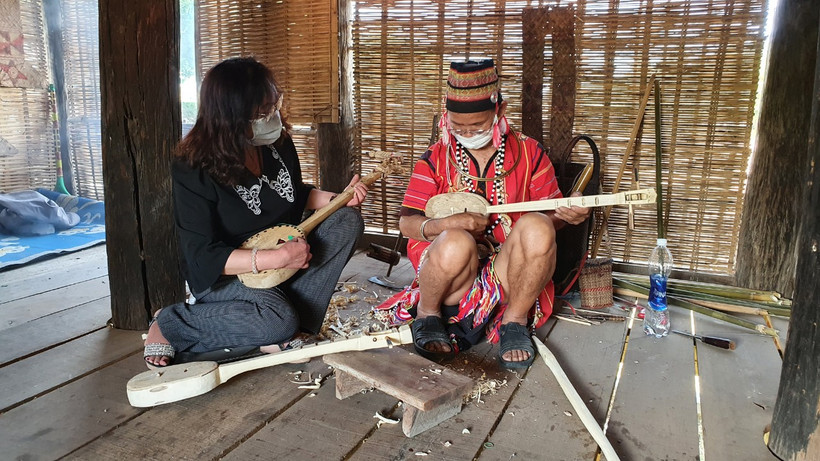
The M’bin puil resembles Western instruments like the guitar or mandolin in shape and structure but is crafted with much more intricate, meticulous techniques.
The resonator (called pok in the Gie-Trieng language) is made from a hollowed piece of wood carved into an oval shape. It has two small sound holes and is sealed with a lid affixed using wild beeswax.
Additional parts include the neck, tuning pegs, strings, frets, and bridge.
A distinctive feature of the instrument is the carved figure of a standing girl in traditional Gie-Trieng attire, which adorns the top of the tuning head.
According to Meritorious Artisan A Broh Ve from Dak Rang village in Dak Duc commune, Ngoc Hoi district, Kon Tum province, this carving is not mere decoration. It symbolizes that the instrument is specifically crafted for expressing love and courtship.
Crafting a M’bin puil requires patience, dexterity, and a keen ear. Every detail must be created with precision. Only those with a deep sensitivity to sound and refined manual skills can make a high-quality instrument with excellent tonal quality.
Carefully selected materials
The wood used must be chosen with care - typically from the hamal or sua tree, known for their acoustic properties.
The strings are made from the fibers of the dung dinh plant (a type of wild palm), harvested when the plant is mature enough to bear fruit but not too old, ensuring elasticity and resilience. Wild beeswax is also used to bind and secure various parts of the instrument.
The M’bin puil earns the nickname “love instrument” because it is used in specific social contexts. In the evenings, when a young Gie-Trieng man reaches maturity, he sits at the front of his stilt house and plays heartfelt melodies.
As the sound flows through the village, young women passing by may stop to listen. If they are moved by the music and feel a connection, they may initiate contact through a matchmaker.
The proposal ceremony is often discreet and simple, taking place at night. The bride’s family presents a small jar of rice wine and a chicken to the groom’s family. Gifts and dowries are exchanged in both directions, and a wedding date is chosen - often on a beautiful full moon night.
From that point on, the M’bin puil continues to accompany the couple, becoming a source of joy and connection in their shared life under one roof.
PV
.svg)
