 Vietnamnet.vn

 Podcast



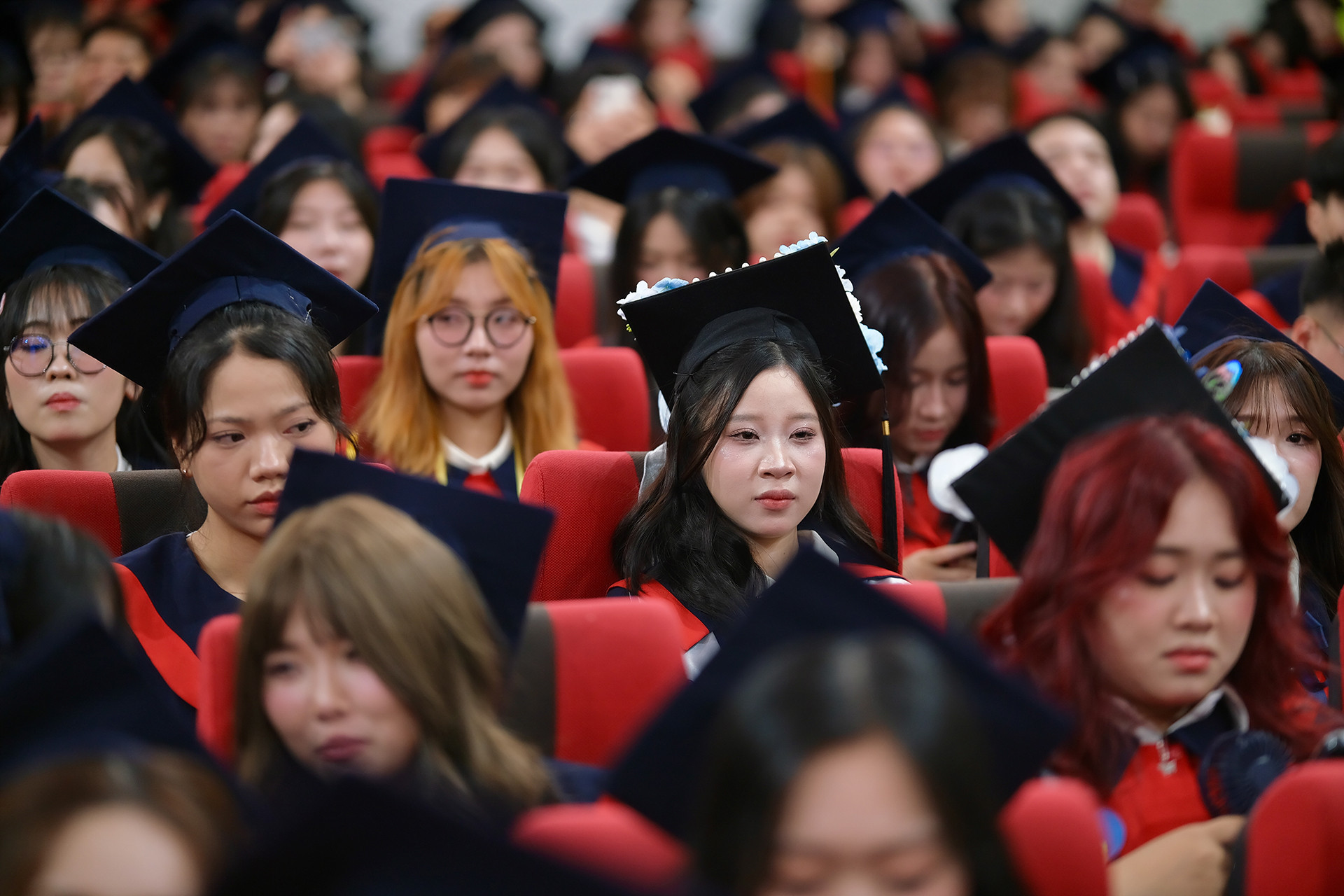
When talking to final-year students, their stories no longer revolve around grades or graduation exams, but rather a very specific anxiety: what to do after graduation.
One student studying finance said he is taking extra classes in data analysis, while a marketing student has registered for a basic programming course. They shared a common feeling that the degree they are about to hold might not be enough to go far.
That feeling is becoming more common nowadays as paths once considered stable have become unpredictable. A popular major today can become saturated after only a few years. A skill that was once an advantage can be quickly replaced, and what was considered certain yesterday needs re-evaluation today.
It is not difficult to recognize the change within university lecture halls. More than 10 years ago, majors such as economics, banking, or marketing were seen as a “golden ticket” to enter the labor market.
But in recent years, the picture has changed quickly. Many students graduating in those once "high-value" majors find themselves struggling to find jobs, while business demand has shifted toward different skills such as data, technology, artificial intelligence, or e-commerce.
All these changes are taking place precisely at a time when Vietnam is in a special stage, where the population structure is bringing a rare advantage. About 63 percent of the population belongs to the working age, equivalent to more than 60 million people, of which the youth, aged 18-35 account for more than 30 million, a large, young, and energy-rich force.
But quantity itself does not create strength if it is not accompanied by quality.
The overall unemployment rate of the country in 2025 was only about 2.22 percent, a low figure compared to many other economies, but when separating the youth group (from 15 to 24 years old), this rate reached 8.64 percent, and in the fourth quarter of 2025, it exceeded 9 percent, with the urban area even above 11 percent.
At the same time, about 1.4 million young people fell into the “three nos”: no job, no education, and no vocational training, accounting for about 10 percent of the total number of youth. When placing these numbers side by side, a fairly clear reality emerges: jobs are not necessarily scarce, but people who are suitable for the jobs are.
Meanwhile, many businesses still complain that they cannot recruit people who can work immediately because they lack practical skills, an ability to adapt to an international environment, and basic skills such as communication or teamwork.
In such a world, the question is no longer about choosing the right profession from the start, but how many times a person can relearn throughout their working life.
Lam emphasized that today's knowledge can quickly become obsolete if people stop learning, and learning is not just to have a job, but also to have enough capacity to shoulder larger tasks when the country needs it.
An education system that puts emphasis on students’ memorization ability than on thinking exercises will find it difficult to create flexible people. When learners are used to rote learning instead of problem-solving, they will be confused when they enter a fast-changing environment.
The gap grows even larger when the link between schools and businesses remains loose. Many things learned in the lecture hall cannot be used in work, while the skills businesses need are not in the curriculum.
An environment where experimentation always comes with too great a risk will make people afraid to try from the start. When mistakes carry a heavy price, the safe choice will always be prioritized, and the "daring to do" spirit gradually erodes.
Conversely, if trial-error-redo is accepted, and if those who dare to do don’t have to bear too great a price for failures, then learning can move beyond books. At that time, knowledge does not just stop at theory but can become a specific value.
Lan Anh
.svg)
