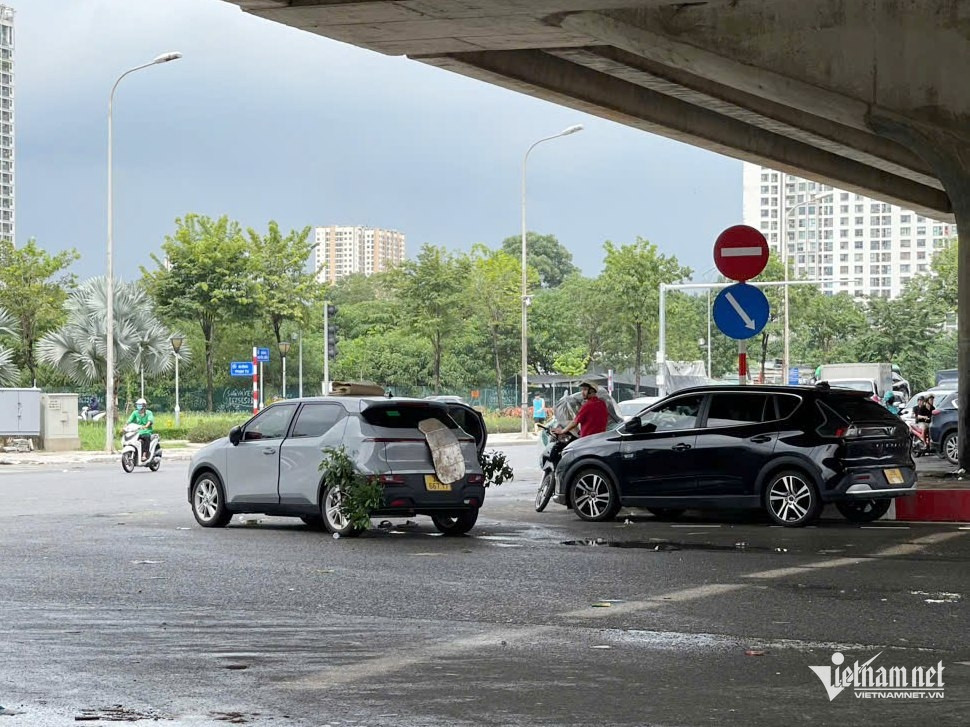
Historic downpours on September 30 turned thousands of vehicles into immobile wrecks. Despite nonstop rescue efforts, by the morning of October 1, the streets of Hanoi remained littered with waterlogged cars waiting to be towed.
Relentless rainfall from the remnants of Storm No. 10 submerged large parts of the capital in deep floodwater.
Thousands of residents and vehicles were left stranded on the streets for hours. Tens of thousands of cars stalled in the floodwaters and had to rely on rescue vehicles for assistance.
Rescue teams worked through the night to tow submerged vehicles. Photo: Hoang Hiep
Overwhelmed garages, endless rescue missions
On the morning of October 1, VietNamNet reporters observed flood-damaged cars still scattered across inner-city areas such as Dong Da, Cau Giay, Thanh Xuan, Hoang Mai, and former Tu Liem. Many vehicles sat along roadsides, sidewalks, and in front of apartment complexes.
Some cars wouldn’t start. Others had flickering warning lights or soaked interiors - yet all had to remain parked where they broke down, awaiting help.
According to rescue units, the number of cars affected by the September 30 flood may have reached into the tens of thousands - many times higher than in previous severe storms.
It wasn’t just low-riding sedans that needed towing. For the first time, many trucks and even electric vehicles had to be pulled to garages or repair centers.
Despite receding floodwaters, many cars still waited for assistance on the morning of October 1. Photo: Hoang Hiep
Do Quang Minh, a tow truck driver working in Thanh Xuan and Hoang Mai, shared that from 4 PM on September 30, his hotline was overwhelmed with calls from stranded drivers and auto shops.
“Flooding was deep, traffic was jammed, and we could barely move. We only managed to tow three cars overnight. Others had to wait until morning. Many of us worked until 3 or 4 AM but still couldn’t keep up. We prioritized small vehicles stranded on roads, while larger trucks or cars in basements had to wait,” Minh said.
Hoang Minh Sang, the owner of a roadside rescue center in Hanoi, added that while the normal towing rate for a vehicle within a 10 km radius is around USD 24–28, during the floods it surged to over USD 60 per call.
“The price hike wasn’t our goal, but the extreme weather and gridlock made every trip more difficult and dangerous. Our team had to wade through waist-deep water, navigate in darkness, and carefully tow vehicles while avoiding hazards. Even our rescue trucks risked stalling or getting stuck,” he explained.
At major garages across Hanoi, demand was overwhelming from midnight onward. Desperate car owners tried booking repair slots but were mostly told “fully booked” or “bring it in and we’ll look later.”
“Even tow trucks had to wait in line. Some customers offered extra money for priority service, but even then, we couldn’t promise immediate repairs,” said the owner of a garage on Nguyen Xien Street.
After the flood: Hidden damage and repair nightmares
Among the greatest fears for drivers whose cars are submerged is “hydrolock” - a condition that occurs when water enters the engine combustion chamber and prevents the pistons from moving.
When this happens, the damage can be severe, with repair costs reaching thousands of dollars. Many owners are left with a tough choice: keep the now-unreliable car or sell it at a major loss.
Automotive engineer Le Hong Dai, director of Dai Linh Auto Service in Dan Phuong, explained that hydrolock happens when water or other liquid enters the combustion chamber through the air intake, blocking piston movement and preventing fuel ignition.
If the driver attempts to restart the car in this condition, the pressure can bend the connecting rods, crack the crankshaft, or even shatter the engine block.
“This is one of the most severe and complicated automotive failures. It requires replacing or rebuilding numerous components and involves extensive labor. That’s why repairs can cost tens of millions of dong (thousands of dollars),” Dai noted.
Hydrolock and water damage can ruin an engine, electrical systems, and interiors - causing serious long-term problems. Drivers must know how to respond appropriately when caught in deep water.
A stalled truck on Pham Tu Street being towed on the morning of October 1. Photo: Hoang HiepRepairing a flood-damaged car often requires enormous effort. Photo: Le Hong Dai
Tips from experts to limit flood damage:
Avoid deep water: Observe water levels during rain. If water rises above half the wheel height, find another route or park on high ground.
Never restart a flooded engine: If your car stalls in water, do not try to restart it. This could draw more water into the engine. Instead, remove the key, cut off the power, and push the car to a dry area.
Call for help early: Contact a trusted rescue service as soon as possible. While waiting, disconnect the battery, open the doors to drain water, and dry the seats and floor to reduce mold and damage.
Get a full inspection post-flood: At the garage, check the engine, transmission, fluids, and entire electrical system. If water is detected in the oil or transmission fluid, replace it immediately. Also, inspect brakes, airbags, and wiring thoroughly.
Experts also recommend monitoring weather forecasts, avoiding low-lying parking spots near rivers or underground garages, and purchasing vehicle insurance that covers flood and natural disaster damage to ease the financial burden.
 Vietnamnet.vn

 Podcast







.svg)
