 Vietnamnet.vn

 Podcast



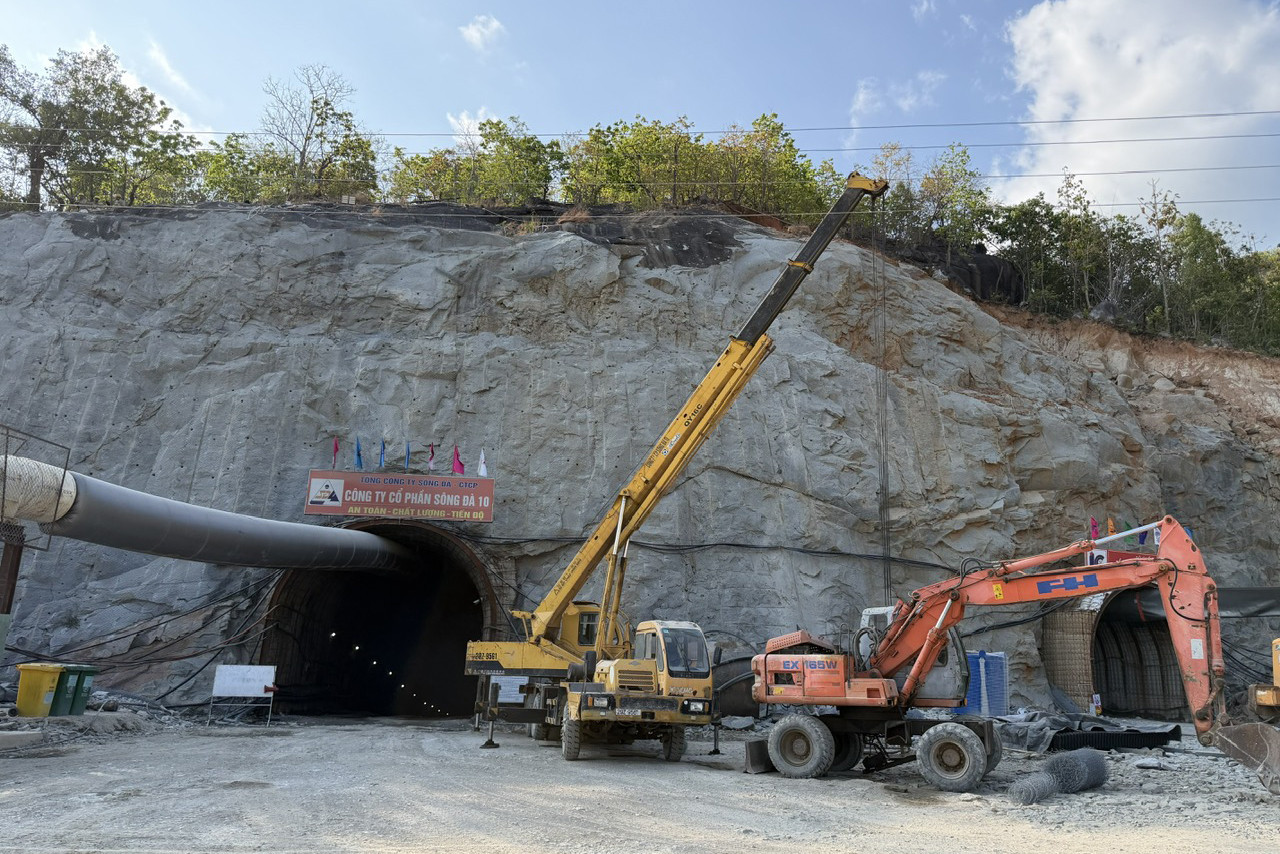
In the race for double-digit growth that Vietnam is pursuing, electricity is not just an input for production, logistics and daily life, but also a foundational condition.
All power projects in Vietnam are operating at maximum speed while still ensuring safety in an effort to add to the country's power sources.
The expanded Tri An Hydropower Plant, with investment capital of nearly VND4,000 billion, adding 200 MW and expected to generate power by the end of 2027, serves as a flexible source to cover peak loads and regulate frequency for the South, where the load during the hot season is always the heaviest in the country.
The Bac Ai Pumped-Storage Hydropower Plant, with a capacity of 1,200 MW and capital of over VND21,000 billion, is very different: it has the ability to store electricity during off-peak hours and discharge it back onto the grid during peak hours. In a system where wind and solar power is increasing, this is the first “mechanical battery” on a national scale.
Meanwhile, the Quang Trach II LNG power plant, 1,500 MW, with total capital of over VND52,490 billion, and expected to operate commercially in the 2028–2029 period, represents a large-scale gas baseload power source, which emits less than coal and is capable of keeping the load stable for the Central region as well as the North-South interconnection corridor.
In the decades following Doi Moi (Renovation), the power industry has always been “one step ahead”, a phrase that the late Prime Minister Do Muoi often used in the early 1990s.
Vietnam’s power system
Currently, the total installed capacity of Vietnam's power system is about 87,600 MW, ranking second in Southeast Asia and 22nd in the world. The economic and technical indicators of the power system are among the leading group in ASEAN.
Regarding the electricity access index, the World Bank's “Doing Business” report ranks Vietnam's electricity service quality second in Southeast Asia after Singapore. This result reflects the continuous improvement efforts of Vietnam Electricity (EVN) in system operation and customer service over many years.
But according to the plan, by 2030, the system must reach the capacity of 183,000 MW, which is nearly double the current capacity.
Electricity of Vietnam (EVN) estimates that it will have to develop about 13,000 MW of new power sources by 2030 alone, while the remaining nearly 83,000 MW will be implemented by other investors. Ensuring electricity for high growth is no longer a problem for a single enterprise but for the entire national energy ecosystem.
In 2025, the capacity of the entire system only increased by about 6,400 MW. This means that to go from the current level of 87,600 MW to the 183,000 MW mark by 2030, on average, Vietnam must put into operation approximately 20,000 MW of new power every year, many times faster than the current addition pace.
These figures show that developing electricity for high growth is no longer a story of a few key projects, but a race against time for the entire economy.
In that context, the statement of EVN President Dang Hoang An at a recent Government conference is worth pondering: If we do not invest today, we will face the risk of power shortages in five years because a power source project usually needs about five years to be implemented.
Electricity must always stay ahead of growth. A factory, an industrial park, a logistics center, or a new urban area can be completed in two to three years, but if the power source is not prepared in advance, the entire investment efficiency will be very difficult to guarantee.
EVN is carrying a huge investment pressure. In the past five years, this group has invested nearly VND500,000 billion in power sources and grids; in 2024 alone, it disbursed nearly VND112,892 billion, and in 2025 it reached VND125,778 billion. In the next five years, EVN expects to continue pouring in about $25 billion for electricity infrastructure, equivalent to about $5 billion per year.
This means that every year EVN must concentrate an enormous amount of capital for both 13,000 MW of new power sources and the synchronized grid system that goes with it.
The problem is that EVN cannot carry it alone. The challenge is even greater as EVN currently only holds about 36 percent of the installed capacity and 40 percent of the electricity output, meaning that ensuring power supply for high growth heavily depends on the progress of Petrovietnam, Vinacomin, and the private sector.
Lan Anh
.svg)
