 Vietnamnet.vn

 Podcast



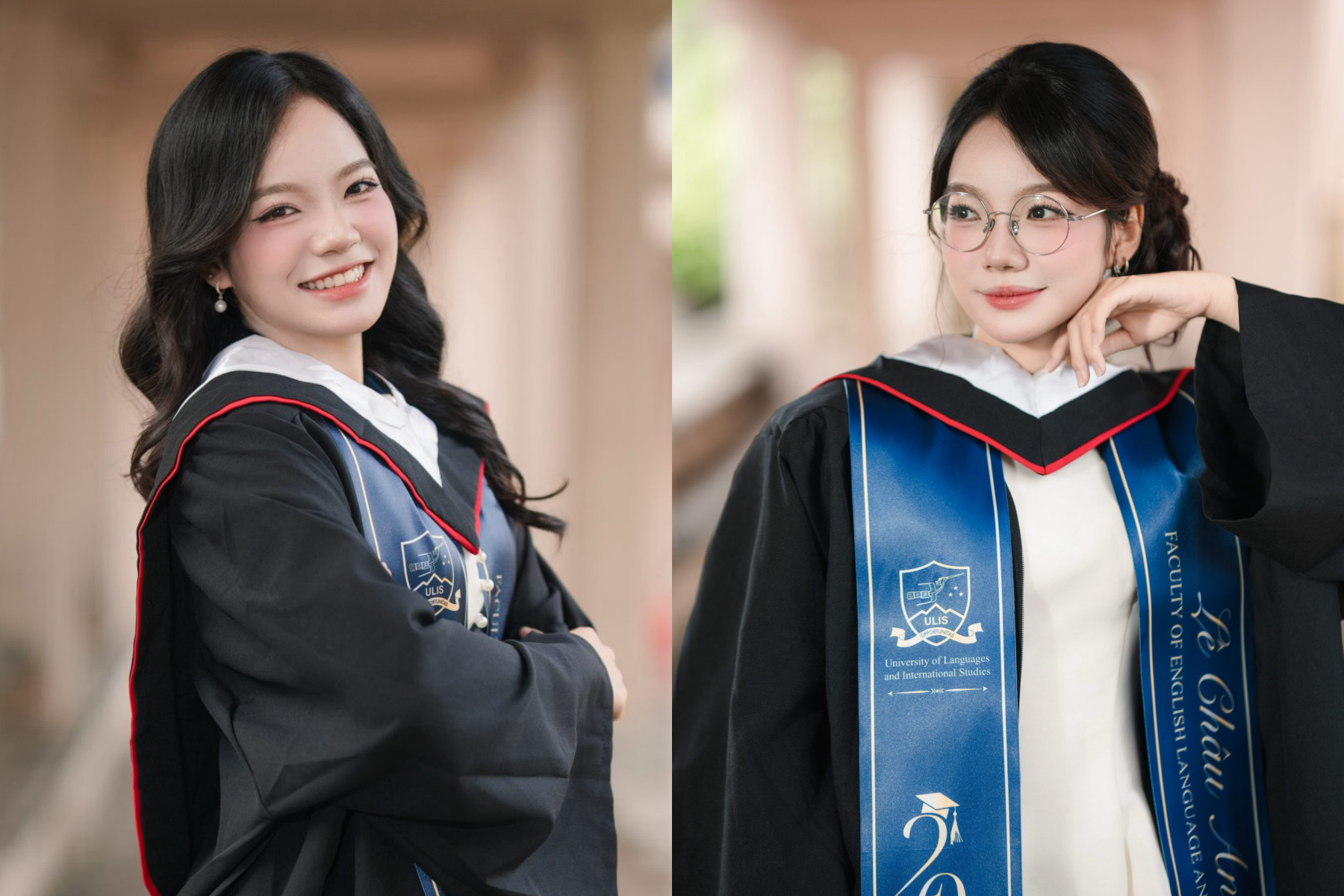
Born in 2004, Phuong Anh and Chau Anh recently graduated with degrees in English Language Teacher Education from the University of Languages and International Studies under the Vietnam National University, Hanoi. Before that, the sisters studied in the English-major class at Lam Son High School for the Gifted in Thanh Hoa, where they both won prizes in the provincial English competition and achieved an IELTS score of 8.0 in the 11th grade.
After four years of university, both sisters have graduated with honors.
“The moment we both walked onto the stage to receive our degrees, our parents were teary-eyed as they held up their phones to capture every moment. These degrees are not only the result of our efforts but also the fruits we wanted to give our parents, who have been wonderful ‘investors’ in us for more than 20 years,” the sisters said.
Childhood as inseparable twins
From an early age, Phuong Anh and Chau Anh were inseparable. They looked so much alike that even their parents sometimes got confused, “washing one child’s face twice while the other was still covered in dirt.” Despite their similar appearance, their personalities began to diverge early on. Phuong Anh was calm and observant, while Chau Anh was more outgoing, playful and mischievous.
Born into a family with a teaching tradition, with both their mother and older sister working as teachers, the twins were introduced to English by their sister when they were four years old. This gradually sparked their passion for the language.
In high school, Phuong Anh decided to pursue foreign languages after realizing it could open doors to different cultures and opportunities.
Chau Anh, meanwhile, seriously considered pursuing a career in the arts for a while because she loved creativity and imagination. But when it was time to choose a university, she realized that her greatest wish was still standing at the lecture podium, just like her mother and older sister.
Both decided to apply to the English Language Teacher Education program at the University of Languages and International Studies.
Upon entering university, they recognized that the academic environment differed vastly from high school. To maintain high academic standing, they understood they could not rely on passive learning methods.
In class, they focused intently on lectures. When completing assignments or projects, both assumed group leader roles, allocating responsibilities and taking ownership of overall progress.
Throughout their four years, the sisters adhered to three core principles: being proactive and responsible, selecting like-minded peers, and actively participating in academic and extracurricular activities.
As a result, Phuong Anh and Chau Anh won First Prize in university-level scientific research, participated in the national Eureka Student Scientific Research Competition, published scientific articles, and earned the city-level "Student of 5 Merits" title.
Refusing to become carbon copies
Despite walking side by side on every journey, the twin sisters maintained an unspoken rule: respecting each other's private space and independence.
"Beside our shared circle of friends, we joined different activities to expand our own separate networks," Chau Anh noted.
Nevertheless, Chau Anh admitted that "constantly being compared" was unavoidable. "At times, we placed internal pressure on ourselves for fear of falling behind the other. Especially during peak periods, feelings of exhaustion and self-doubt intensified.
“However, rather than turning that pressure into envy or panic, we chose to reframe our perspective because the other person is a support pillar, not a competitor. Thanks to that, we gained extra motivation to move forward," Chau Anh said.
She added that walking together does not mean turning into a copy or dissolving into the other person; rather, it resembles two parallel lines advancing toward a shared direction.
Throughout four years of university, the sisters served as both "close confidantes" and "teammates," supporting each other by critiquing lesson plans, reviewing presentation slides, providing feedback on research drafts, and reminding each other of study schedules.
Phuong Anh recalled nights when both stayed up until dawn to review coursework. Instead of studying individually, they devised a mutual support method: one person summarized core theory and key knowledge for the other to hear, after which they swapped roles. This study method kept them alert and accelerated memory retention.
Thuy Nga
.svg)
