 Vietnamnet.vn

 Podcast



As Vietnam strengthens its policy framework, legal foundation, national strategy and science and technology programs for the semiconductor industry, one question remains: how can the country move further up the global semiconductor value chain?
From a practical perspective, turning chip designs into fully manufactured integrated circuits still faces significant obstacles.
According to the Ministry of Science and Technology, Vietnam's semiconductor ecosystem currently includes around 60 chip design companies, 7,000 engineers and 166 universities and higher education institutions involved in workforce training.
Despite this growing potential, the country's research and tape-out infrastructure remains limited.
Research teams, universities and businesses still rely largely on overseas foundries for prototype manufacturing.
Each tape-out typically costs between US$30,000 and US$200,000, while waiting times range from 12 to 24 months.
These constraints make semiconductor research expensive, extend product development cycles and limit commercialization opportunities.
Experts therefore argue that Vietnam should clearly define priority products while building shared infrastructure to avoid spreading resources too thin.
Three priority product groups
Speaking at the launch of the National Semiconductor Chip Prototype Support Center (VNMPW/CC) on June 26, leading semiconductor experts agreed that Vietnam should avoid investing broadly across too many directions at once.
According to Nguyen Thi Bich Yen, Chairwoman of VSAP Lab, the country should initially focus on three product groups that match existing capabilities, respond to practical demand and offer long-term growth potential.
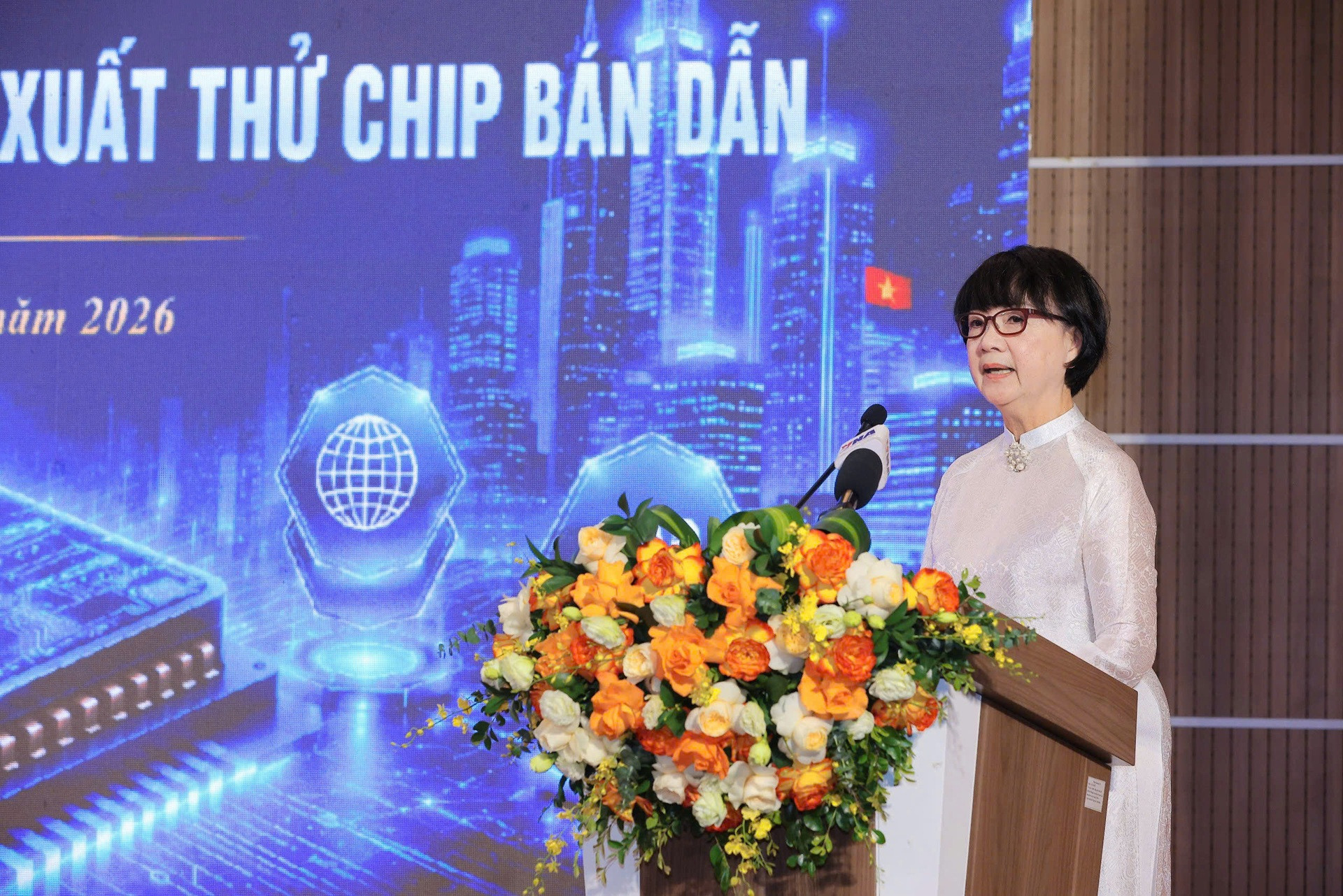
"We do not necessarily have to compete immediately in the most advanced technology nodes. Vietnam can begin with simple functional chiplets, test vehicles, reusable intellectual property blocks, package design, substrates, interposers, die-to-die testing and post-packaging reliability evaluation," she said.
The first priority is Edge AI chips or neural processing units (NPUs) optimized for the Vietnamese language and specialized domestic applications.
Demand for these products is expected to grow across public administration, healthcare, education, transportation and smart city systems.
Rather than developing large-scale AI processors, Vietnam could initially build smaller AI accelerators for tasks such as Vietnamese speech recognition and optical character recognition (OCR).
The second priority includes microcontroller units (MCUs) and system-on-chip (SoC) products for Internet of Things (IoT) applications integrated with hardware security.
These products rely on mature, cost-effective technologies while meeting growing requirements for data security and device authentication within digital infrastructure.
The third priority focuses on chiplets combined with advanced packaging technologies.
Instead of manufacturing one large and highly complex chip, chiplet architecture divides the system into multiple specialized components - one chiplet for AI processing, another for memory management, another for security, another for data communication and another for power management.
These chiplets do not need to use the same manufacturing node. They are assembled closely together and interconnected within a single package through advanced packaging technology.
Nguyen Thi Bich Yen compared the concept to constructing a house: rather than building one enormous structure from the beginning, developers first build individual functional blocks before connecting them into a unified complex.
Components requiring higher performance can adopt more advanced manufacturing technologies, while control, security, power management and communication functions can rely on mature and more economical process nodes.
Collaboration is essential

Alongside product priorities, experts emphasized that Vietnam's semiconductor ecosystem also requires a different approach to collaboration.
A strategic technology project cannot depend solely on a single research institute, university or company.
Minister of Science and Technology Vu Hai Quan said building a semiconductor industry requires strong collaboration.
"We cannot move forward independently or in isolation. Clear cooperation is essential," he said.
Modern semiconductor laboratories, particularly cleanrooms, require investment far beyond the capacity of many small and medium-sized enterprises.
To address this challenge, the ministry plans to establish shared laboratories and testing centers across different economic regions.
Minister Vu Hai Quan also raised three key questions for Vietnam's semiconductor ecosystem.
The first concerns improving workforce quality, as universities continue to face shortages of senior teaching experts, laboratory equipment and practical training facilities.
Recalling a foreign semiconductor company's decision to invest in Vietnam because of the country's talented engineers, he asked: "How can we nurture these talents? Only such people will be able to participate deeply in the industry and create real breakthroughs."
His second question focuses on moving further up the global value chain.
Government agencies need to better understand the needs of small and medium-sized enterprises in areas such as manufacturing processes, materials and equipment so that shared infrastructure can be planned effectively.
Finally, he stressed the importance of clearly identifying Vietnam's flagship semiconductor products for the coming years in order to maximize accumulated technological capabilities while avoiding fragmented investment.
He called for further recommendations from leading experts, government agencies, universities, research institutes and businesses.
Du Lam
.svg)
