 Vietnamnet.vn

 Podcast



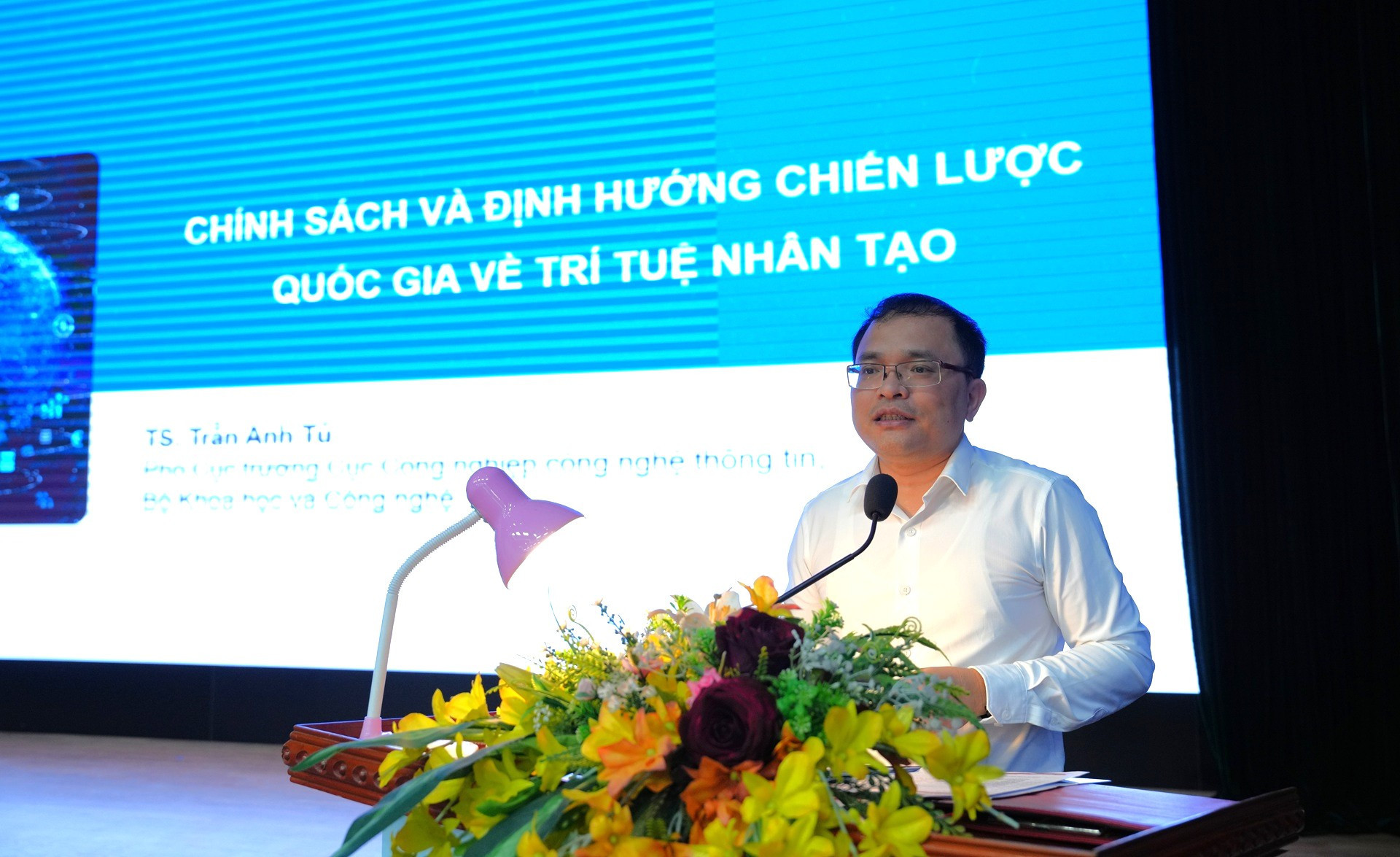
Dr. Tran Anh Tu, deputy director of the Department of Information Technology Industry under the Ministry of Science and Technology, outlined the country's proposed AI policies and strategic direction during a presentation at the AI for Cryptography and Information Security 2026 (AI4CRIS 2026) national scientific conference on August 14.
According to Tu, the ministry is submitting the draft strategy, tentatively titled the "National AI Transformation Strategy," to the Prime Minister. Its technical content has largely secured agreement among relevant ministries, agencies and organizations.
The approach represents a shift from simply incorporating AI into products, services and processes toward more comprehensive transformation driven by the technology.
Under the strategy, AI would become a core capability from the earliest stages of identifying problems and designing solutions through to their operation.
Nine pillars for AI transformation
The draft National AI Transformation Strategy through 2030, with a vision to 2045, identifies nine pillars: nationwide AI skills and human resources; AI data and models; AI infrastructure; research, development and technological mastery; AI in national governance; AI across industries and sectors; AI for small and medium-sized enterprises, household businesses and cooperatives; the AI ecosystem; and safe and trustworthy AI governance.
The first five pillars focus on building foundational capabilities and making AI a core tool for governance, research and innovation.
Human resources are considered a decisive factor, with plans to develop AI experts and talent, retrain the workforce and expand access to AI skills.
For data and models, the strategy seeks to open up, connect and share high-quality data, develop a data market and establish control over AI models suited to different scales and purposes, including Vietnamese-language models and evaluation benchmarks.
AI infrastructure would encompass computing capacity, cloud computing, edge AI and data centers.
The draft also refers to a platform for coordinating computing resources, while calling for infrastructure to be developed in a greener, more energy-efficient way that makes effective use of resources.
The research, development and technological mastery pillar focuses on AI centers of excellence, research alliances and the use of AI to address major national challenges.
Priority areas include Make in Viet Nam AI, core technologies, next-generation AI, physical AI, robotics and open technology ecosystems.
In national governance, AI is envisioned as supporting policy analysis, forecasting, decision-making, public services and government operations.
The draft also proposes AI assistants for public officials, intelligent operation centers and digital twins.
The remaining four pillars focus on bringing AI deeper into the economy.
Targeted areas range from scientific research, manufacturing, logistics, transportation and agriculture to finance and banking, healthcare, education, energy and telecommunications.
Notably, small and medium-sized enterprises, household businesses and cooperatives have been designated a separate pillar.
The aim is to help these groups gain affordable access to AI cloud services, APIs, data, computing resources, tools and training.
In parallel, the strategy seeks to develop AI companies, startups, centers of excellence, industry clusters and an AI market, while promoting open-source technologies and the commercialization and export of AI products and services.
The final pillar focuses on safe and trustworthy AI governance, covering legal compliance, ethics, safety, security, testing, evaluation and the monitoring of AI systems.
Measurable targets set for 2030
By 2030, the draft strategy aims to place Vietnam among Southeast Asia's top three countries for AI research and development, with the AI economy accounting for around 6% of GDP.
Labor productivity in sectors adopting AI is targeted to increase by 10-15%, while exports of AI-integrated products, services and solutions are expected to reach approximately US$5 billion.
Around 60% of businesses adopting AI are expected to record higher productivity, lower costs or increased revenue.
In the public sector, the target is for 60% of leadership and administrative decisions to be supported by data and AI.
Looking toward 2045, Vietnam aims to rank among Asia's 10 leading countries in AI capabilities, with artificial intelligence becoming a primary operational foundation for government, the economy and society.
For the public sector, the draft sets a target for 100% of ministries, government agencies and local authorities to issue AI transformation plans.
It also calls for 100% of online public services and administrative procedure records to receive AI support.
Human resources represent another major focus.
Vietnam aims to develop 10,000 highly specialized AI professionals and at least 50,000 workers with university-level or higher AI qualifications.
Another 500,000 workers would undergo retraining, while at least 10 million workers would be equipped with basic AI skills.
To achieve these goals, the draft outlines six groups of breakthrough measures: improving institutions and policies; strengthening national coordination and implementation responsibilities; mobilizing resources and securing funding; expanding international cooperation and developing standards and technical regulations; raising awareness and fostering a culture of responsible AI use; and establishing measurement, monitoring and evaluation mechanisms.
The strategy therefore goes beyond simply encouraging AI development and adoption.
It seeks to measure the technology's tangible impact on productivity, costs, revenue, governance quality and the competitiveness of the Vietnamese economy.
Those measurements would also provide a basis for determining whether AI transformation is genuinely changing the way businesses and government agencies operate - and ultimately how the technology affects society as a whole.
Du Lam
.svg)
