 Vietnamnet.vn

 Podcast



As part of the delegation accompanying General Secretary and President To Lam and his wife on a state visit to Russia, Vietnam’s Minister of Ethnic and Religious Affairs Nguyen Dinh Khang held talks with Stanislav Bedkin, deputy head of Russia’s Federal Agency for Ethnic Affairs, on Sept. 8 local time.
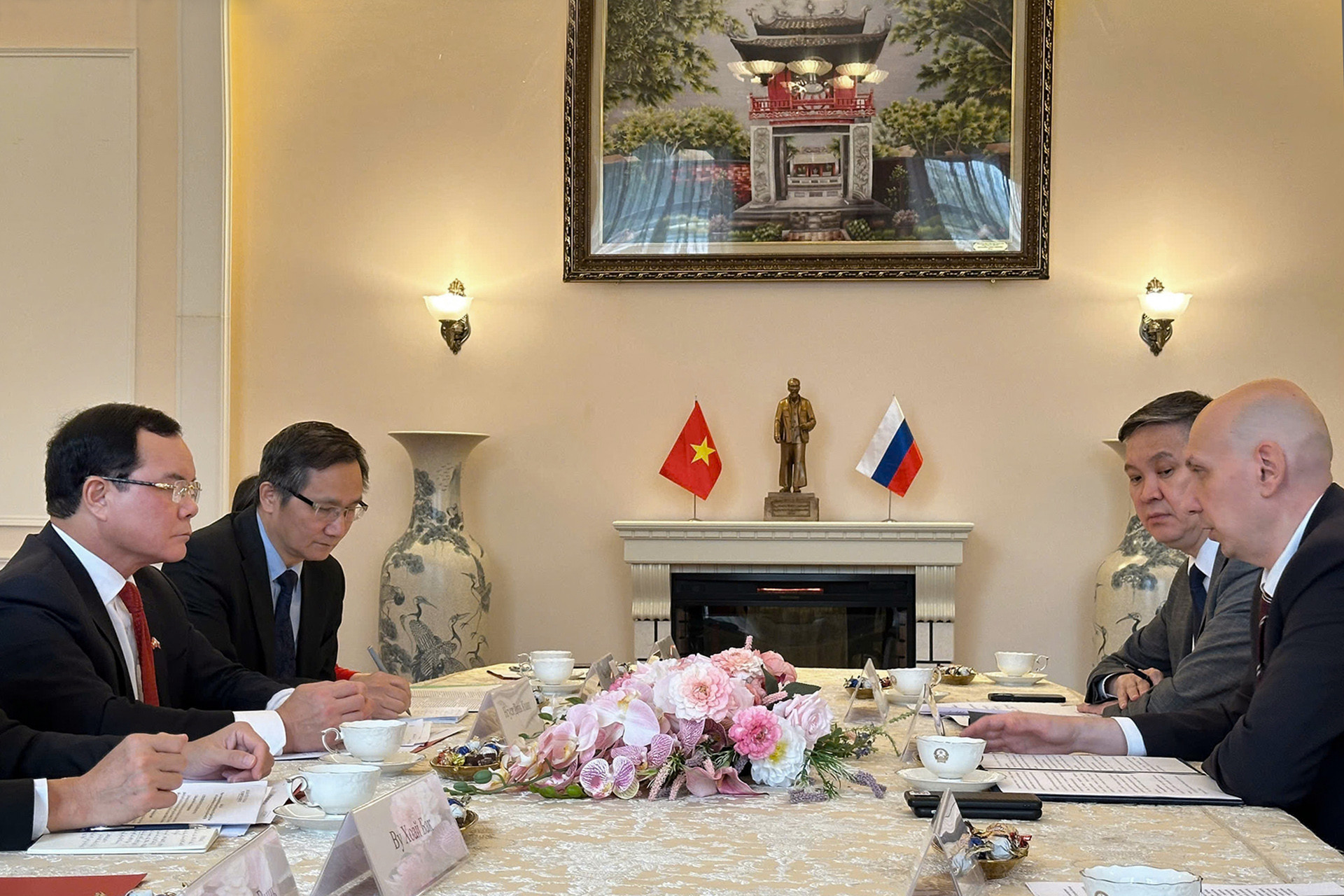
During the meeting, Khang signed a memorandum of understanding on cooperation between Vietnam’s Ministry of Ethnic and Religious Affairs and Russia’s Federal Agency for Ethnic Affairs.
Khang stressed the importance of strengthening exchanges and cooperation between the two government agencies responsible for ethnic affairs.
He said Vietnam is home to 54 ethnic groups, with its 53 ethnic minority groups accounting for more than 14% of the country’s population.
Vietnam also has 16 religions with around 28 million followers, representing approximately 28% of the population.
Khang said Vietnam’s Party and State regard ethnic affairs as a long-term strategic priority linked to strengthening national unity, maintaining political and social stability, promoting socioeconomic development, and preserving and promoting the cultural identities of different ethnic groups.
The Ministry of Ethnic and Religious Affairs is the government agency responsible for state management of ethnic affairs, religion and beliefs.
Khang said the ministry places particular importance on international cooperation and exchanges of experience with agencies responsible for ethnic affairs in other countries, particularly those with ethnically diverse populations and experience in developing and implementing related policies.
Moving toward practical cooperation
Vietnam has maintained and developed cooperation with agencies responsible for ethnic affairs in countries including Laos, Cambodia, Thailand and China, while expanding exchanges with other partners.
These activities have included delegation exchanges, sharing experience in policymaking, people-to-people and cultural exchanges, education and scientific cooperation.
Such cooperation has contributed to greater understanding among ethnic communities as well as between Vietnam’s specialized agencies and their counterparts overseas.
Khang praised the coordination between the Vietnamese and Russian sides in completing the memorandum of understanding.
He said its signing was significant because it established a framework for the two agencies to increase exchanges and cooperation in areas of mutual interest.
Khang said Vietnam attaches importance to its Comprehensive Strategic Partnership with Russia and sees considerable potential for cooperation between the two agencies in ethnic affairs.
He expressed hope that Russia’s Federal Agency for Ethnic Affairs and Vietnam’s Ministry of Ethnic and Religious Affairs would turn the areas agreed in the memorandum into concrete, practical and effective cooperation.
Strengthening the foundations of Vietnam-Russia ties
For the Russian side, Bedkin said the memorandum would help strengthen relations between the two countries in ethnic policy while facilitating joint activities in culture, science and education.
He said Russia and Vietnam share a longstanding tradition of friendship and similarities in the importance they place on historical heritage and the cultural diversity of their peoples.
Russia is home to representatives of more than 190 ethnic groups, with around 300 languages and dialects in use, according to Bedkin.
He said Russia’s experience in managing an ethnically and culturally diverse society offered significant scope for the two countries to exchange expertise and examine approaches suited to their respective circumstances.
Under the program, Khang and I.V. Barinov, head of Russia’s Federal Agency for Ethnic Affairs, were scheduled to exchange the cooperation memorandum during state-level activities in Moscow later in the day.
Thai An
.svg)
