 Vietnamnet.vn

 Podcast



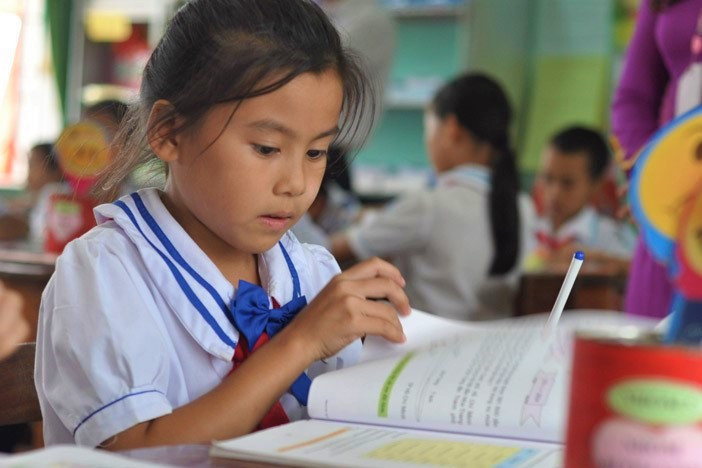
On December 26, the Ministry of Education and Training officially announced the selection of a unified national textbook series for general education, to be implemented from the 2026–2027 academic year.
The chosen series, “Connecting Knowledge with Life,” published by the Vietnam Education Publishing House, will be used uniformly across the country.
Why “Connecting Knowledge with Life” was chosen
The Ministry noted that after evaluating current textbook options against a set of standardized criteria, the “Connecting Knowledge with Life” series stood out.
This series covers all subjects and educational activities comprehensively across primary, lower secondary, and upper secondary levels. It has been widely used in all 34 provinces and cities, serving the largest number of students among existing textbook series.
Its scientific and pedagogical quality has been validated through practical implementation.
In addition, it offers the highest level of content stability, easy revision, and readiness for deployment. The publisher has the logistical capacity to distribute the books nationwide, ensuring reliable supply.
The ministry emphasized that this series minimizes disruptions for teachers, students, and parents. Teachers are already familiar with its lesson structure and teaching methods, and it is currently the most widely adopted textbook set.
Benefits for teachers
A unified textbook system will reduce fragmentation in teaching materials, allowing for smoother implementation of lessons.
Teachers will follow a consistent pedagogical design, with standardized lesson structures, terminology, and learning objectives. This reduces the burden of choosing materials and eliminates inconsistencies in content delivery between provinces.
Professional development programs and teacher training will also be more cost-effective and targeted, as all training will focus on a single textbook system.
This enables teachers to dedicate more time to refining teaching methods, applying educational technology, assessing student performance, and developing supplementary learning materials.
Benefits for students
With a single textbook series, students across Vietnam-regardless of region-will gain equitable access to knowledge.
The consistent curriculum from grades 1 through 12 ensures smooth knowledge progression and helps prevent educational gaps, especially for students in difficult circumstances or those whose families migrate during the school year.
By 2030, all textbooks will be provided free of charge, easing the financial burden on families.
As the books are gradually digitized, students will also gain access to open learning platforms, exercises, videos, and simulations-tools that foster engagement, independent study, and lifelong learning.
Impact on society and the education system
Nationally standardizing textbooks stabilizes Vietnam’s learning materials policy, fostering public trust and consensus in education reform.
The move will significantly reduce annual household spending on textbooks, especially benefiting students in disadvantaged areas.
It also helps local governments plan budgets and manage textbook procurement more effectively, while reducing communication and implementation challenges.
A strategic education reform directive
The decision aligns with Resolution 71 issued by the Politburo, which calls for a breakthrough in education and training development.
It also supports the Government’s Resolution 281/NQ-CP, which lays out the action plan to implement Resolution 71.
From the 2026–2027 academic year onward, Vietnam will use a unified textbook series nationwide, with full free textbook provision expected by 2030.
This policy is part of a broader strategy to standardize education content, ensure equal access to knowledge, promote digital transformation, and build a national learning resources ecosystem.
Toward an equitable, digital future
The unified textbook policy is expected to enhance government oversight of educational materials, reduce household costs, promote fairness in education, and support both teachers and students with a consistent learning framework from grade 1 through 12.
It also lays the groundwork for digitalizing textbooks, creating an open digital resource hub, and gradually offering free textbooks to all students as planned.
Thanh Hung
.svg)
