 Vietnamnet.vn

 Podcast



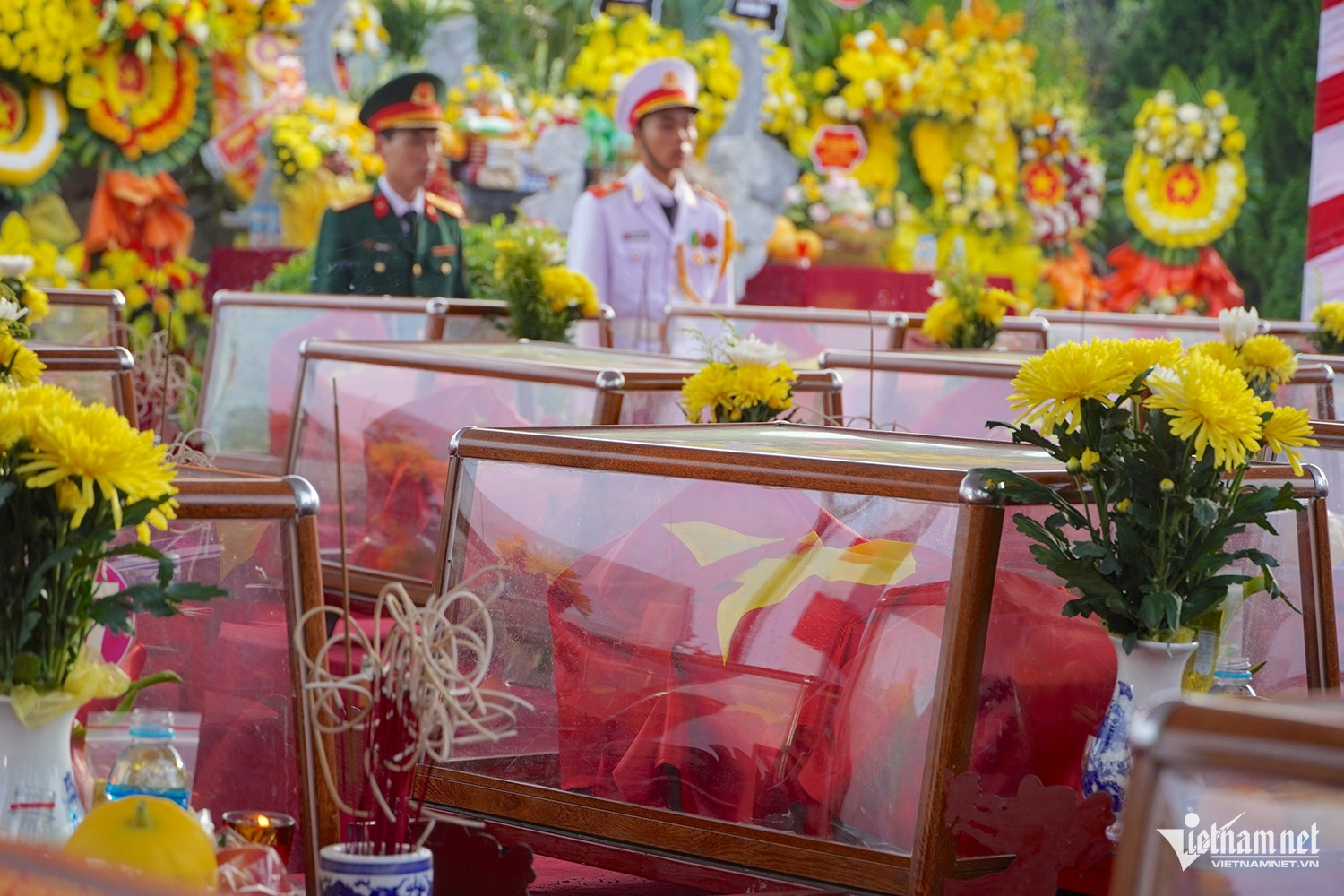
According to representatives of the National Steering Committee, the Party and State have for many years attached special importance to the search, recovery and identification of fallen soldiers' remains, as well as the construction of martyrs' cemeteries, memorial monuments and commemorative markers honoring those who sacrificed their lives for the nation.
To date, more than 1.075 million martyrs' graves and remains have been located and recovered. However, the search, recovery and identification process continues to face significant challenges and complexities. Authorities estimate that more than 175,000 fallen soldiers' remains still need to be found and recovered, while nearly 300,000 graves in martyrs' cemeteries remain unidentified.
Nationwide campaign targets thousands of identifications
The National Steering Committee has launched the "500-Day Campaign to Accelerate the Search, Recovery and Identification of Fallen Soldiers' Remains," running from March 15, 2026, to July 27, 2027, in preparation for the 80th anniversary of War Invalids and Martyrs Day.
The campaign aims to recover approximately 7,000 sets of remains, complete sampling procedures for around 230,000 unidentified graves in martyrs' cemeteries and newly recovered remains, and conduct DNA testing on approximately 18,000 samples.
As of now, the campaign has recovered 1,109 sets of remains, including 242 in Vietnam, 173 in Laos and 694 in Cambodia. Two collective burial sites have also been identified in Tuyen Quang Province.
Two scientific workshops have been organized to verify and assess information related to collective graves in Kon Tum Ward, Quang Ngai Province, on May 29, and at Le Thi Rieng Park in Ho Chi Minh City on June 8.
Following the workshops, the Deputy Prime Minister and head of the National Steering Committee instructed relevant agencies to urgently complete documentation, mobilize resources and employ modern technologies, including ground-penetrating radar, to accelerate surveying, excavation and recovery efforts.
Relevant authorities are currently conducting excavation work in areas around Dak Cam Ward Martyrs' Cemetery and along Truong Chinh Street in Kon Tum Ward, Quang Ngai Province.
DNA databases and AI to play a larger role
In efforts to collect samples from unidentified graves, all military regions and provincial-level authorities have completed implementation plans. A total of 297 sampling teams, comprising 3,615 personnel, have been established.
Sampling activities have already been conducted at 3,651 graves. Of these, 2,510 graves met the conditions required for sampling, representing 68.75% of the total, while 1,145 graves were determined to be unsuitable for sample collection.
To achieve the campaign's targets, the National Steering Committee has outlined several key priorities for the coming period. Among them is the expanded use of science, technology and artificial intelligence to accelerate data identification, analysis and extraction from historical martyr records, helping authorities isolate and manage valuable information that can support search and recovery operations.
The committee also plans to prioritize additional personnel, equipment and logistical support for search and recovery activities. Efforts will be intensified to collect, analyze and compare DNA samples from martyrs' relatives for integration into a national genetic database used to identify remains that still lack information.
At the same time, Vietnam aims to strengthen international cooperation in information sharing, the exchange of artifacts and personal belongings, and the sharing of expertise in DNA testing technologies and forensic identification methods that support the search, recovery and identification of fallen soldiers.
Huong Quynh
.svg)
