 Vietnamnet.vn

 Podcast



According to the Ministry of Finance, by December 2025, Vietnam had invested in 1,991 projects across 85 countries and territories, with total capital exceeding $23.7 billion. The largest destinations were Laos, with more than $6.2 billion, or 26.2% of the total; Cambodia, with over $2.94 billion, or 12.4%; and Venezuela, with more than $1.82 billion, or 7.7%.
Last week, an adviser to a major Vietnamese private business group told me, with evident delight, that the company had just received its overseas investment registration certificate.
Less than two weeks had passed between the acceptance of its application and the issuance of the certificate- a turnaround he called a “record.” Previously, he said, the company had wanted to invest in AI, the digital economy and other sectors in the US and several developed countries, only to be defeated by mountains of paperwork.
Showing me the documents, he said: “I have the investment certificate right here. We are very excited.” The company would initially invest $60 million to $70 million, he added, and could later double that amount.
His satisfaction reflects a change introduced by the revised Investment Law of 2025, which took effect in March 2026. The law removed the requirement for in-principle approval of overseas investments, although projects subject to registration still require a certificate.
Removing one approval stage is progress. But the fact that a quick certificate can be described as a “record” says something about the work still to be done.
One approval removed, another retained
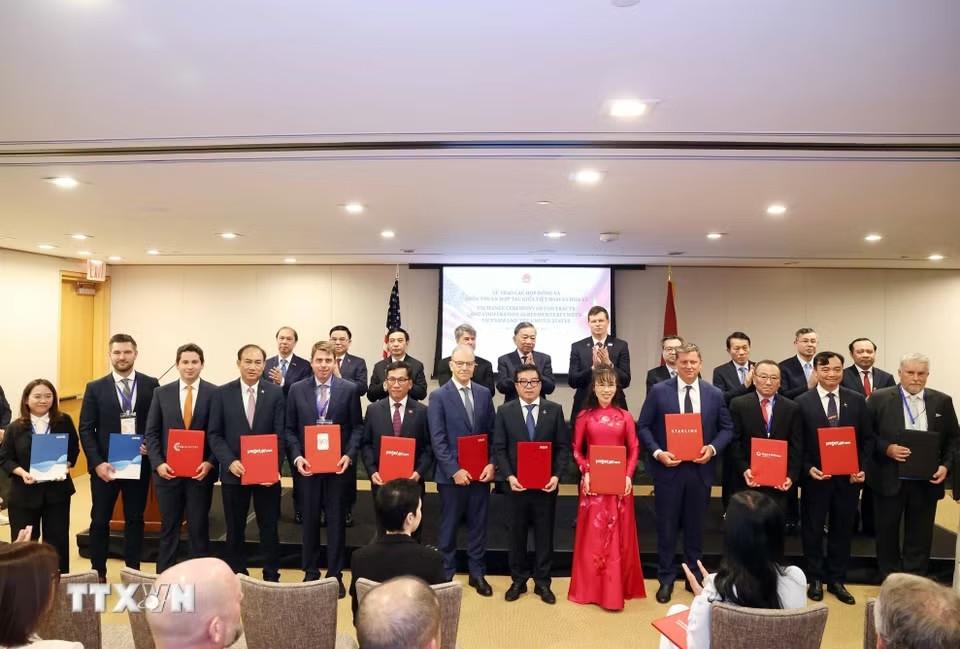
Party General Secretary and President To Lam witnesses the exchange of contracts and cooperation agreements between Vietnamese and US businesses in New York on September 23, local time. Photo: Thong Nhat/Vietnam News Agency
An earlier draft of the 2025 Investment Law proposed going further: abolishing both in-principle approval and overseas investment registration certificates, with investors instead registering with the State Bank of Vietnam when transferring capital.
The business community initially welcomed and strongly supported that proposal. If a private company uses its own money to invest in a foreign business, acquire technology, find customers or establish operations overseas, why should domestic authorities approve its location, scale and business timetable? And if a transaction changes in response to market conditions, why must the company return to Vietnam to seek an amendment to its certificate?
Unfortunately, the proposal failed to win consensus. By the time the draft was presented to the National Assembly on November 11, it provided only for removing in-principle approval.
The reviewing body raised a more difficult question: without the certificate, what information would authorities use to monitor capital flows? It proposed a notification or project-information registration mechanism that would not require investors to wait for approval, with the data linked to the State Bank to reconcile outgoing transfers.
The outcome was a compromise. The 2025 law removed in-principle approval but retained certificates for projects subject to registration.
The Ministry of Finance must still submit large projects, or those seeking special support mechanisms, to the prime minister for consideration and approval before issuing a certificate. A subsequent decree set the threshold for large projects at VND 1.6 trillion, approximately $61.6 million. Ordinary projects below VND 7 billion, approximately $269,000, are exempt from certification if they do not involve sectors subject to investment conditions.
The state has removed one approval stage, but it has not relinquished certification and prior review for certain projects.
A procedure that outlasted successive terms
During amendments to the Investment Law in 2024, then-Minister of Planning and Investment Nguyen Chi Dung said the ministry would decentralize licensing for industrial parks and overseas investment projects.
Unfortunately, the latter proposal failed to secure agreement and was left out of the draft submitted to the National Assembly.
Go back another decade. During the drafting of the 2014 Investment Law, several members of the drafting committee urged then-Minister of Planning and Investment Bui Quang Vinh to abolish licensing for overseas investment projects.
They wanted Vietnamese businesses to seek markets, partners and profits around the world rather than confining themselves to the domestic market. Vinh strongly supported the idea.
Even he, however, could not persuade the other parties involved. The law passed later that year retained both in-principle decisions for certain projects and overseas investment registration certificates.
Two successive ministers recognized the need for change. Yet it was not until the 2025 revision that the National Assembly removed the in-principle approval requirement. An idea that had once failed to get beyond the drafting table had taken 11 years to become law.
What investing abroad can bring home
The argument advanced by reform advocates during the drafting of the 2014 law was not simply that businesses needed more places to make money. Overseas investment can provide access to technology ecosystems, talent and management expertise, while building relationships that support production at home.
Vietnamese businesses need to venture into the wider world. Why must they keep asking permission? Do businesses elsewhere face the same requirement when investing abroad?
Singapore has programs that help companies find markets and establish overseas operations. Japan’s JETRO provides advice, connections and support in destination markets.
China also offers a point of comparison. Its overseas investment regulations, effective from July 2026, recognize investors’ right to make their own decisions and bear their own risks, profits and losses. They nevertheless distinguish between encouraged, restricted and prohibited activities and provide for reviews of investments that could affect national security.
Each country has its own approach, but a notable common thread is that they regard their businesses’ overseas presence as something to promote.
Until recently, Vietnam had yet to encourage outward investment, despite having signed as many as 19 new-generation free trade agreements.
Media reports have described numerous companies that wanted to invest abroad but abandoned their plans because procedural barriers proved too difficult to overcome.
The more relaxed provisions in the 2025 Investment Law will therefore undoubtedly help more Vietnamese businesses expand overseas.
After 11 years of debate, this is a tangible change. The next step should be to ensure that businesses no longer regard the swift completion of a procedure as an exceptional event.
When companies seek technology, markets and opportunities abroad, the state should support them and help them go further, rather than hold them back.
As we parted, the adviser told me: “Just imagine. There are so many successful Vietnamese people working in technology corporations in the US. Why don’t we invest in those very companies that are leading the way?”
Tu Giang
.svg)
