 Vietnamnet.vn

 Podcast



A warning echoed over three decades
It is no coincidence that, among hundreds of pages of the draft political report for the 14th National Congress just released, this message is placed prominently-as a consistent warning about the most enduring threat to the nation’s future.
The “risk of economic lag” was first mentioned in the documents of the 7th Party Congress in 1991. Over the past three decades and seven congresses, the phrase has continued to reappear as a persistent reminder.
Thirty-five years later, as the country enters the 14th Congress, the Party candidly acknowledges that the risk not only remains unresolved but has become more pressing amid a rapidly shifting world driven by technology, data, and institutional competition.
The regional gap within ASEAN
These warnings are not merely theoretical-they are reflected in hard data.
According to the latest World Bank figures, Singapore’s GDP per capita in 2024 exceeded USD 90,000-nearly 20 times higher than Vietnam’s. Malaysia reached over USD 11,800, Thailand more than USD 7,300, and both Indonesia and the Philippines hover around USD 5,000. Vietnam, by comparison, stands at just USD 4,717. At the lower end, Cambodia, Laos, and Myanmar remain in the USD 2,000–3,000 range, while Brunei-thanks to oil and gas-tops USD 33,000.
Over the past 15 years, Vietnam’s GDP per capita has nearly tripled-but so has that of neighboring countries. The absolute gap has not narrowed; it has widened.
In terms of global GDP contribution, Vietnam accounts for only 0.45%, while its population represents over 1.2% of the world-meaning the average productivity of Vietnamese workers is just one-third of the global average.
Positioned “in the middle”-no longer poor, but not yet rich-Vietnam faces a critical threshold that many countries have stumbled at: the middle-income trap. Escaping this trap requires not just fast but also smart growth, rooted in an effectively functioning institutional system-something that “half-market, half-administrative” economies struggle to achieve.
Hitting the speed limit
According to the General Statistics Office, Vietnam’s GDP growth has clearly slowed over the past three decades. The 1990s were marked by a strong surge, averaging 7.56% annually-reflecting the post-Doi Moi economic rebound. Between 2001 and 2010, growth dipped slightly to 7.26%, though Vietnam still ranked among the region's fastest-growing economies.
From 2011 to 2020, amid global economic turbulence and domestic restructuring, growth fell further to 5.95% annually.
For 2021–2025, the draft political report for the 14th Congress forecasts an average growth of about 6.3%-a modest improvement over the previous decade, but still well below the early Doi Moi years.
The highest growth years-1995 (9.5%) and 1996 (9.3%)-remain unmatched.
To achieve the 2030 target of USD 8,500 per capita, from USD 5,000 in 2025, Vietnam must sustain annual GDP per capita growth of more than 11% in USD terms-equivalent to 7–8% real growth each year. This pace is unprecedented over the past 40 years.
Globally, only South Korea and China have achieved double-digit growth over 15–20 consecutive years-and only after deep institutional reforms. No country can sustain such growth without overhauling its existing model.
The old growth model has reached its limits
Vietnam's growth is not only slowing-it’s also showing structural weaknesses.
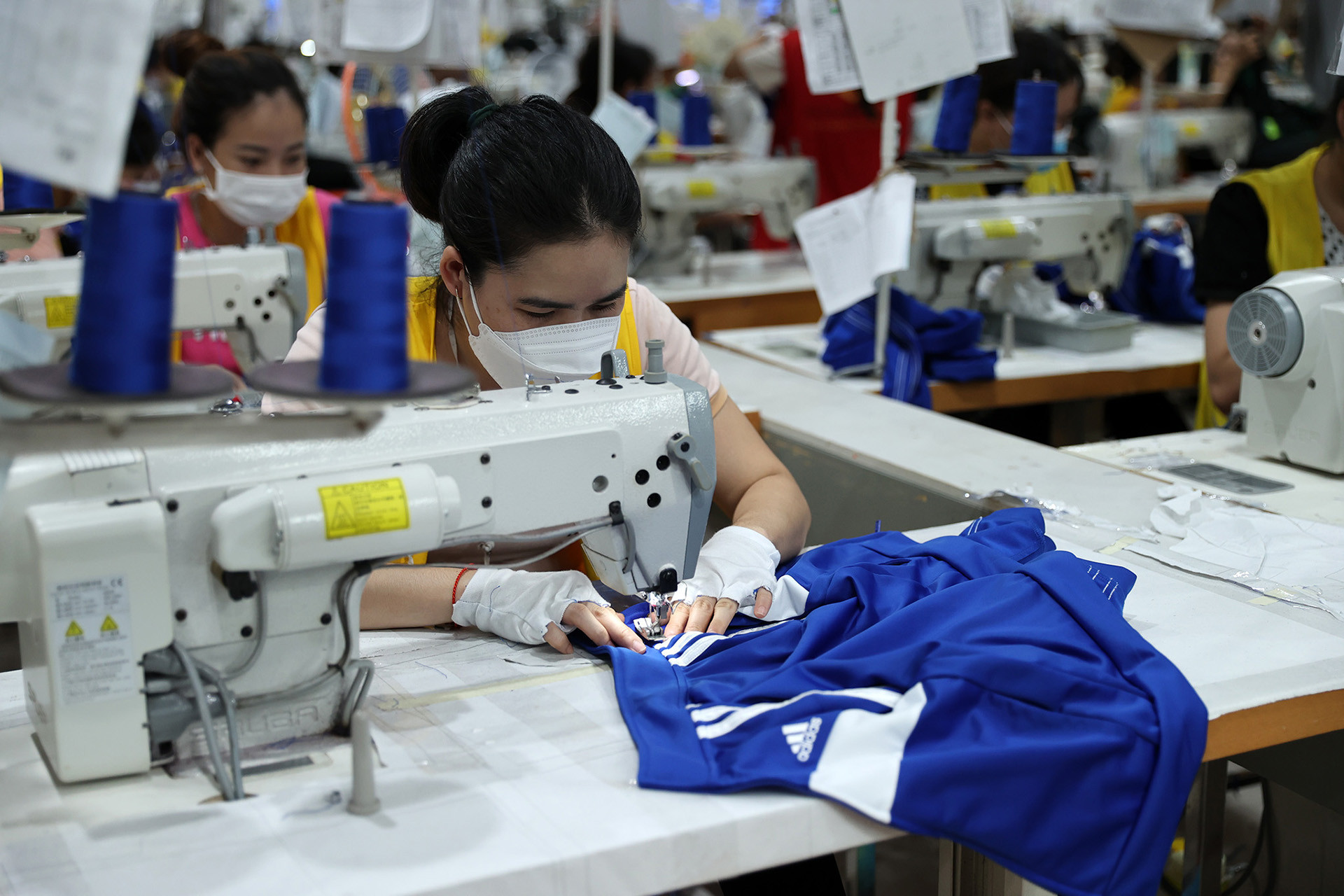
For more than three decades, the country has relied heavily on investment capital, low-cost labor, and export processing. Once an advantage, this model is now outdated in the age of automation, artificial intelligence, and green transformation.
The private sector-contributing over 50% of GDP-is still constrained by an unstable legal framework, high compliance costs, and a pervasive “ask-give” mechanism. Meanwhile, foreign direct investment (FDI), although accounting for more than 70% of export value, contributes minimal domestic added value.
Technology, a key focus of the 14th Congress, has yet to become a true economic driver. Vietnam’s labor productivity is only 1/15 that of Singapore, 1/5 of Malaysia, and half of Thailand. Without a policy shift, the country risks repeating a familiar cycle: fast growth without sustainability, expanding scale without improving quality.
Institutions: The core bottleneck
The “risk of lagging behind” does not stem from the people’s capabilities, but from institutional frameworks falling behind real-world demands. The draft political report openly states: Vietnam’s development institutions remain fragmented, becoming the “bottleneck of all bottlenecks.”
When the economy moves faster than governance capacity, when businesses must "ask permission to do business,” and when managerial thinking outweighs a service mindset, even sound policies struggle to take effect.
Nearly 40 years since Doi Moi, Vietnam’s socialist-oriented market economy remains ill-defined. The market still does not play a decisive role in resource allocation, the public sector remains oversized, and accountability mechanisms are unclear. This slow reform process has prevented productivity from increasing in line with industrialization.
To escape the middle-income trap, institutional reform is the only path: clarify property rights, create a level playing field for all economic sectors, lower compliance costs, decentralize more power to localities, and end “ownership without responsibility.”
A mindset overhaul is needed
If Doi Moi in 1986 was a revolution to liberate productive forces, today, the country needs a second Doi Moi-a transformation in institutional thinking and national governance.
It must shift from “state management” to a “facilitating and service-oriented government”; from businesses asking for permission to the state granting rights and ensuring fair competition. As the 14th Congress affirms: “Reform is essential for development. Without reform, we fall behind and lose opportunities.”
This second reform must go beyond administrative tweaks-it must restructure the entire economic power system. The government should only do what the market cannot, while people and businesses should be free to do everything not prohibited by law.
When institutions open up, productivity rises. When property rights are protected, creativity flourishes. When the state treats domestic enterprises like FDI firms, the economy will rediscover its true growth engine.
The draft political report continues to affirm three strategic breakthroughs:
(1) Institutional reform – enhance policy-making and implementation capacity, promote decentralization and empowerment, unlock social resources, foster innovation, private sector growth, and the startup ecosystem.
(2) Human capital reform – develop high-quality human resources, value talent, and encourage public servants to think boldly, act decisively, and accept responsibility.
(3) Infrastructure reform – develop multimodal transport systems, digital infrastructure, green infrastructure, energy systems, and climate-resilient infrastructure.
These are well-directed priorities but remain traditional in approach. They lack the institutional “push” needed to match the demands of the digital era.
Today’s world waits for no one. The race in technology, data, and artificial intelligence is reshaping global development orders. In this race, falling behind is not a moment-it is a quiet, daily process that happens when institutions react slower than reality, when policies can’t keep up with dynamic businesses and technologies.
Without bold reform, Vietnam may continue to grow steadily at 5–6–7% per year-but remain stuck in the “low-middle-income zone,” trapped in the middle-income trap. Eventually, falling behind will no longer be a "risk”-it will be an undeniable reality as the demographic dividend fades.
Tu Giang
.svg)
