 Vietnamnet.vn

 Podcast



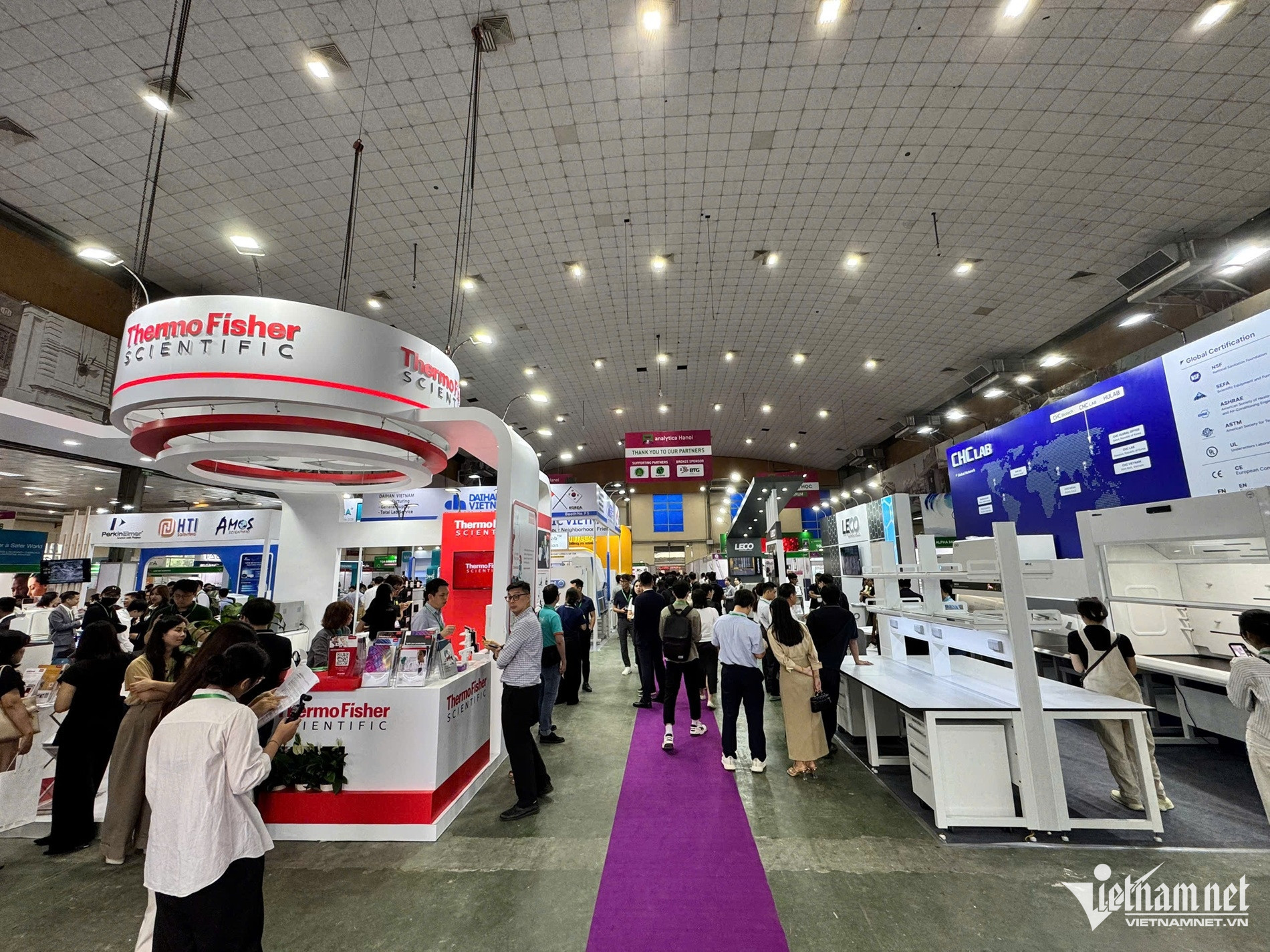
The analytica Hanoi 2026 international exhibition opens on April 22. Photo: Du Lam
On the morning of April 22, the international exhibition analytica Hanoi 2026 officially opened, drawing more than 150 exhibitors from major technology nations, including the US, Germany, Japan, South Korea, and Singapore.
Returning to Hanoi after nearly a decade, this year’s exhibition stands out with the introduction of specialized subcommittees focused on the semiconductor industry.
According to Professor Dang Vu Minh, Honorary Chairman of the Vietnam Union of Science and Technology Associations, analytica has evolved beyond a traditional trade fair into a platform for global knowledge exchange.
He emphasized that alongside traditional fields such as environmental analysis, green chemistry, and food quality control, this year’s event expands into strategic areas. Two new subcommittees have been introduced, including one dedicated to semiconductors, covering topics from material fabrication and cleanroom design to chip production and packaging.
The addition of the semiconductor segment is seen by experts as a proactive move aligned with Vietnam’s national strategy to develop its microchip industry.
As Vietnam accelerates innovation to become a developed nation, platforms like analytica play a crucial role in bridging scientific research with industrial application.
Vietnam on Southeast Asia’s semiconductor map

Assessing market potential, Michael Wilton, General Director of MMI Asia and organizer of the exhibition, stressed that quality is the defining factor in the semiconductor industry.
“We all understand the reliance on semiconductor supply chains globally. To ensure precision at the nano level, advanced analytical and diagnostic technologies are essential,” he said.
According to Wilton, Vietnam holds strong potential in this field, but its role should be viewed within the broader regional context.
While Malaysia has long been a hub for high-end semiconductor manufacturing and design, Vietnam, along with Thailand and Indonesia, is emerging as a key complementary player, particularly in component production and quality control.
“Vietnam’s potential depends on which segments of the semiconductor process it participates in - whether machinery manufacturing, design, fabrication, or specific chip segments,” he noted. “Maintaining quality is the top priority. It is entirely appropriate that this exhibition brings together solutions to help Vietnam’s semiconductor industry meet international standards.”
Beyond semiconductors, analytica Hanoi 2026 continues to affirm its position as a leading platform for laboratory equipment. For the first time in northern Vietnam, a “Live Lab” model has been introduced, allowing visitors to observe real-time laboratory operations and evaluate equipment performance through demonstrations in molecular biology and microbiology.
The event takes place as northern provinces increasingly attract high-tech foreign direct investment. Demand for laboratories meeting ISO/IEC 17025 standards is rising sharply to support export activities.
The exhibition is expected to welcome thousands of industry visitors, opening opportunities for direct business connections through the “Buyer-Seller Meeting” program.
“At the opening of analytica Hanoi 2026, we bring strong confidence and a clear long-term commitment. This marks the beginning of a journey to build northern Vietnam into a center of excellence in laboratory and analytical sciences,” Wilton said.
Du Lam
.svg)
