 Vietnamnet.vn

 Podcast



Among seven competencies assessed, the ability to apply technology was the only area in which recent university graduates were generally considered to meet employers' expectations.
Yet even in this area, expectations are rising rapidly, with 94% of employers saying they now demand higher levels of digital and artificial intelligence (AI) proficiency than they did two or three years ago.
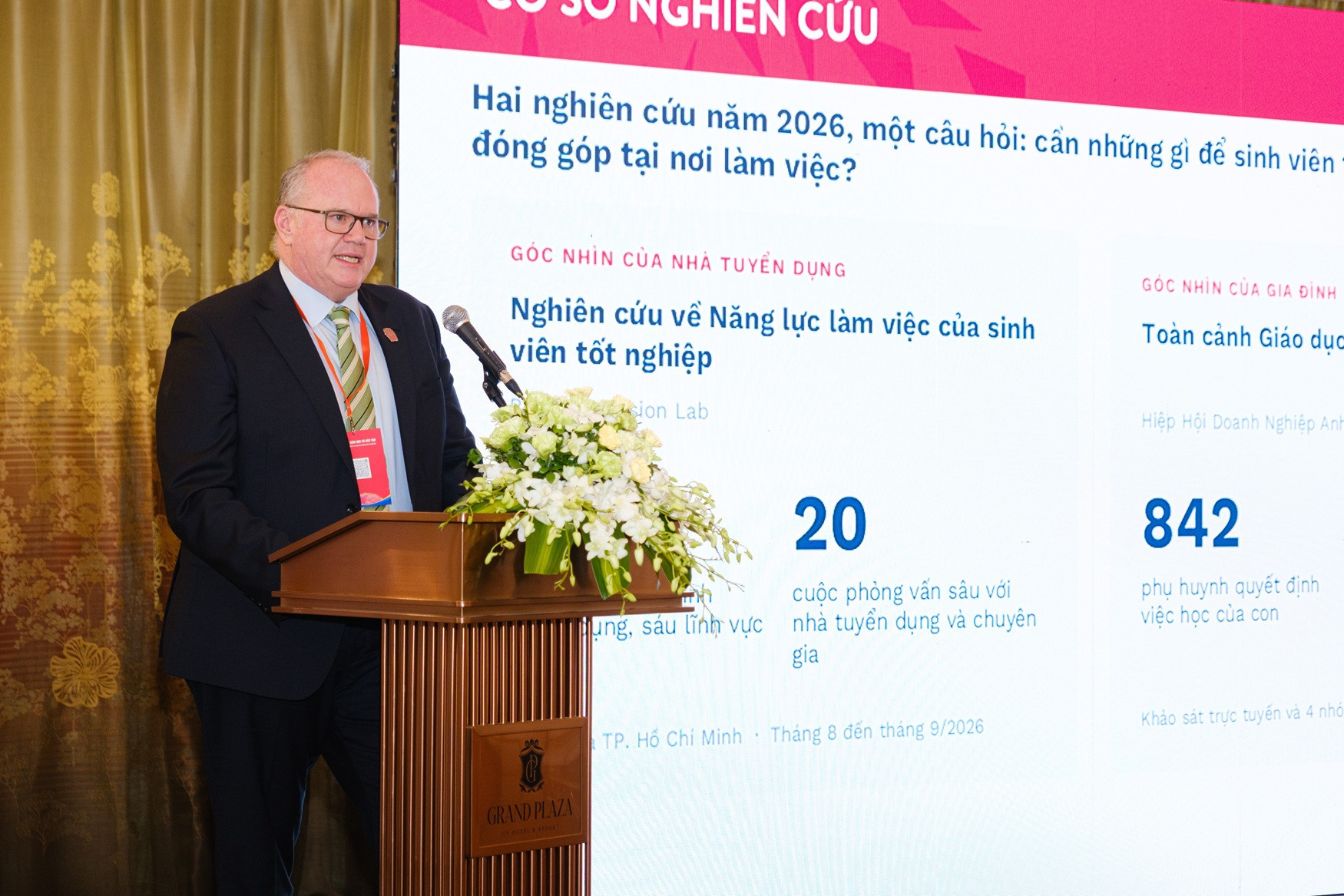
The findings come from the Vietnam Employability Report 2026, released by British University Vietnam (BUV) in collaboration with market research firm Decision Lab.
The research surveyed 375 domestic and international companies about their recruitment decisions concerning recent university graduates.
The seven competencies examined were time management, problem-solving, communication, adaptability, critical thinking, teamwork and digital literacy.
Paul Bennett, Director of Marketing and Student Recruitment at BUV, said all seven competencies were considered important by 74% to 86% of employers.
However, when employers assessed how graduates actually performed in the workplace, six of the seven competencies fell short of expectations.
The largest gaps were found in time management and problem-solving.
Time management was rated important by 80% of employers, but graduates' demonstrated performance reached only 54%.
Similarly, 84% of employers considered problem-solving important, while graduates' demonstrated capability stood at 61%.
According to Bennett, the shortcomings become particularly apparent when young employees face urgent assignments, incomplete information or tasks requiring coordination with multiple people.
In such situations, companies expect employees to honor their commitments, flag potential delays early and proactively suggest solutions rather than wait for detailed instructions.
The survey also found that employers largely assess candidates based on what they can demonstrate directly during recruitment.
Among the four leading hiring criteria, three can be observed during interviews or assessments.
These include candidates' attitudes and cultural fit, soft skills, and performance in interviews or assessment exercises.
The remaining criterion involves international qualifications or overseas study experience, with international degrees representing the only formal academic credential among the leading factors considered by employers.
More than half of the surveyed employers said they valued international qualifications for benefits extending beyond English-language proficiency.
According to Bennett, graduates of international education programs tend to be more confident and better equipped to adapt to multicultural workplaces.
They are also more likely to ask questions proactively, challenge ideas constructively and express their opinions when working with senior colleagues.
AI raises the bar for graduate recruitment
The survey also highlights the growing influence of artificial intelligence on recruitment standards.
Some 83% of companies reported that AI has already changed or is beginning to change their hiring criteria.
However, employers are not primarily looking for advanced AI specialists.
Only 3% require candidates to possess AI programming or data analysis skills.
Instead, 94% of employers said their expectations for graduates' digital literacy and ability to apply AI had increased over the past two to three years.
Notably, 79% expect graduates to be proficient in widely used AI tools or capable of applying AI to specific workplace tasks.
The findings suggest that practical technological competence is becoming increasingly important, even for entry-level positions.
Bennett emphasized that technological proficiency alone is not enough.
"The more powerful technology becomes, the sharper human judgment needs to be," he said. "The important question is no longer simply what degree students hold when they graduate, but what their actual capabilities allow them to do on their very first day at work."
The report also found that cooperation between universities and businesses remains largely concentrated on recruitment rather than curriculum development.
While 59% of surveyed companies offer internships to university students, only 15% participate in providing input on academic programs.
Meanwhile, 23% of businesses have no partnerships with universities at all.
The research identified three essential conditions for internships to genuinely help students develop workplace competencies: meaningful assignments, close supervision and tangible evidence of students' contributions.
These findings highlight the importance of ensuring that practical experience does more than simply give students a placement on their resumes.
For internships to prepare graduates for employment, students must have opportunities to take on real responsibilities, receive constructive guidance and demonstrate the value of their work.
Thanh Hung
.svg)
